Instant
01 · Ask
Ask the AI a follow-up
Got more questions about custom Blind Installation? Describe the bit you're unsure about — the AI explains options, sequencing and what to ask the curtains & blinds.

Bespoke fabric, motorised or non-standard size — supplied, made and fitted to your window.
You've read the brief on custom Blind Installation. Now lean on us to find the right curtains & blinds — and stay in control of the job.
Got more questions about custom Blind Installation? Describe the bit you're unsure about — the AI explains options, sequencing and what to ask the curtains & blinds.
Costs, timelines, pitfalls and the right questions to ask before any curtains & blinds starts on custom Blind Installation.
Itemised quotes from up to 3 local curtains & blindss on custom Blind Installation — so you can compare like-for-like, not lump sums.
Ready when you are
Enter your postcode and get free quotes from local pros.
Four moves that separate a smooth job from a nightmare.
Failing to account for window handles or tiles within the recess.
Standard DIY drills often fail to penetrate the steel beams above windows; professionals use specialised cobalt bits.
Choosing non-UV stabilised fabrics for south-facing windows, leading to rapid discolouration.
Blinds pulling out of the plasterboard because the wrong wall plugs were used for the weight of the blind.
Indicative UK ranges and what affects price.
By job type
Quote spread is typically ± 18% — always get 3 quotes.
Curtains & Blinds quick-view
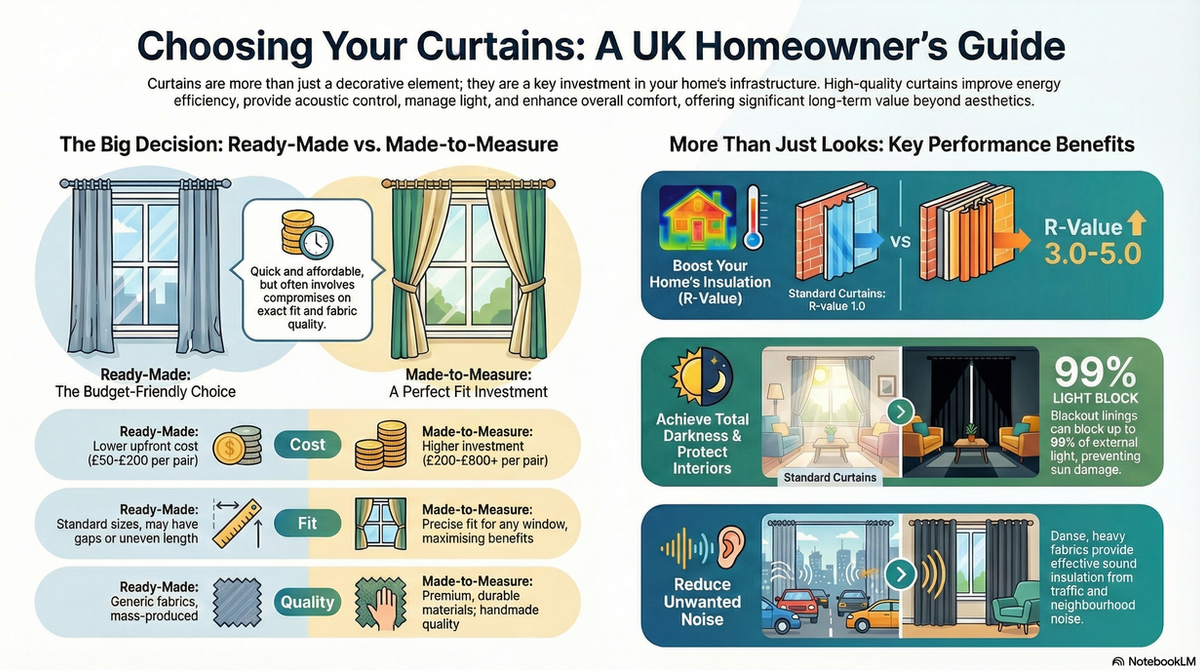
Curtains & Blinds explained
Professional installation ensures that your window treatments operate smoothly and, crucially, comply with stringent UK child safety regulations. Whether you are looking for classic Romans, modern Rollers, or specialised "Perfect Fit" blinds for uPVC doors, a professional installer provides the precision that DIY often lacks.
Prices for custom blinds vary significantly based on fabric quality, window size, and the complexity of the mechanism. Motorised options or specialised shapes (like apex windows) will sit at the higher end of the scale.
| Item | Low £ | High £ | Notes |
|---|---|---|---|
| Survey & Measurement | £30 | £75 | Often waived if you proceed with the order. |
| Custom Roller Blind | £70 | £180 | Per standard window; includes basic fabric. |
| Custom Roman Blind | £150 | £450 | Higher cost due to fabric volume and lining. |
| Wooden Venetian Blinds | £110 | £280 | Real wood or high-quality faux wood. |
| Motorisation Upgrade | £80 | £250 | Per blind; excludes central hub costs. |
| Installation Labour | £45 | £75 | Hourly rate (typically fits 1-2 blinds per hour). |
Prices generally include VAT. Remember that bay windows require multiple individual blinds, which can triple the cost compared to a single flat window.
While DIY fitting is possible for standard windows, it carries risks. Inaccurate measurements by even 5mm can result in a blind that won't fit the recess or leaves significant light gaps.
Professionals have the heavy-duty drills required to penetrate steel lintels often found in modern UK homes. Furthermore, professional installers must legally comply with BS EN 13120 regarding child safety, which is a mandatory requirement for all internal blinds installed in homes where children have access.
Perfect Fit blinds use a unique frame that clips directly onto the uPVC window bead without the need for drilling. They are ideal for conservatories and French doors as they move with the window or door when it opens.
If you are sensitive to light or have streetlights outside, blackout blinds are highly recommended. For the best results, these should be fitted outside the recess or used in a "zipped" side-channel system to eliminate the "halo" effect around the edges.
It is sometimes possible to retrofit a motor to a high-quality roller blind, but it is usually more cost-effective to buy a purpose-built motorised blind. Battery-powered motors are now very common and don't require any electrical wiring.
Most can be lightly dusted or vacuumed with a brush attachment. For Roman blinds, check if the fabric is dry-clean only. Avoid using harsh chemicals on blackout coatings as they can peel or crack.
Yes, but they must be installed with safety devices. Cords must be kept at a minimum height of 1.5 metres from the floor and secured with a tensioner or cleat to prevent loops from forming.
This guide was written with AI assistance and is intended for general information only. Prices are estimates based on UK averages and may vary by region. Always get at least three quotes and consult a qualified professional before starting any work.
Ask follow-ups in plain English. The AI explains options, sequencing and what to ask the curtains & blinds — so you walk in informed.
Installing conservatory blinds is one of the most effective ways for UK homeowners to reclaim their living space. While conservatories offer beautiful light, th...
READ GUIDE →GuideVenetian blinds are a staple in UK homes, offering a classic look with excellent light control. However, because they rely on a complex system of cords, pulleys...
READ GUIDE →GuideProfessional curtain installation is about more than just aesthetics; it ensures your window treatments are level, secure, and operate smoothly. For UK homeowne...
READ GUIDE →GuideA snapped or frayed curtain cord can render even the most expensive window dressings useless. In the UK, many homes still rely on corded tracks or Roman blind s...
READ GUIDE →GuideVertical blinds are a practical and popular choice for UK homes, particularly for large patio doors and bay windows. While they are durable, the moving parts wi...
READ GUIDE →GuideWooden shutters, often referred to as plantation shutters, are a premium window treatment that offers a timeless aesthetic for UK homes. Beyond their visual app...
READ GUIDE →