Instant
01 · Ask
Ask the AI a follow-up
Got more questions about fence installation? Describe the bit you're unsure about — the AI explains options, sequencing and what to ask the fencing & gates.

Panel, close-board or feather-edge — concreted posts, gravel boards and capping rails.
You've read the brief on fence installation. Now lean on us to find the right fencing & gates — and stay in control of the job.
Got more questions about fence installation? Describe the bit you're unsure about — the AI explains options, sequencing and what to ask the fencing & gates.
Costs, timelines, pitfalls and the right questions to ask before any fencing & gates starts on fence installation.
Itemised quotes from up to 3 local fencing & gatess on fence installation — so you can compare like-for-like, not lump sums.
Ready when you are
Enter your postcode and get free quotes from local pros.
Four moves that separate a smooth job from a nightmare.
If posts aren't deep enough, the fence will lean or blow over in the first winter storm.
Using timber posts without gravel boards often leads to the bottom of the fence rotting within 5 years.
Digging blindly can sever internet cables or water pipes; always insist on a service scan first.
Installing a fence even a few inches onto a neighbour's land can lead to expensive legal battles.
Indicative UK ranges and what affects price.
By job type
Quote spread is typically ± 18% — always get 3 quotes.
Fencing & Gates quick-view
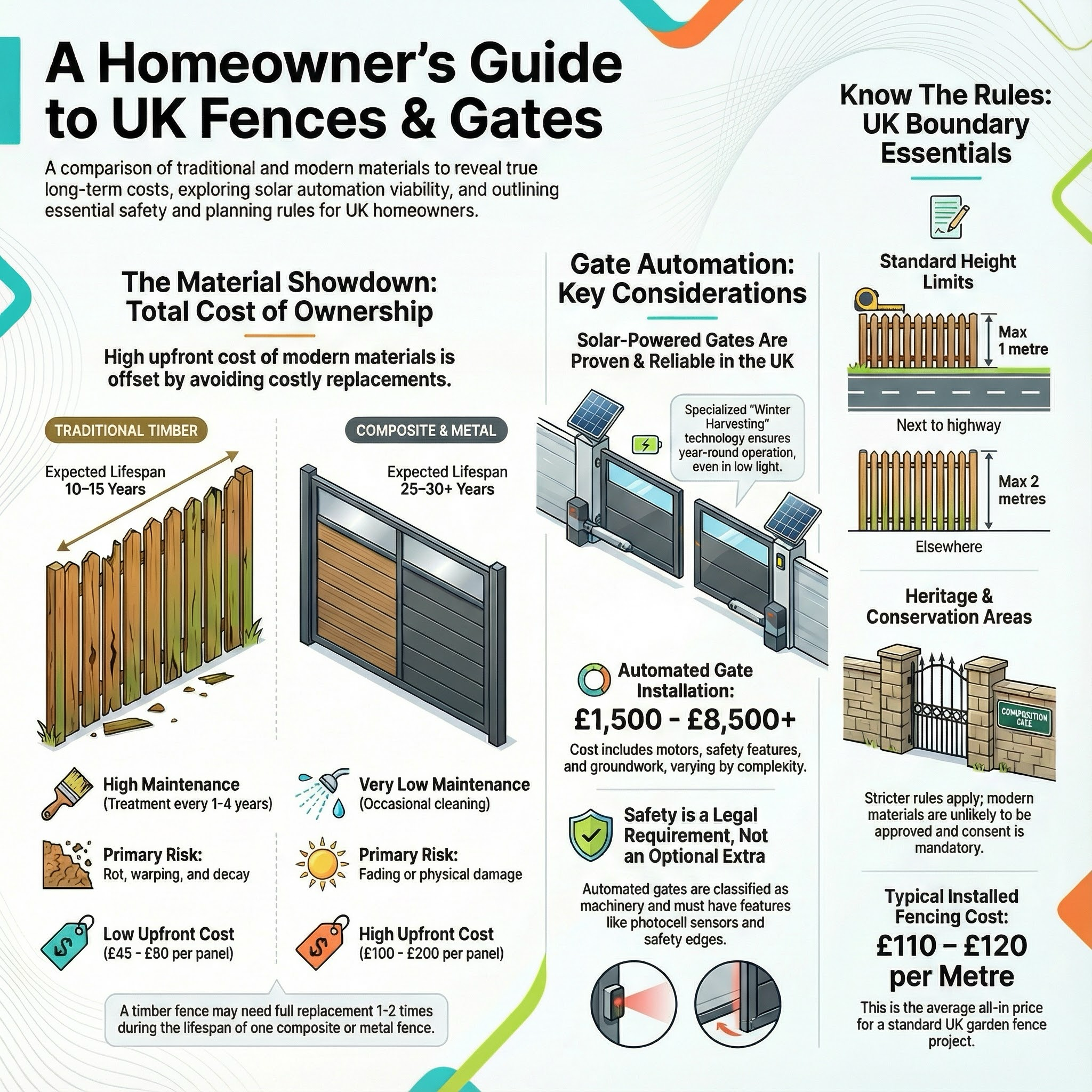
Fencing & Gates explained
Whether you are replacing a storm-damaged panel or installing a complete run of featheredge fencing, understanding the process and costs involved will help you achieve a professional finish that lasts for decades rather than seasons.
Pricing for fencing is usually quoted per "bay" (one panel and one post) or per linear metre. The following 2025/26 estimates include materials, labour, and VAT.
| Item | Low £ | High £ | Notes |
|---|---|---|---|
| Standard Lap Panel (per 1.8m bay) | £160 | £240 | Inc. timber post and gravel board. |
| Closeboard / Featheredge (per 1.8m bay) | £200 | £320 | Stronger, built on-site, inc. posts. |
| Decorative / Slatted Panels (per bay) | £250 | £450 | Premium aesthetics, e.g., Venetian style. |
| Concrete Post & Gravel Board Upgrade | £30 | £60 | Additional cost per bay over timber. |
| Standard Garden Gate (Installed) | £250 | £550 | Includes heavy-duty ironmongery. |
| Waste Disposal (per load/skip) | £150 | £300 | Cost to remove and recycle old fencing. |
Factors that increase the price include steep slopes (requiring "stepping"), extremely rocky ground, or limited access that requires materials to be carried through a house.
While a confident DIYer can replace a single panel, a full installation is physically demanding and technically precise. Digging post holes to the correct depth (at least 2 feet) is back-breaking work, and if posts aren't perfectly vertical and aligned, panels will not fit.
Professionals have the equipment to navigate underground services safely and the expertise to ensure the fence can withstand high winds. Furthermore, hiring a pro ensures your boundaries are correctly aligned, avoiding costly disputes with neighbours later.
Pro Tip: Always opt for "UC4" pressure-treated timber for any wood in contact with the ground. It is specifically treated for ground-contact use and lasts significantly longer than standard treated timber.
Questions to ask:
There is no universal rule. You must check your property deeds (the "Title Plan"), which usually feature "T" marks. A "T" on your side of the boundary line indicates you are responsible for that fence.
Concrete posts are more expensive but will not rot, often lasting 30+ years. Wooden posts look more natural but even treated ones may need replacing after 10–15 years.
Most modern fencing is pressure-treated (tanalised). You should wait 6–12 months for the treatment to weather slightly before applying your own stain or oil to ensure it absorbs correctly.
Technically, the 2-metre height limit includes any trellis. If the combined height exceeds 2 metres, you may officially need planning permission.
Autumn and winter are popular due to storm damage, but spring is ideal. The ground is softer for digging, and you avoid damaging garden plants that are in full summer bloom.
This guide was written with AI assistance and is intended for general information only. Prices are estimates based on UK averages and may vary by region. Always get at least three quotes and consult a qualified professional before starting any work.
Ask follow-ups in plain English. The AI explains options, sequencing and what to ask the fencing & gates — so you walk in informed.
A high-quality garden fence is essential for UK homeowners, providing privacy, security, and a vital windbreak against the British weather. Beyond aesthetics, a...
READ GUIDE →GuideA well-installed wooden gate is more than just a boundary; it provides essential security, privacy, and kerb appeal for your property. In the UK, where wind and...
READ GUIDE →GuideCrash barrier cutting, often referred to as Armco cutting, is a specialist task typically required when a barrier has been damaged by a vehicle or needs modifyi...
READ GUIDE →GuideA sturdy fence is the backbone of UK garden security, privacy, and aesthetic appeal. Whether your panels have succumbed to a winter gale or your posts have fina...
READ GUIDE →GuideA well-installed front fence does more than just mark your property boundary; it enhances kerb appeal, provides security, and keeps pets or children safe from t...
READ GUIDE →GuideTrellis installation is a versatile way for UK homeowners to enhance garden privacy, support climbing plants, and create decorative zones within an outdoor spac...
READ GUIDE →