Instant
01 · Ask
Ask the AI a follow-up
Got more questions about front fence installation? Describe the bit you're unsure about — the AI explains options, sequencing and what to ask the fencing & gates.

Garden boundary fence — picket, panel or close-board, with gate where needed.
You've read the brief on front fence installation. Now lean on us to find the right fencing & gates — and stay in control of the job.
Got more questions about front fence installation? Describe the bit you're unsure about — the AI explains options, sequencing and what to ask the fencing & gates.
Costs, timelines, pitfalls and the right questions to ask before any fencing & gates starts on front fence installation.
Itemised quotes from up to 3 local fencing & gatess on front fence installation — so you can compare like-for-like, not lump sums.
Ready when you are
Enter your postcode and get free quotes from local pros.
Four moves that separate a smooth job from a nightmare.
Front gardens are hotspots for gas and water mains; hitting one is dangerous and expensive.
Installing a fence even 5cm onto a neighbour's land or public pavement can lead to legal orders to remove it.
If posts aren't deep enough, the first gale will leave the fence leaning at a precarious angle.
Using non-treated timber or failing to use gravel boards leads to "ground rot" within 3-5 years.
Indicative UK ranges and what affects price.
By job type
Quote spread is typically ± 18% — always get 3 quotes.
Fencing & Gates quick-view
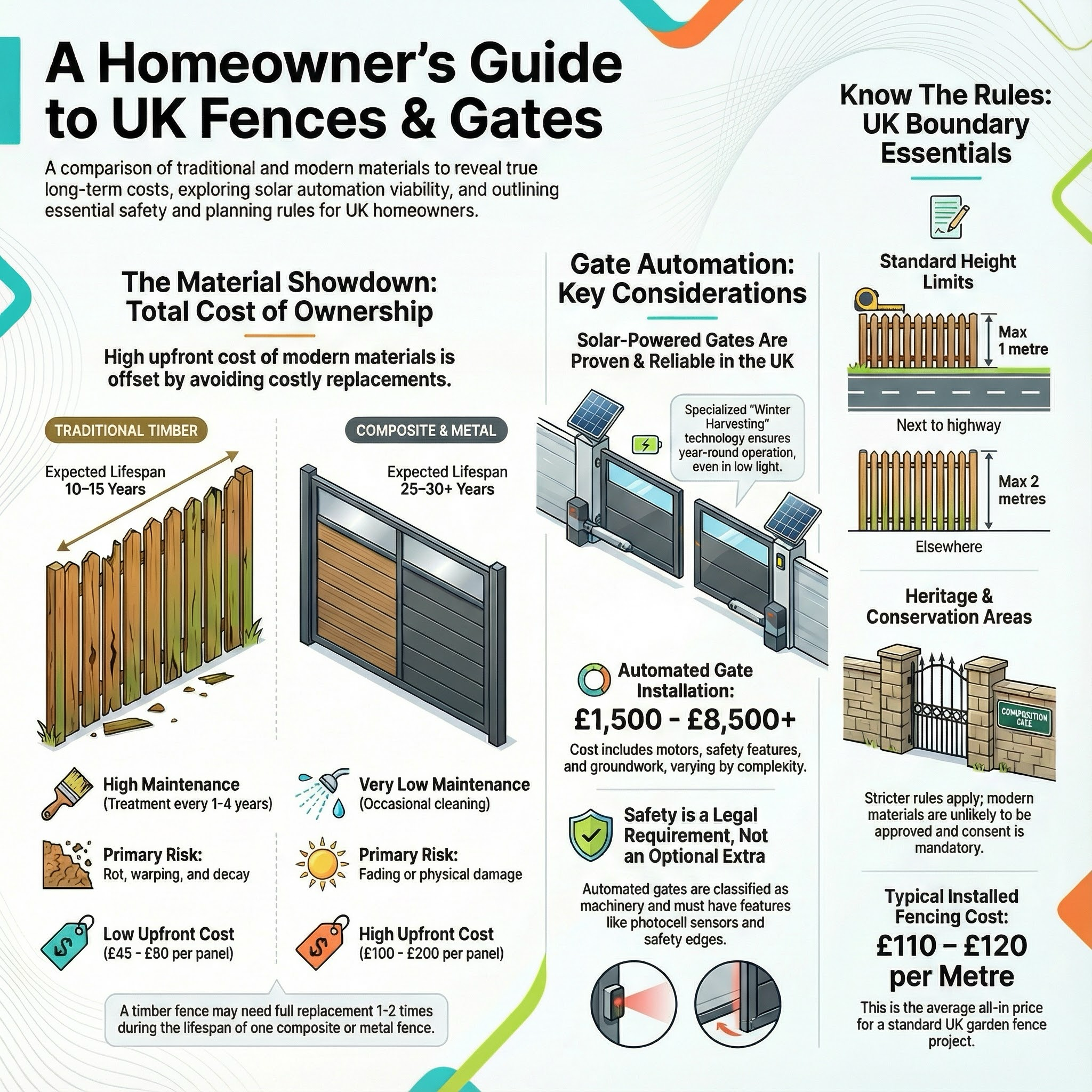
Fencing & Gates explained
Whether you are opting for traditional picket fencing, modern slatted panels, or sturdy close-board, getting the foundations right is essential. Poorly installed posts are the leading cause of fence failure during British winter storms.
Prices for front fencing vary significantly based on the materials chosen and the total linear meterage. Concrete posts and gravel boards cost more upfront but offer a much longer lifespan than timber alternatives.
| Item | Low £ | High £ | Notes |
|---|---|---|---|
| Labour (per day) | £350 | £550 | Usually a two-person team for efficiency. |
| Standard Lap Panel (per 1.8m bay) | £70 | £110 | Includes post, gravel board, and basic panel. |
| Premium Slatted/Close-board (per bay) | £120 | £220 | Higher quality timber and decorative finishes. |
| Pedestrian Gate & Ironmongery | £150 | £450 | Price depends on thickness and lock type. |
| Waste Disposal (Skip or Man-and-Van) | £100 | £250 | Removal of old concrete footings is heavy and costly. |
| Total Project (Average 10m run) | £850 | £2,500 | Includes VAT, materials, and labour. |
The primary cost drivers are the choice of wood (pressure-treated softwood vs. hardwood), the use of concrete vs. timber posts, and whether the ground requires significant levelling or clearing of old concrete footings.
While a DIY enthusiast can install a basic fence, front fences are highly visible and subject to "wind sail" effects. Professional installers have the tools to penetrate hard ground and the expertise to ensure the fence remains perfectly level on sloping terrain. Furthermore, a professional will be aware of underground services (gas/water/electric) that often run close to front boundaries.
Note: If your fence is adjacent to a public highway, it must comply with specific height restrictions to avoid being served a notice by the local council.
In most cases, yes. If the fence is adjacent to a highway (including a pavement), any height over 1 metre usually requires planning permission from your local authority.
Concrete posts are more durable and won't rot, but they are heavy and more expensive to install. Timber posts look more traditional but must be UC4 pressure-treated to last more than a few years in wet soil.
There is no legal rule, but the "good" side (the one without the rails) traditionally faces out toward the road or your neighbour. This is often considered "fencing etiquette."
Usually, yes, provided it is on your legal boundary. However, you must ensure it does not obstruct the "sight lines" for drivers pulling out of neighbouring driveways.
Most modern panels are pre-treated, but applying a high-quality UV-resistant stain or oil every 2-3 years will significantly extend the life of the wood and prevent silvering.
This guide was written with AI assistance and is intended for general information only. Prices are estimates based on UK averages and may vary by region. Always get at least three quotes and consult a qualified professional before starting any work.
Ask follow-ups in plain English. The AI explains options, sequencing and what to ask the fencing & gates — so you walk in informed.
A high-quality garden fence is essential for UK homeowners, providing privacy, security, and a vital windbreak against the British weather. Beyond aesthetics, a...
READ GUIDE →GuideA well-installed wooden gate is more than just a boundary; it provides essential security, privacy, and kerb appeal for your property. In the UK, where wind and...
READ GUIDE →GuideA high-quality fence is more than just a boundary; it provides security, privacy, and essential shelter for your garden. In the UK, our fences must withstand ev...
READ GUIDE →GuideCrash barrier cutting, often referred to as Armco cutting, is a specialist task typically required when a barrier has been damaged by a vehicle or needs modifyi...
READ GUIDE →GuideA sturdy fence is the backbone of UK garden security, privacy, and aesthetic appeal. Whether your panels have succumbed to a winter gale or your posts have fina...
READ GUIDE →GuideTrellis installation is a versatile way for UK homeowners to enhance garden privacy, support climbing plants, and create decorative zones within an outdoor spac...
READ GUIDE →