Instant
01 · Ask
Repair, replace or restyle?
One blown panel, a whole side gone, or a full overhaul? Describe what you see and the AI tells you whether it's a Saturday job or a multi-day project.

Panel fencing, garden gates and security fencing — supplied, concreted in and finished.
Read the brief on ownership, materials and planning — then let Three local fencers quote on the same spec.
One blown panel, a whole side gone, or a full overhaul? Describe what you see and the AI tells you whether it's a Saturday job or a multi-day project.
Concrete vs timber posts, gravel boards, panel grades, planning heights, gate automation rules. Know what to ask for.
Three local fencers quote on the same spec — posts, panels, gates, waste — so you can pick the right materials for your boundary.
Ready when you are
Enter your postcode and get free quotes from local pros.
Four moves that separate a smooth job from a nightmare.
Deeds usually mark which side of which boundary you own. Replacing a fence you don't own is a neighbour dispute waiting to happen.
Timber posts rot at ground level in 7–10 years. Concrete posts last 25+. The £30/post upgrade pays back the first time a panel doesn't blow away.
Soil + damp = timber rot. Insist on a gravel board (concrete or treated timber) so the panel never touches earth.
Front gardens: max 1m without permission. Rear: 2m. Above that needs planning. A gate near a public road may need extra consent.
Indicative UK ranges and what affects price.
By job type
Quote spread is typically ± 18% — always get 3 quotes.
Visual breakdown of costs, timelines and the questions you should be asking.
Fencing & Gates quick-view
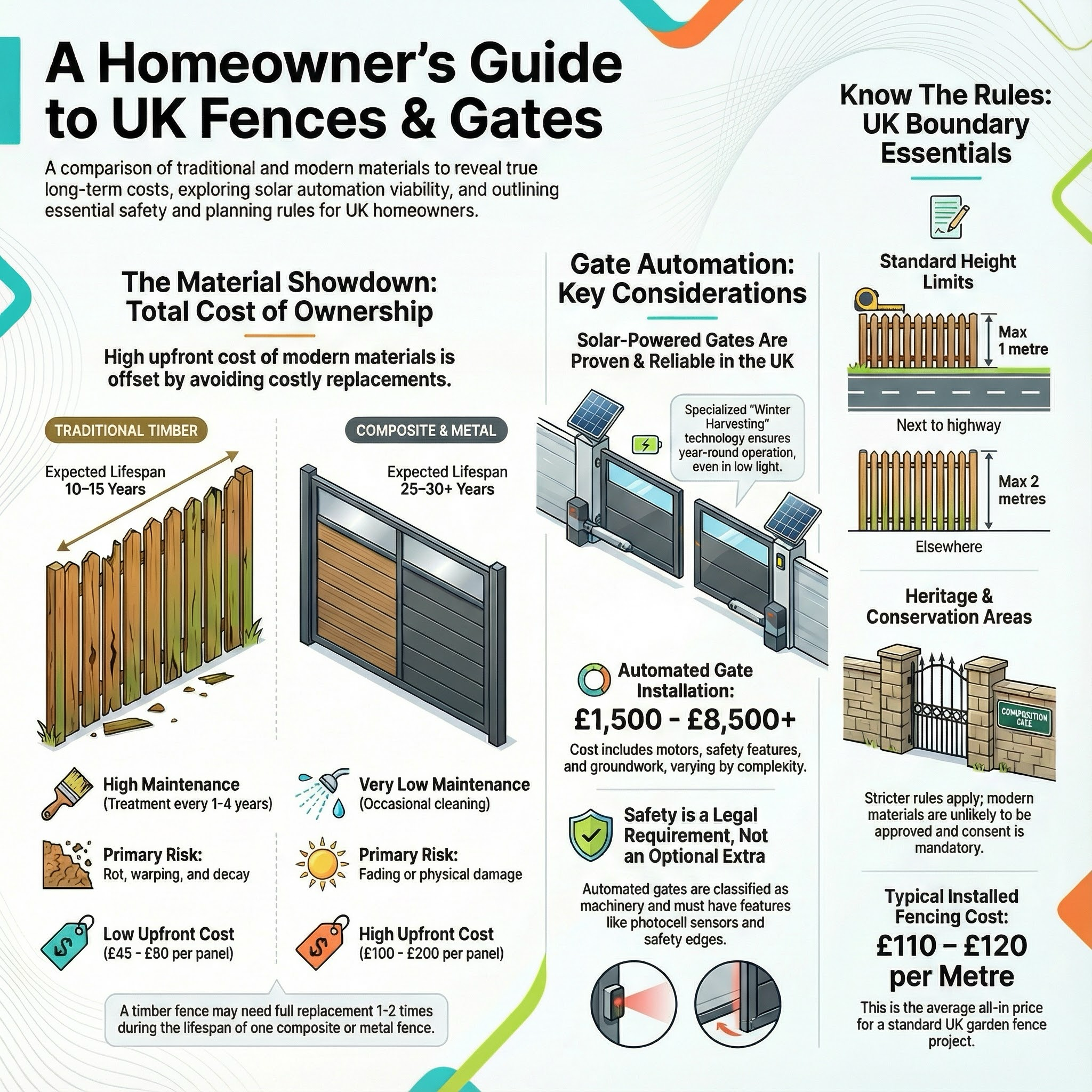
Fencing & Gates explained
Everything you need to know before hiring a fencing & gates.
Fencing and gate specialists are the experts responsible for securing your property’s perimeter, providing privacy, and enhancing your home’s kerb appeal. From installing classic timber panels to bespoke driveway gates, these tradespeople combine heavy-duty groundworks with precise carpentry to ensure your boundaries stand firm against the British weather.
UK homeowners typically call upon these professionals for everything from emergency storm damage repairs to complete garden transformations. A well-installed fence does more than mark a boundary; it acts as a windbreak, a noise barrier, and a vital security feature for children and pets.
Beyond standard garden fencing, these specialists often handle decorative trellis work, secure side gates, and robust security fencing for commercial or larger residential properties. They understand the local soil conditions and wind loads, ensuring that your investment doesn't lean or collapse after the first winter gale.
A professional fencing project follows a structured process to ensure longevity and structural integrity. Here is what you can typically expect when you hire a specialist:
While fencing is often viewed as a DIY task, the physical demands and technical requirements are frequently underestimated. Professional installers have the specialised equipment—such as petrol augers and heavy-duty breakers—to handle stubborn roots or rocky British soil that would break a standard spade.
Structural Integrity: A fence acts like a giant sail in the wind. Professionals know exactly how deep posts need to be and how to spacing them to prevent the entire line from blowing over during a storm.
Legal and Boundary Accuracy: Fencing pros can help ensure your new boundary stays on your land, avoiding costly disputes with neighbours. They are also familiar with local planning laws, such as the standard 2-metre height restriction for rear gardens.
Material Knowledge: A specialist knows the difference between dip-treated and pressure-treated timber (UC3/UC4 grades). Using the wrong grade for ground contact is the primary cause of premature rot in DIY fences.
Fencing costs are usually quoted "per bay" (typically 1.8m or 6ft wide) or as a total project price. Prices vary based on the height of the fence, the material of the posts (wood vs concrete), and the ease of access to your garden.
| Service | Low £ | High £ | Notes |
|---|---|---|---|
| Closeboard (Featheredge) Fencing | £110 | £190 | Per 1.8m bay, including labour and materials. |
| Standard Lap Panel Fencing | £75 | £130 | Per 1.8m bay. Budget-friendly but less durable. |
| Timber Side Gate (Installed) | £250 | £500 | Includes heavy-duty hinges and latch. |
| Double Driveway Gates (Timber) | £800 | £2,500+ | Varies wildly by design and wood type (Softwood vs Hardwood). |
| Post Replacement (Repair) | £90 | £160 | Per post. Includes digging out the old concrete. |
| Waste Disposal Fee | £100 | £250 | Depends on the volume of old fencing removed. |
Factors that increase the price include steep slopes, which require "stepping" the panels, and the choice of concrete posts over timber, which are more expensive but last significantly longer.
Choosing a reputable tradesperson ensures your fence remains upright for a decade or more rather than just a few seasons. Use this checklist to vet your potential contractor:
Questions to ask before hiring:
In most parts of the UK, you do not need planning permission for a fence under 2 metres high in a rear garden. However, if the fence is adjacent to a highway or footpath, it is usually restricted to 1 metre. Listed buildings and conservation areas may have stricter rules.
Concrete posts are more expensive and harder to install but will not rot, potentially lasting 20-30 years. Wooden posts offer a more natural look and are cheaper upfront, but even pressure-treated wood will eventually succumb to ground rot, usually within 10-15 years.
An experienced two-person team can typically install 4 to 6 bays (roughly 7-10 metres) of standard fencing per day, including the removal of the old fence. Very hard ground or complex slopes may slow this progress.
There is no law stating which side must face you, but traditionally the "good side" (the one without the rails) faces your neighbour. However, many modern panels look the same from both sides to avoid this dilemma.
Describe the job in plain English. The AI asks a few smart questions, then tells you whether a fencing & gates is the right call, what it should cost, and what to ask before they start.
Crash barrier cutting, often referred to as Armco cutting, is a specialist task typically required when a barrier has been damaged by a vehicle or needs modifyi...
READ GUIDE →GuideIn the UK, our garden fencing endures everything from Atlantic gales to prolonged damp winters. While a well-installed fence can last decades, individual compon...
READ GUIDE →GuideA high-quality fence is more than just a boundary; it provides security, privacy, and essential shelter for your garden. In the UK, our fences must withstand ev...
READ GUIDE →GuideA well-installed front fence does more than just mark your property boundary; it enhances kerb appeal, provides security, and keeps pets or children safe from t...
READ GUIDE →A professionally installed dog pen or outdoor run offers a secure, dedicated environment for your pet to exercise and relax safely. For UK homeowners, this is a...
READ GUIDE →GuideA sturdy fence is the backbone of UK garden security, privacy, and aesthetic appeal. Whether your panels have succumbed to a winter gale or your posts have fina...
READ GUIDE →GuideA high-quality garden fence is essential for UK homeowners, providing privacy, security, and a vital windbreak against the British weather. Beyond aesthetics, a...
READ GUIDE →GuidePanel fencing is the most popular choice for UK homeowners seeking a balance of privacy, security, and affordability. It provides an instant boundary that defin...
READ GUIDE →Scope of Works • Assess site and consult on design options for a custom trellis • Take precise measurements and finalise bespoke design plans • Source quality t...
READ GUIDE →GuideTrellis installation is a versatile way for UK homeowners to enhance garden privacy, support climbing plants, and create decorative zones within an outdoor spac...
READ GUIDE →