Instant
01 · Ask
Ask the AI a follow-up
Got more questions about dining chair repair? Describe the bit you're unsure about — the AI explains options, sequencing and what to ask the furniture repair.

Loose joint, broken rung or split seat — re-glued, doweled and re-finished by a chair specialist.
You've read the brief on dining chair repair. Now lean on us to find the right furniture repair — and stay in control of the job.
Got more questions about dining chair repair? Describe the bit you're unsure about — the AI explains options, sequencing and what to ask the furniture repair.
Costs, timelines, pitfalls and the right questions to ask before any furniture repair starts on dining chair repair.
Itemised quotes from up to 3 local furniture repairs on dining chair repair — so you can compare like-for-like, not lump sums.
Ready when you are
Enter your postcode and get free quotes from local pros.
Four moves that separate a smooth job from a nightmare.
Applying new glue over old, crusty residue is the most common cause of repair failure. The joint must be cleaned back to bare wood.
Structural failure is often blamed on "wear and tear" when it is actually caused by internal tunneling from larvae.
Attempting to "spot-repair" a lacquer finish often results in a patchy appearance; often the entire rail or leg needs refinishing.
Cheap elastic webbing used as a "quick fix" will often stretch and sag within 12 months, requiring the job to be done twice.
Indicative UK ranges and what affects price.
By job type
Quote spread is typically ± 18% — always get 3 quotes.
Furniture Repair quick-view
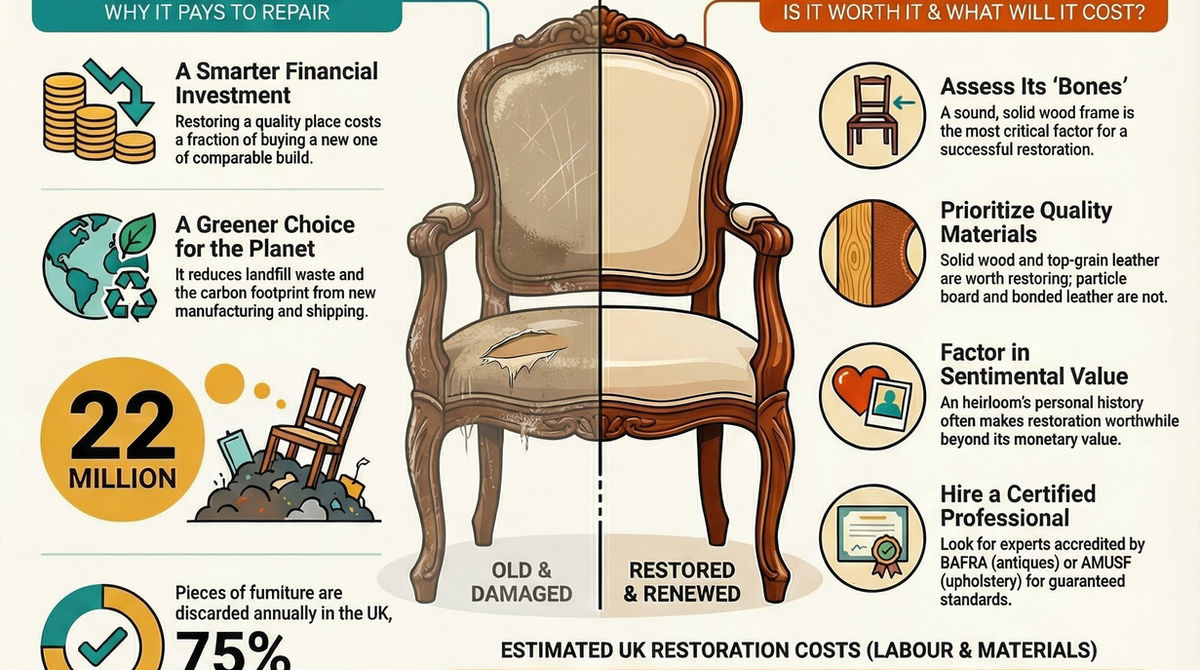
Repairing your chairs also supports a more sustainable household by keeping timber and textiles out of landfill. For UK homeowners, a skilled furniture restorer can return structural integrity and aesthetic appeal to a single chair or a complete set, often within a surprisingly modest budget.
Prices for dining chair repairs vary depending on whether the issue is purely structural or involves complex upholstery. Costs in the UK for 2025/26 typically include VAT and are influenced by the rarity of the timber and the quality of replacement fabrics.
| Item / Service | Low £ | High £ | Notes |
|---|---|---|---|
| Call-out / Assessment Fee | £60 | £120 | Often deducted from the final bill if work proceeds. |
| Basic Joint Re-glue (per chair) | £45 | £95 | Simple structural tightening of a single chair. |
| Seat Re-webbing (labour) | £50 | £110 | Excludes the cost of premium webbing materials. |
| Full Reupholstery (labour only) | £120 | £350 | Depends on chair style (e.g., carver vs side chair). |
| Veneer or French Polish Repair | £80 | £250 | Highly skilled work for antique or high-end pieces. |
| Average Total Project | £150 | £450 | Based on a single chair requiring structural and fabric work. |
The total price is heavily dictated by your choice of fabric and the number of chairs being repaired at once. Most restorers offer a "set discount" if you have four or more chairs requiring the same treatment.
While a DIY enthusiast can handle basic surface waxing or simple screw-tightening, structural repairs are best left to professionals. Using the wrong glue (like standard PVA over old animal glue) can prevent a permanent bond, leading to the joint failing again within months.
Professional restorers use specialised clamps and traditional adhesives that respect the original construction of the piece, ensuring the repair lasts for decades rather than weeks.
Upholstery is also deceptively difficult. Achieving a professional "tension" on the fabric without wrinkles requires specialist tools and experience. Furthermore, professionals ensure all new materials meet UK fire safety standards.
If the chair is made of solid wood, it is almost always worth repairing. However, for mass-produced chairs made of MDF or particle board, the cost of labour often exceeds the replacement value, as these materials do not hold glue or screws well once they have broken.
Most restorers can source fabric for you and will have pattern books to choose from. If you provide your own, ensure it is "upholstery grade" (high Martindale rub count) and meets UK fire safety standards, otherwise the tradesperson may refuse to fit it.
Yes, usually by "dowelling" or "splining" the break. A skilled restorer can reinforce the break internally so it is stronger than the original wood, then disguise the fracture line with specialist waxes and tints.
Look for tiny circular holes (1-2mm) and "frass" (fine, flour-like sawdust) underneath the chair. If you see fresh dust, the infestation is active and needs immediate treatment to prevent it spreading to your floorboards or other furniture.
Screws are often a secondary fixing. If the internal mortise and tenon joint has dried out and shrunk, the wood is no longer making contact. A professional will need to disassemble the joint and "shim" it or re-glue it to fill the gap.
This guide was written with AI assistance and is intended for general information only. Prices are estimates based on UK averages and may vary by region. Always get at least three quotes and consult a qualified professional before starting any work.
Ask follow-ups in plain English. The AI explains options, sequencing and what to ask the furniture repair — so you walk in informed.
Restoring a cherished piece of furniture is often more cost-effective and sustainable than buying new. Whether it is a family heirloom or a high-quality find th...
READ GUIDE →GuideTable revarnishing is one of the most effective ways to breathe new life into tired furniture. Whether it is a cherished family heirloom, a sturdy oak dining ta...
READ GUIDE →GuideA high-quality sofa is often a significant investment, making professional repair a far more sustainable and cost-effective choice than replacement. Whether it ...
READ GUIDE →GuideA coffee table is often the focal point of a British living room, but years of tea spills, hot mugs, and general wear can leave it looking tired. Restoring a hi...
READ GUIDE →GuideMoth damage can be a distressing discovery for UK homeowners, often affecting expensive wool carpets, heirloom upholstery, or high-end cashmere garments. While ...
READ GUIDE →GuideReupholstering a cherished armchair is a sustainable way to breathe new life into high-quality furniture that has seen better days. Many older UK-made chairs fe...
READ GUIDE →