Instant
01 · Ask
Refurbish, repair or full restore?
Modern reupholster, antique tidy-up, full conservation? Describe the piece and the AI tells you which specialist you need.

What restoration costs in 2026 — by item type, damage and finish required.
Read the brief on inspection, finishes and antique value — then let three BAFRA restorers quote.
Modern reupholster, antique tidy-up, full conservation? Describe the piece and the AI tells you which specialist you need.
Finish types, period-correct repair, transport insurance, BAFRA standards. Know what 'right' means.
Three BAFRA restorers quote on the same piece — inspection, finish, materials — so the heirloom is preserved, not patched.
Ready when you are
Enter your postcode and get free quotes from local pros.
Four moves that separate a smooth job from a nightmare.
Furniture restoration costs depend entirely on hidden damage. Anyone quoting over the phone is guessing — insist on in-person inspection.
French polish, oil, lacquer, wax — each gives a different look and resilience. Get the finish on the quote.
Replacing a Victorian leg with a modern reproduction halves the value. Insist on like-for-like restoration on antiques.
Antique furniture in transit needs declared-value insurance. Get this in writing before they take it away.
Indicative UK ranges and what affects price.
By job type
Quote spread is typically ± 18% — always get 3 quotes.
Furniture Repair quick-view
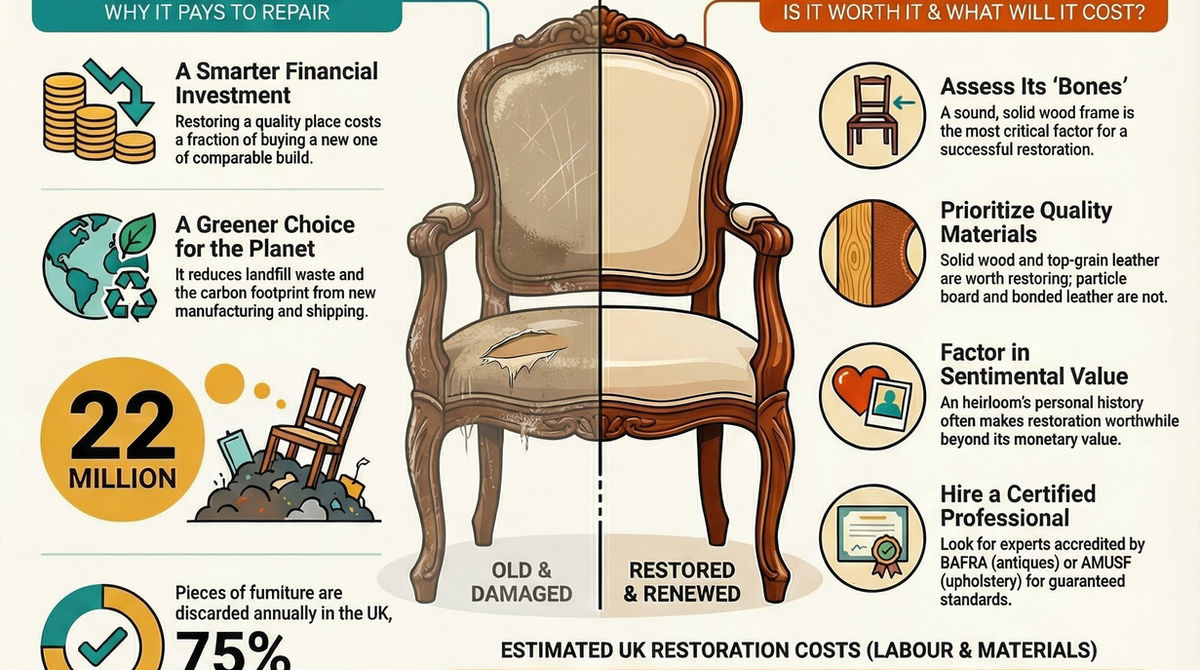
Furniture restoration in the UK typically costs £200–£3,500 per piece, depending on size, period, condition and how authentic you want the finish to be. Mid-range restoration on a Victorian or Edwardian piece (chest of drawers, bureau, mid-size sideboard) typically falls in the £400–£1,200 bracket. Major projects involving veneer replacement, marquetry repair, or French polishing on a large surface run higher.
"Restoration" specifically means returning the piece toward its original condition using period-appropriate materials and techniques — different from "repair" (functional fix only) or "refinishing" (modern finish over old surface).
| Piece | Typical price |
|---|---|
| Dining chair (per chair) | £80–£250 |
| Carver chair / armchair | £150–£450 |
| Side table / occasional table | £150–£500 |
| Dining table (refinish + repairs) | £400–£1,500 |
| Chest of drawers | £350–£1,000 |
| Bureau / desk | £600–£2,500 |
| Sideboard / dresser | £500–£1,800 |
| Wardrobe / armoire | £700–£2,500 |
| Bookcase / display cabinet | £500–£2,000 |
| Antique long-case clock | £800–£3,500 |
The single biggest decision in any restoration: do you strip the existing finish entirely, or preserve it and just clean/touch-up?
A good restorer will discuss this honestly. Be cautious of anyone who jumps straight to "strip and refinish" on a Georgian or earlier piece.
French polishing involves applying many thin coats of shellac dissolved in alcohol, rubbed in by hand with a rubber pad. The result is a deep, glossy finish that's the hallmark of quality British antique furniture. It's also delicate and labour-intensive — a typical sideboard top is 30–60 hours of polishing time.
Cost: £200–£800 for a small piece (chair top, occasional table); £600–£2,000 for medium pieces; £1,500+ for large dining tables and sideboards. Expensive, but appropriate for genuine antiques where the original finish would have been French polish.
Small pieces (single chair, occasional table): 2–4 weeks in the workshop. Medium (chest of drawers, bureau): 4–8 weeks. Large or major restorations: 2–4 months. Add waiting time for the restorer's queue — most have 2–6 week lead times before they can start.
Sometimes — particularly for sentimental pieces or where replacing equivalents new would cost more than the restoration. For purely commercial decisions, calculate cost vs. an equivalent new piece; for family heirlooms, the calculation is different.
Yes for surface care (waxing, scratch concealment with a wax stick). Some structural work (re-gluing chair joints, simple veneer patches) is achievable with care. French polishing, marquetry, and major refinishing are specialist skills — DIY attempts often need professional rescue afterwards.
Sympathetic restoration usually maintains or increases value (broken antiques are worth less than restored ones). Aggressive over-restoration (stripping patina, replacing original hardware, modern lacquer over period finishes) reduces value, sometimes substantially. The restorer's approach matters more than the price.
BAFRA (British Antique Furniture Restorers' Association) maintains a member directory. Local antique dealers often recommend specific restorers they trust. Always view recent work in person before committing — photographs flatter restorations beyond reality.
For sale, often as-is is better — buyers tend to prefer to make their own restoration choices. For your own use, restoration makes sense when the piece will live with you for years and the cost is reasonable against equivalent replacement.
Want a local pro to handle this? A BAFRA-registered or experienced furniture restorer will assess your piece honestly, advise on what's economic, and use period-appropriate techniques. Worth a 30-minute conversation before committing — restoration is one of those services where the practitioner's judgement matters as much as their price.
This guide was written with AI assistance and is intended for general information only. Prices are estimates based on UK averages and may vary by region. Always get at least three quotes and consult a qualified professional before starting any work.
Ask follow-ups in plain English. The AI explains options, sequencing and what to ask the furniture repair — so you walk in informed.
Restoring a cherished piece of furniture is often more cost-effective and sustainable than buying new. Whether it is a family heirloom or a high-quality find th...
READ GUIDE →GuideTable revarnishing is one of the most effective ways to breathe new life into tired furniture. Whether it is a cherished family heirloom, a sturdy oak dining ta...
READ GUIDE →GuideA high-quality sofa is often a significant investment, making professional repair a far more sustainable and cost-effective choice than replacement. Whether it ...
READ GUIDE →GuideA coffee table is often the focal point of a British living room, but years of tea spills, hot mugs, and general wear can leave it looking tired. Restoring a hi...
READ GUIDE →GuideMoth damage can be a distressing discovery for UK homeowners, often affecting expensive wool carpets, heirloom upholstery, or high-end cashmere garments. While ...
READ GUIDE →GuideReupholstering a cherished armchair is a sustainable way to breathe new life into high-quality furniture that has seen better days. Many older UK-made chairs fe...
READ GUIDE →