Instant
01 · Ask
Ask the AI a follow-up
Got more questions about emergency Stabilisation Works? Describe the bit you're unsure about — the AI explains options, sequencing and what to ask the groundworks.

Subsidence, collapsed wall, sinkhole or storm damage — stabilised same-day by groundworks engineers.
You've read the brief on emergency Stabilisation Works. Now lean on us to find the right groundworks — and stay in control of the job.
Got more questions about emergency Stabilisation Works? Describe the bit you're unsure about — the AI explains options, sequencing and what to ask the groundworks.
Costs, timelines, pitfalls and the right questions to ask before any groundworks starts on emergency Stabilisation Works.
Itemised quotes from up to 3 local groundworkss on emergency Stabilisation Works — so you can compare like-for-like, not lump sums.
Ready when you are
Enter your postcode and get free quotes from local pros.
Four moves that separate a smooth job from a nightmare.
Waiting for insurance approval before stabilising a building can lead to total collapse; most policies allow for "reasonable steps" to prevent further loss.
Failing to address the source of water (like a leaking mains pipe) means the stabilisation will fail as the soil continues to wash away.
Using standard DIY-grade props for heavy masonry loads, which can buckle under the weight of a traditional UK brick-and-block house.
Stabilising your ground could potentially shift the problem to a neighbouring property if not handled by an expert.
Indicative UK ranges and what affects price.
By job type
Quote spread is typically ± 18% — always get 3 quotes.
Groundworks quick-view
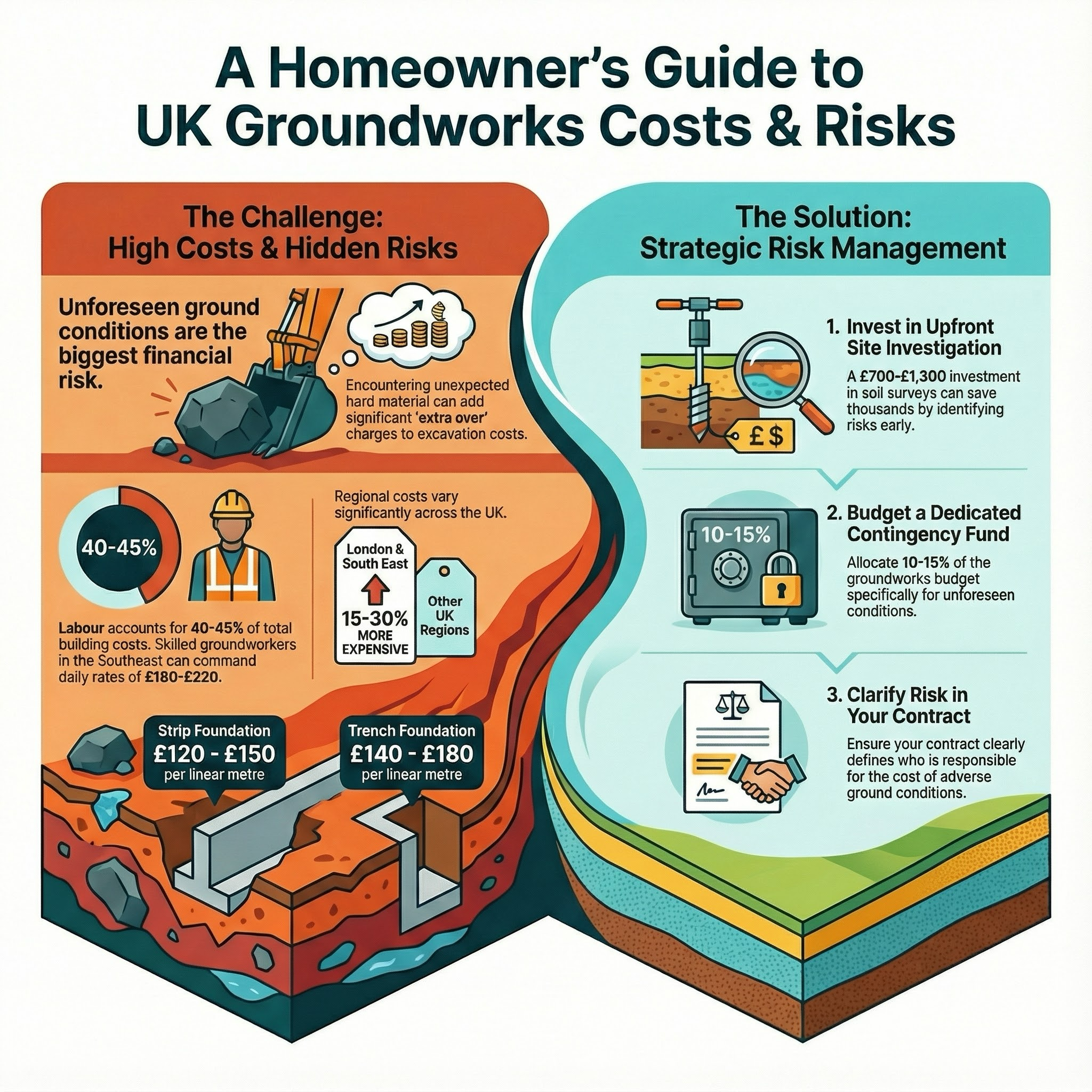
Groundworks explained
For UK homeowners, this is a high-stakes scenario where safety and structural integrity take precedence over aesthetics. Acting quickly not only protects your family but can also significantly reduce the long-term costs of permanent repairs and satisfy insurance requirements.
Emergency rates are generally higher than planned works due to the immediate response required and the specialist equipment involved. Prices below include VAT at 20% and reflect current 2025/26 UK market rates.
| Item | Low £ | High £ | Notes |
|---|---|---|---|
| Emergency Call-out (Out of hours) | £250 | £600 | Includes initial 1-2 hours of assessment. |
| Structural Engineer Report | £450 | £950 | Essential for insurance and safety sign-off. |
| Groundworks Crew (Day Rate) | £400 | £800 | Per team of two, depending on location. |
| Shoring Equipment Rental | £150 | £400 | Weekly hire for props and heavy-duty timber. |
| Temporary Fencing & Security | £200 | £500 | To secure the site perimeter. |
Total project costs fluctuate based on your location (London and the SE carry a 20-30% premium) and the severity of the structural threat. Most emergency stabilisations for a domestic property fall between £1,500 and £4,500 for the initial response.
This is strictly a professional-only task. Attempting to stabilise a moving structure without specialist knowledge is life-threatening and will almost certainly void your home insurance policy.
Structural stabilisation requires precise load-bearing calculations; an incorrectly placed prop can actually accelerate a collapse by shifting the centre of gravity.
Professional groundworkers and engineers carry Professional Indemnity Insurance and Public Liability Insurance, which are essential when dealing with structural failure. They also have the heavy-duty equipment required to handle tonnes of lateral pressure from shifting soil or masonry.
Questions to ask:
In most cases, yes. Most UK policies cover "reasonable costs" incurred to prevent further damage to the property, provided the cause (e.g., subsidence or impact) is a covered peril.
This depends on the Structural Engineer's assessment. If they issue a "Dangerous Structure" notice, you may be required to vacate until the temporary works are signed off as safe.
No. Stabilisation is a "stop-gap" to make the site safe. You will eventually need a permanent solution, such as underpinning, piling, or resin injection, which is a separate project.
Look for cracks wider than 5mm, doors or windows that suddenly won't open or close, or visible leaning of external walls. If you hear "popping" or "creaking" sounds from the structure, call a professional immediately.
If the building is deemed a risk to the public, the local authority's Building Control department may get involved and can even issue an order for the work to be carried out if you fail to act.
This guide was written with AI assistance and is intended for general information only. Prices are estimates based on UK averages and may vary by region. Always get at least three quotes and consult a qualified professional before starting any work.
Ask follow-ups in plain English. The AI explains options, sequencing and what to ask the groundworks — so you walk in informed.
Foundation issues are among the most significant concerns for UK homeowners. Whether caused by subsidence, heave, or historical poor construction, ensuring your...
READ GUIDE →GuideQuality topsoil is the biological engine of any healthy UK garden. Whether you are preparing for a new lawn, building raised beds, or levelling a tired landscap...
READ GUIDE →GuideUnderpinning is a critical structural intervention used to strengthen and stabilise a property's foundations. It is most commonly required when a building’s ori...
READ GUIDE →GuideA leaking kitchen sink is one of the most common domestic headaches for UK homeowners. While a small drip might seem minor, it can quickly lead to blown kitchen...
READ GUIDE →GuideUnderpinning is a critical structural intervention used to strengthen and stabilise the foundations of a property. For UK homeowners, this is typically necessar...
READ GUIDE →GuideDeep foundation pile driving is a critical structural process used when the surface soil is too weak to support the weight of a new building or extension. By dr...
READ GUIDE →