Instant
01 · Ask
Ask the AI a follow-up
Got more questions about topsoil delivery and laying? Describe the bit you're unsure about — the AI explains options, sequencing and what to ask the groundworks.

Quality screened topsoil delivered and laid — for new lawns, beds or post-excavation levelling.
You've read the brief on topsoil delivery and laying. Now lean on us to find the right groundworks — and stay in control of the job.
Got more questions about topsoil delivery and laying? Describe the bit you're unsure about — the AI explains options, sequencing and what to ask the groundworks.
Costs, timelines, pitfalls and the right questions to ask before any groundworks starts on topsoil delivery and laying.
Itemised quotes from up to 3 local groundworkss on topsoil delivery and laying — so you can compare like-for-like, not lump sums.
Ready when you are
Enter your postcode and get free quotes from local pros.
Four moves that separate a smooth job from a nightmare.
Laying heavy topsoil over compacted clay without "forking" the subsoil first creates a "bath-tub effect" where water cannot escape.
Cheap, uncertified soil can contain dormant weed seeds (like Japanese Knotweed), glass, or even heavy metals.
Laying soil too deep (over 300mm) in one go can cause it to become anaerobic (lacking oxygen), killing the beneficial bacteria.
Failing to lightly consolidate the soil results in "sinkholes" appearing after the first heavy rainfall.
Indicative UK ranges and what affects price.
By job type
Quote spread is typically ± 18% — always get 3 quotes.
Groundworks quick-view
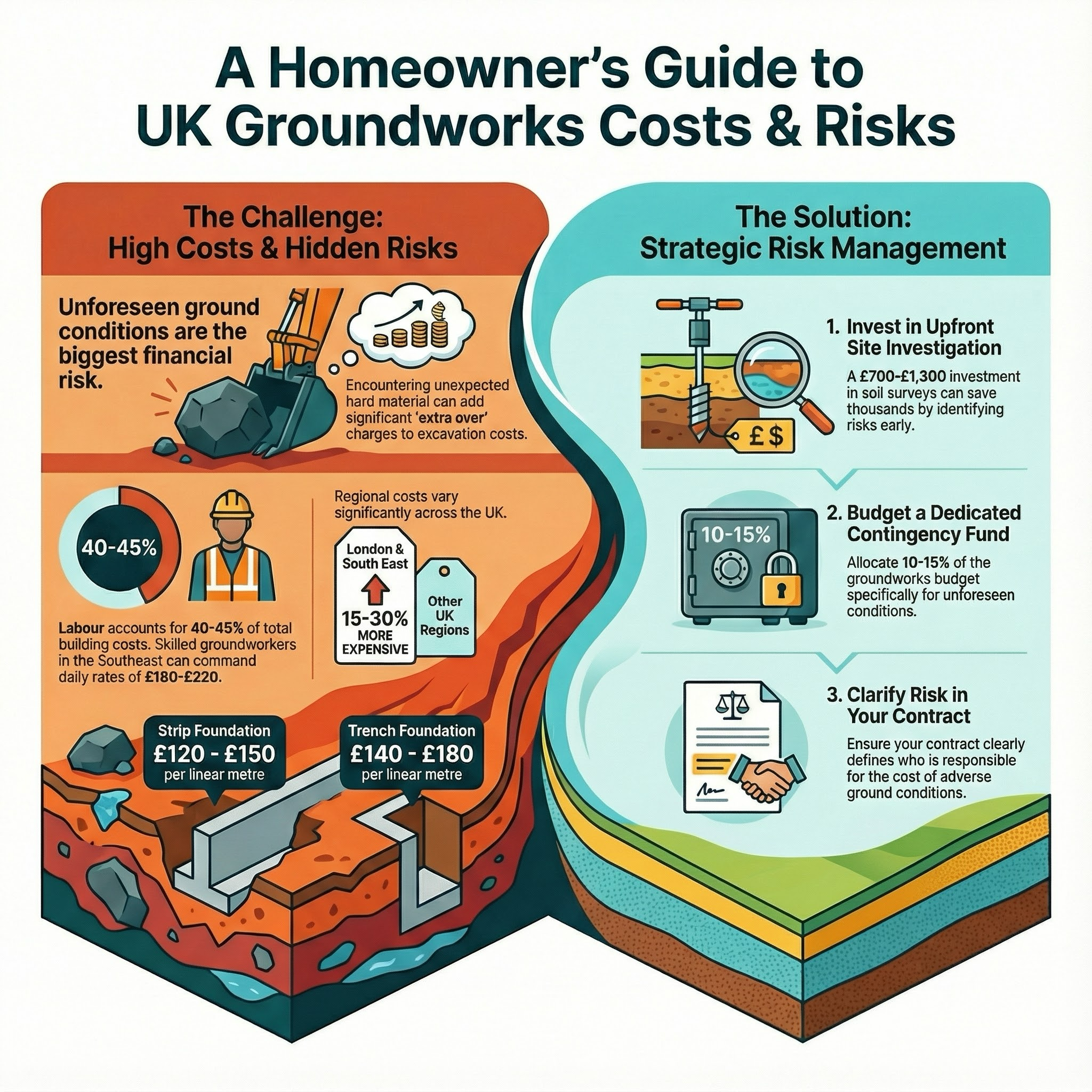
Groundworks explained
In the UK, our heavy clay or sandy coastal soils often require a "top-up" of high-quality organic matter. Professional delivery and laying ensure that the soil is not only the right nutritional match for your garden but is also structured correctly to prevent drainage issues and compaction.
Prices for topsoil vary significantly based on the grade (Economy, General Purpose, or Premium) and the delivery method. Bulk loads are generally cheaper than individual bags but require more space for offloading.
| Item | Low £ | High £ | Notes |
|---|---|---|---|
| Screened Topsoil (per m3) | £45 | £85 | Price depends on grade and organic content. |
| Bulk Bag (approx. 850kg) | £55 | £95 | Convenient for small sites or restricted access. |
| Grab Lorry Delivery | £250 | £450 | Fixed cost per load (approx. 12-15 tonnes). |
| Labour (per person/day) | £180 | £280 | Moving and spreading soil manually. |
| Mini-Digger/Dumper Hire | £120 | £220 | Per day, essential for volumes over 10m3. |
| Waste Removal (per skip) | £220 | £380 | For removing old "muck" or turf before laying. |
Note: Total project costs are heavily influenced by access. If soil must be moved through a house or up steep steps by hand, labour costs can double.
Spreading a few bags of soil for a flower bed is a straightforward DIY task. However, moving several tonnes of soil is physically exhausting and requires a keen eye for levels to avoid creating "sumps" where water will pool.
Professionals bring the advantage of machinery and knowledge of BS 3882:2015 standards. If you are hiring a contractor to remove old soil, they must hold a valid Waste Carrier Licence to ensure your old garden waste isn't fly-tipped, which could leave you legally liable.
The most important standard in the UK is BS 3882:2015, which specifies the requirements for "multipurpose" and "specific purpose" topsoils.
Multiply the length by the width of the area to get the square metres. Then multiply by the depth (e.g., 0.1 for 100mm). For example, a 50m2 lawn needing 100mm of soil requires 5m3. Always add 10% for settlement.
Screened soil has been passed through a mesh to remove stones, roots, and debris. 10mm-20mm screening is standard for gardens; unscreened soil is only suitable for deep fill where quality doesn't matter.
It is best avoided. Working with wet topsoil destroys its structure, leading to heavy compaction and "smearing," which prevents air and water from reaching plant roots once it dries.
No. One cubic metre (m3) of dry topsoil usually weighs between 1.2 and 1.6 tonnes. If the soil is damp, it will be significantly heavier, which is why professionals often quote in volume (m3) rather than weight.
Ideally, yes. If you bury old grass under more than 50mm of soil, it will rot down and create an unstable, spongy layer that can cause your new lawn to become uneven.
This guide was written with AI assistance and is intended for general information only. Prices are estimates based on UK averages and may vary by region. Always get at least three quotes and consult a qualified professional before starting any work.
Ask follow-ups in plain English. The AI explains options, sequencing and what to ask the groundworks — so you walk in informed.
Foundation issues are among the most significant concerns for UK homeowners. Whether caused by subsidence, heave, or historical poor construction, ensuring your...
READ GUIDE →GuideEmergency stabilisation works are the critical first response to sudden structural failure or ground instability. Whether caused by extreme weather, a burst wat...
READ GUIDE →GuideUnderpinning is a critical structural intervention used to strengthen and stabilise a property's foundations. It is most commonly required when a building’s ori...
READ GUIDE →GuideA leaking kitchen sink is one of the most common domestic headaches for UK homeowners. While a small drip might seem minor, it can quickly lead to blown kitchen...
READ GUIDE →GuideUnderpinning is a critical structural intervention used to strengthen and stabilise the foundations of a property. For UK homeowners, this is typically necessar...
READ GUIDE →GuideDeep foundation pile driving is a critical structural process used when the surface soil is too weak to support the weight of a new building or extension. By dr...
READ GUIDE →