Instant
01 · Ask
Ask the AI a follow-up
Got more questions about underpinning Work Cost &? Describe the bit you're unsure about — the AI explains options, sequencing and what to ask the groundworks.

What underpinning really costs — by method, length and access. Insurance-claim ready specifications.
You've read the brief on underpinning Work Cost &. Now lean on us to find the right groundworks — and stay in control of the job.
Got more questions about underpinning Work Cost &? Describe the bit you're unsure about — the AI explains options, sequencing and what to ask the groundworks.
Costs, timelines, pitfalls and the right questions to ask before any groundworks starts on underpinning Work Cost &.
Itemised quotes from up to 3 local groundworkss on underpinning Work Cost & — so you can compare like-for-like, not lump sums.
Ready when you are
Enter your postcode and get free quotes from local pros.
Four moves that separate a smooth job from a nightmare.
If the "load-bearing strata" (stable ground) isn't reached, the property may continue to sink even after underpinning.
Failing to use non-shrink grout (dry pack) between the new and old foundations leaves a gap that allows for further settlement.
Underpinning often reveals that leaky drains caused the subsidence; if these aren't fixed, the problem may recur elsewhere.
Excavating can uncover undocumented gas, water, or electric lines, leading to delays and additional costs.
Indicative UK ranges and what affects price.
By job type
Quote spread is typically ± 18% — always get 3 quotes.
Groundworks quick-view
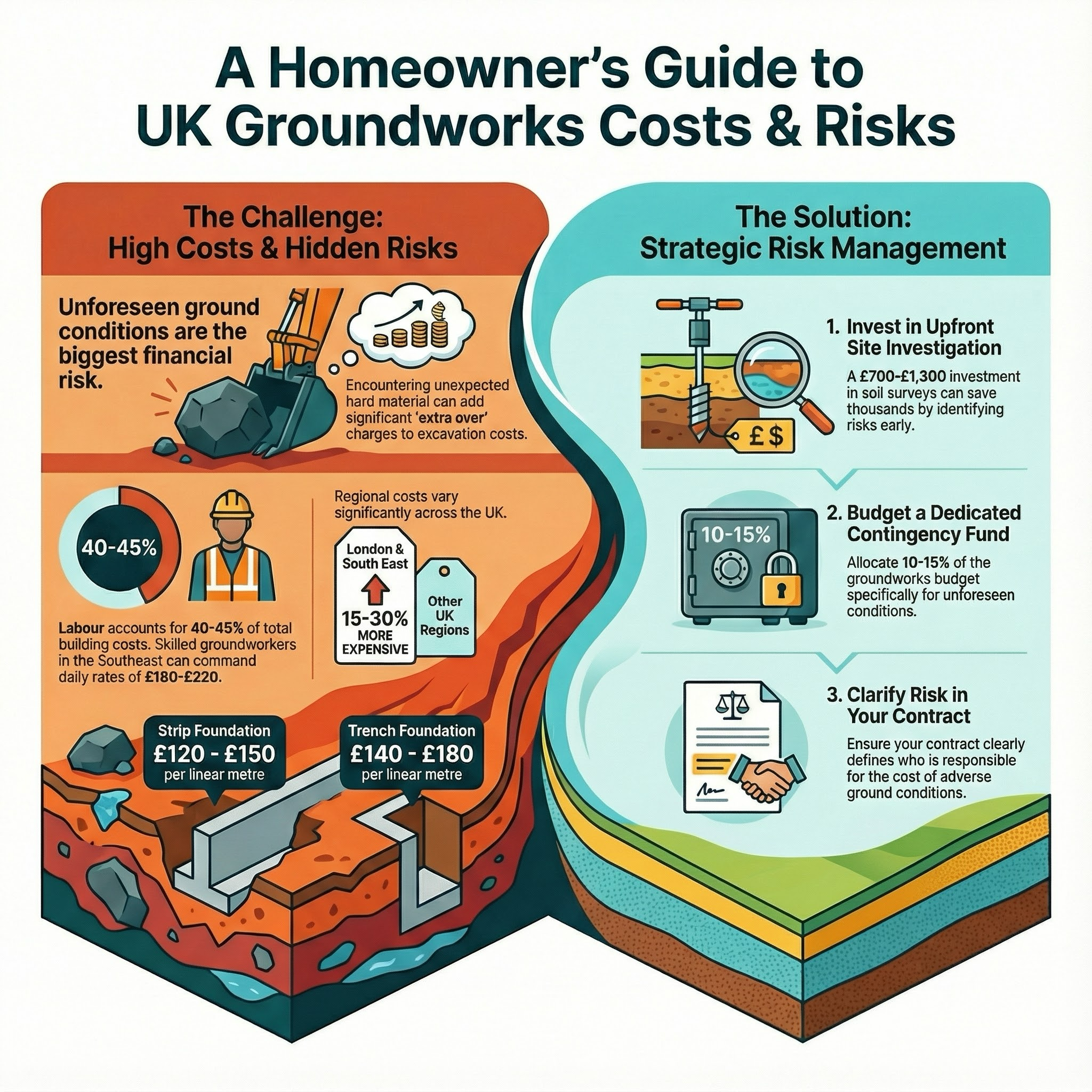
Groundworks explained
For UK homeowners, addressing foundation issues early is essential to prevent catastrophic structural failure and to maintain the property's market value. While the prospect of underpinning can be daunting, modern techniques allow for precise, long-lasting solutions that secure your home for decades to come.
The cost of underpinning varies significantly based on the method used, the depth of the required footings, and your local soil conditions. Prices in London and the South East typically sit at the higher end of these estimates.
| Item | Low £ | High £ | Notes |
|---|---|---|---|
| Structural Engineer Design | £800 | £2,000 | Required for Building Regulations. |
| Mass Pour (per linear metre) | £1,500 | £2,800 | The traditional "dig and fill" method. |
| Beam and Base (per linear metre) | £2,000 | £3,500 | Used for deeper or more complex loads. |
| Mini-Piling (per linear metre) | £2,500 | £4,500 | Best for restricted access or very deep stable ground. |
| Building Control Fees | £400 | £900 | Local authority inspection and certification. |
| Party Wall Surveyor | £1,000 | £2,500 | If work is on a shared boundary wall. |
Total project costs for a typical semi-detached house requiring partial underpinning usually range between £10,000 and £25,000. Full property underpinning can easily exceed £50,000 depending on the perimeter length.
Underpinning is never a DIY project. It is a high-risk structural activity that requires professional engineering oversight and specialised groundworks expertise.
Attempting to underpin a property without professional guidance can lead to total structural collapse, voided home insurance, and legal action from local authorities.
You must hire a specialist groundworks contractor or a structural repair firm. They carry the necessary professional indemnity insurance and have the equipment to manage soil stability and heavy loading safely.
If the underpinning is required due to subsidence (ground movement), most standard UK home insurance policies will cover the cost, minus your subsidence excess (typically £1,000). However, they will not usually cover it if the work is needed because of poor original construction or for a new extension.
Concrete underpinning is a traditional structural method involving excavation. Resin injection involves pumping expanding polymers into the soil to harden it. Resin is faster and less messy but is not suitable for all soil types or significant structural failures.
A property that has been professionally underpinned with a Building Regulations completion certificate and an insurance-backed guarantee is structurally sound. While it must be disclosed to buyers, it is often seen as a "permanent fix," though it may limit your choice of insurance providers.
Common signs include diagonal cracks in plaster or external brickwork (wider than 3mm), doors and windows sticking in their frames, and visible gaps between the floor and skirting boards. Always consult a structural engineer for a definitive diagnosis.
In most residential cases, yes. Since the work is performed externally and in sections, the house remains habitable. However, you should expect significant noise, dust, and vibration during the excavation phases.
This guide was written with AI assistance and is intended for general information only. Prices are estimates based on UK averages and may vary by region. Always get at least three quotes and consult a qualified professional before starting any work.
Ask follow-ups in plain English. The AI explains options, sequencing and what to ask the groundworks — so you walk in informed.
Foundation issues are among the most significant concerns for UK homeowners. Whether caused by subsidence, heave, or historical poor construction, ensuring your...
READ GUIDE →GuideEmergency stabilisation works are the critical first response to sudden structural failure or ground instability. Whether caused by extreme weather, a burst wat...
READ GUIDE →GuideQuality topsoil is the biological engine of any healthy UK garden. Whether you are preparing for a new lawn, building raised beds, or levelling a tired landscap...
READ GUIDE →GuideA leaking kitchen sink is one of the most common domestic headaches for UK homeowners. While a small drip might seem minor, it can quickly lead to blown kitchen...
READ GUIDE →GuideUnderpinning is a critical structural intervention used to strengthen and stabilise the foundations of a property. For UK homeowners, this is typically necessar...
READ GUIDE →GuideDeep foundation pile driving is a critical structural process used when the surface soil is too weak to support the weight of a new building or extension. By dr...
READ GUIDE →