Instant
01 · Ask
Ask the AI a follow-up
Got more questions about underpinning Process? Describe the bit you're unsure about — the AI explains options, sequencing and what to ask the groundworks.

How an underpinning project actually runs — diagnosis, design, sequenced bays, monitoring, sign-off.
You've read the brief on underpinning Process. Now lean on us to find the right groundworks — and stay in control of the job.
Got more questions about underpinning Process? Describe the bit you're unsure about — the AI explains options, sequencing and what to ask the groundworks.
Costs, timelines, pitfalls and the right questions to ask before any groundworks starts on underpinning Process.
Itemised quotes from up to 3 local groundworkss on underpinning Process — so you can compare like-for-like, not lump sums.
Ready when you are
Enter your postcode and get free quotes from local pros.
Four moves that separate a smooth job from a nightmare.
If the "pins" aren't dug deep enough to reach stable ground, the house may continue to sink.
If the gap between the new concrete and old foundation isn't packed correctly, the load won't transfer, and cracks will reappear.
Excavation often reveals old clay pipes; if these aren't repaired or diverted, future leaks will wash away the new support.
Digging too many sections at once can cause the wall above to drop or rotate.
Indicative UK ranges and what affects price.
By job type
Quote spread is typically ± 18% — always get 3 quotes.
Groundworks quick-view
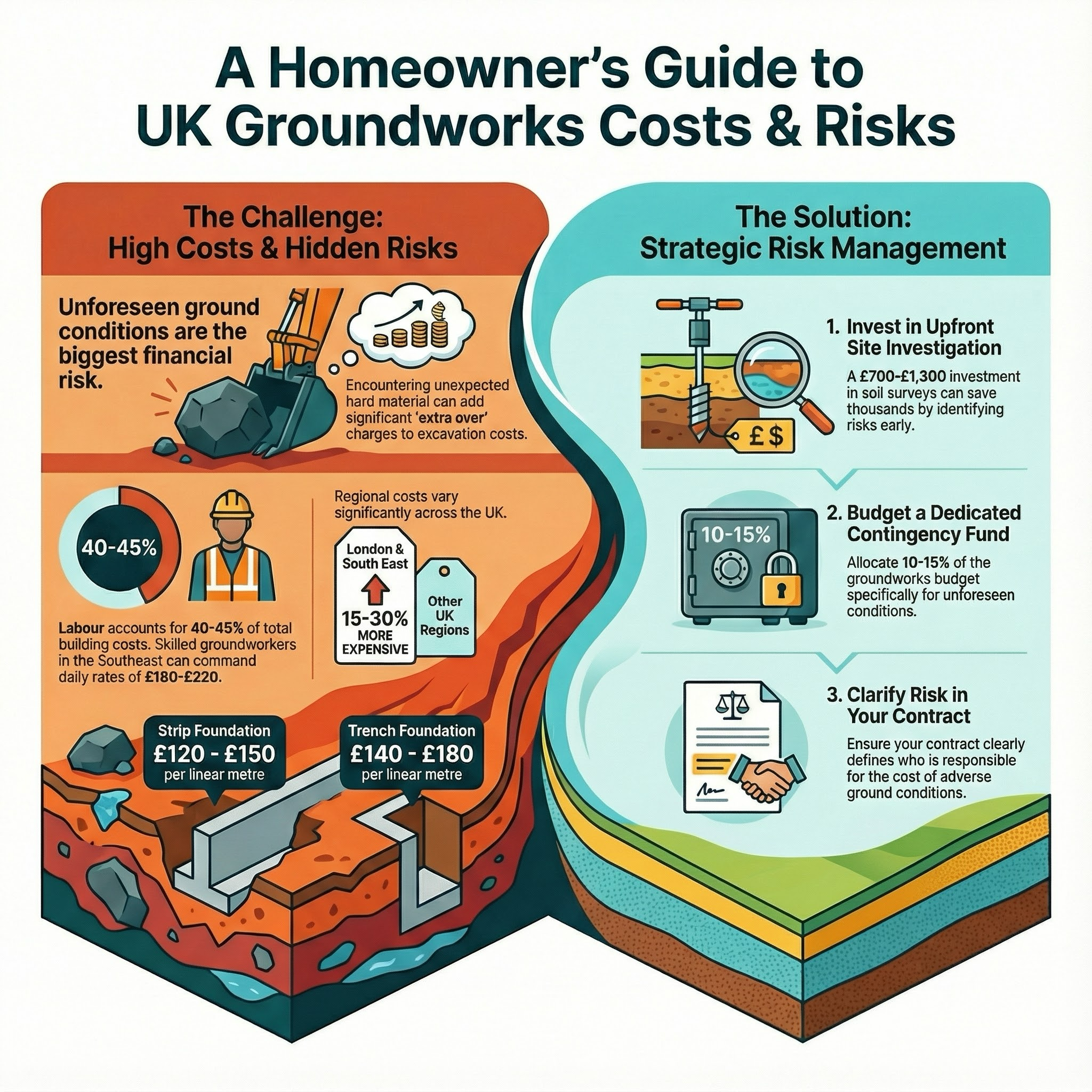
Groundworks explained
While the prospect of foundation work can be daunting, modern underpinning techniques are highly effective at halting structural movement and protecting your home's long-term value. This guide outlines the processes, costs, and regulations involved in securing your property’s footprint.
The cost of underpinning is usually calculated per linear metre. Prices vary significantly based on the depth required and the method used (e.g., traditional mass-pour vs. mini-piling).
| Item | Low £ | High £ | Notes |
|---|---|---|---|
| Structural Engineer's Report | £800 | £1,500 | Essential for design and Building Control. |
| Mass Pour Underpinning (per metre) | £1,500 | £2,800 | Standard for residential subsidence. |
| Mini-Piling (per metre) | £2,500 | £4,000 | Required for very deep or unstable soils. |
| Building Control Fees | £400 | £800 | Mandatory local authority inspection. |
| Party Wall Surveyor | £1,000 | £2,500 | Only if working near a neighbour's boundary. |
Total project costs are heavily influenced by soil type, the depth of the stable strata, and site accessibility. If the property is a terraced house, Party Wall Agreement costs can sometimes exceed the cost of the physical labour.
Underpinning is never a DIY project. It involves temporary removal of a building's support and carries a high risk of total structural collapse if handled incorrectly. In the UK, this work must be designed by a qualified Structural Engineer and executed by specialist groundworks contractors.
Failure to obtain a Building Regulations completion certificate for underpinning will make it virtually impossible to sell or insure your home in the future.
Initially, it can make a house harder to sell. However, a property that has been professionally underpinned with a 10-year ASUC guarantee and Building Control sign-off is often more stable than neighbouring houses that haven't been treated.
If the underpinning is required due to active subsidence, most standard UK buildings insurance policies will cover the cost, minus your subsidence excess (usually £1,000).
In most cases, yes. Underpinning is usually carried out from the exterior. However, if internal floors need to be lifted or if the structure is deemed unsafe, you may need to vacate temporarily.
This is the most common UK method. It involves digging holes beneath the foundations in sections and filling them with concrete to create a deeper, wider base.
Yes, absolutely. A builder executes the work, but an engineer calculates the loads and soil pressures. Building Control will not sign off the work without an engineer’s design.
This guide was written with AI assistance and is intended for general information only. Prices are estimates based on UK averages and may vary by region. Always get at least three quotes and consult a qualified professional before starting any work.
Ask follow-ups in plain English. The AI explains options, sequencing and what to ask the groundworks — so you walk in informed.
Foundation issues are among the most significant concerns for UK homeowners. Whether caused by subsidence, heave, or historical poor construction, ensuring your...
READ GUIDE →GuideEmergency stabilisation works are the critical first response to sudden structural failure or ground instability. Whether caused by extreme weather, a burst wat...
READ GUIDE →GuideQuality topsoil is the biological engine of any healthy UK garden. Whether you are preparing for a new lawn, building raised beds, or levelling a tired landscap...
READ GUIDE →GuideUnderpinning is a critical structural intervention used to strengthen and stabilise a property's foundations. It is most commonly required when a building’s ori...
READ GUIDE →GuideA leaking kitchen sink is one of the most common domestic headaches for UK homeowners. While a small drip might seem minor, it can quickly lead to blown kitchen...
READ GUIDE →GuideDeep foundation pile driving is a critical structural process used when the surface soil is too weak to support the weight of a new building or extension. By dr...
READ GUIDE →