Instant
01 · Ask
Ask the AI a follow-up
Got more questions about foundation Support Cost & Work? Describe the bit you're unsure about — the AI explains options, sequencing and what to ask the groundworks.

Underpinning, helibar reinforcement or pile-and-beam — what each method costs and when each suits the defect.
You've read the brief on foundation Support Cost & Work. Now lean on us to find the right groundworks — and stay in control of the job.
Got more questions about foundation Support Cost & Work? Describe the bit you're unsure about — the AI explains options, sequencing and what to ask the groundworks.
Costs, timelines, pitfalls and the right questions to ask before any groundworks starts on foundation Support Cost & Work.
Itemised quotes from up to 3 local groundworkss on foundation Support Cost & Work — so you can compare like-for-like, not lump sums.
Ready when you are
Enter your postcode and get free quotes from local pros.
Four moves that separate a smooth job from a nightmare.
Filling cracks with mortar without addressing the shifting foundation will result in the cracks reappearing within months.
Failing to identify "shrinkable clay" can lead to the new foundations being designed at the wrong depth.
Simply underpinning may not work if nearby trees are not managed; however, removing trees can sometimes cause "heave" (soil swelling).
Overlooking a leaking sewer pipe can cause ongoing soil erosion even after the foundation has been reinforced.
Indicative UK ranges and what affects price.
By job type
Quote spread is typically ± 18% — always get 3 quotes.
Groundworks quick-view
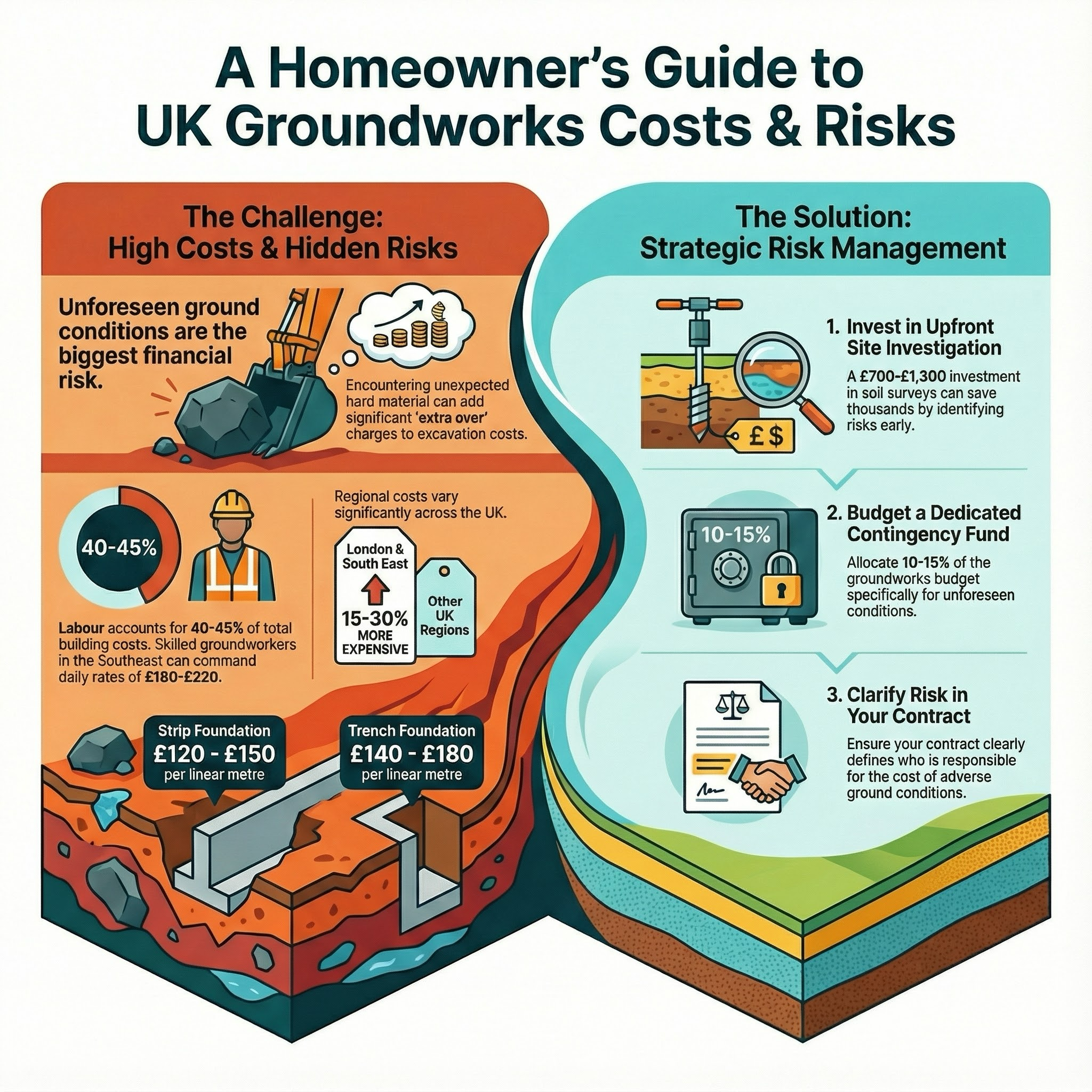
Groundworks explained
Professional foundation support involves stabilising the ground beneath your property to prevent further movement. This guide explores the technical processes, current UK market costs, and the essential regulations you must follow to protect your investment.
Foundation costs vary significantly based on the method used and the depth of the stable strata. Prices below include VAT and reflect 2025/26 UK averages for professional groundworks.
| Item | Low £ | High £ | Notes |
|---|---|---|---|
| Structural Engineer Report | £600 | £1,800 | Essential for Building Control and insurance. |
| Trial Pit Excavation | £400 | £850 | Per pit, including backfilling and reporting. |
| Mass Pour Underpinning | £1,500 | £3,000 | Per linear metre. Traditional hand-dug method. |
| Mini-Piling Support | £2,500 | £5,000 | Per linear metre. Required for very deep stable soil. |
| Resin Injection | £1,000 | £2,200 | Per linear metre. Faster and less mess than concrete. |
| Building Control Fees | £400 | £900 | Local authority inspection and certification. |
Total project costs are heavily influenced by site access. If machinery cannot reach the affected area, manual labour costs will increase significantly, particularly in terraced properties or urban areas like London.
Foundation support is strictly a professional-only task. Attempting to shore up a foundation without structural calculations can lead to catastrophic building failure and will invalidate your home insurance.
Foundation works must be designed by a Structural Engineer and executed by specialist groundworks contractors. You will need a completion certificate from Building Control to sell your home in the future.
Most standard UK policies cover subsidence, but they usually carry a high excess (often £1,000). They will generally only pay for the stabilisation of the building, not the cosmetic repairs, provided the damage wasn't caused by poor maintenance.
Settlement is the natural "bedding down" of a new building, which is usually harmless. Subsidence is the downward movement of the ground beneath an existing building, which requires professional intervention.
Yes. You have a legal duty of disclosure. Failing to notify them of structural work or previous subsidence can void your entire policy, even if the work was done to a high standard.
Resin injection is excellent for ground compaction and re-levelling without mess. However, for severe structural failure or specific soil types, traditional mass-pour concrete or piling may still be the engineer's preferred choice.
Yes, provided you have the Structural Engineer's sign-off and the Building Control Completion Certificate. You may need to use a specialist insurer, but a correctly repaired home is considered safe and mortgageable.
This guide was written with AI assistance and is intended for general information only. Prices are estimates based on UK averages and may vary by region. Always get at least three quotes and consult a qualified professional before starting any work.
Ask follow-ups in plain English. The AI explains options, sequencing and what to ask the groundworks — so you walk in informed.
Emergency stabilisation works are the critical first response to sudden structural failure or ground instability. Whether caused by extreme weather, a burst wat...
READ GUIDE →GuideQuality topsoil is the biological engine of any healthy UK garden. Whether you are preparing for a new lawn, building raised beds, or levelling a tired landscap...
READ GUIDE →GuideUnderpinning is a critical structural intervention used to strengthen and stabilise a property's foundations. It is most commonly required when a building’s ori...
READ GUIDE →GuideA leaking kitchen sink is one of the most common domestic headaches for UK homeowners. While a small drip might seem minor, it can quickly lead to blown kitchen...
READ GUIDE →GuideUnderpinning is a critical structural intervention used to strengthen and stabilise the foundations of a property. For UK homeowners, this is typically necessar...
READ GUIDE →GuideDeep foundation pile driving is a critical structural process used when the surface soil is too weak to support the weight of a new building or extension. By dr...
READ GUIDE →