Instant
01 · Ask
Foundations, drains or full site prep?
Describe the job and the AI tells you whether it's a one-day mini-digger hire or a multi-week CDM-regulated project.

Foundations, drainage, site clearance and excavation — quoted from drawings or a site visit.
Read the brief on soil surveys, CDM, spoil disposal — then let Three local groundworkers quote on the same site plan.
Describe the job and the AI tells you whether it's a one-day mini-digger hire or a multi-week CDM-regulated project.
Strip vs raft vs piled foundations, soakaway design, NHBC depth rules, spoil disposal. Know the spec before the digger arrives.
Three local groundworkers quote on the same plan — dig depths, materials, disposal, drainage — so the underground work is right.
Ready when you are
Enter your postcode and get free quotes from local pros.
Four moves that separate a smooth job from a nightmare.
For anything over 30 days or 500 person-days, the Construction (Design and Management) Regs 2015 require a Principal Designer. Don't let the groundworker skip this.
Clay, peat, made ground — soils dictate foundation type and cost. A £400 soil survey saves £4,000 in surprise underpinning.
Buried services, foundations, drains — once back-filled, you can't see them. Insist on dated photos at every depth, especially around utilities.
Removing 1m³ of soil costs £25–£60 if it's clean, more if contaminated. Spoil disposal lines should be itemised — not hidden in 'site clearance'.
Indicative UK ranges and what affects price.
By job type
Quote spread is typically ± 18% — always get 3 quotes.
Visual breakdown of costs, timelines and the questions you should be asking.
Groundworks quick-view
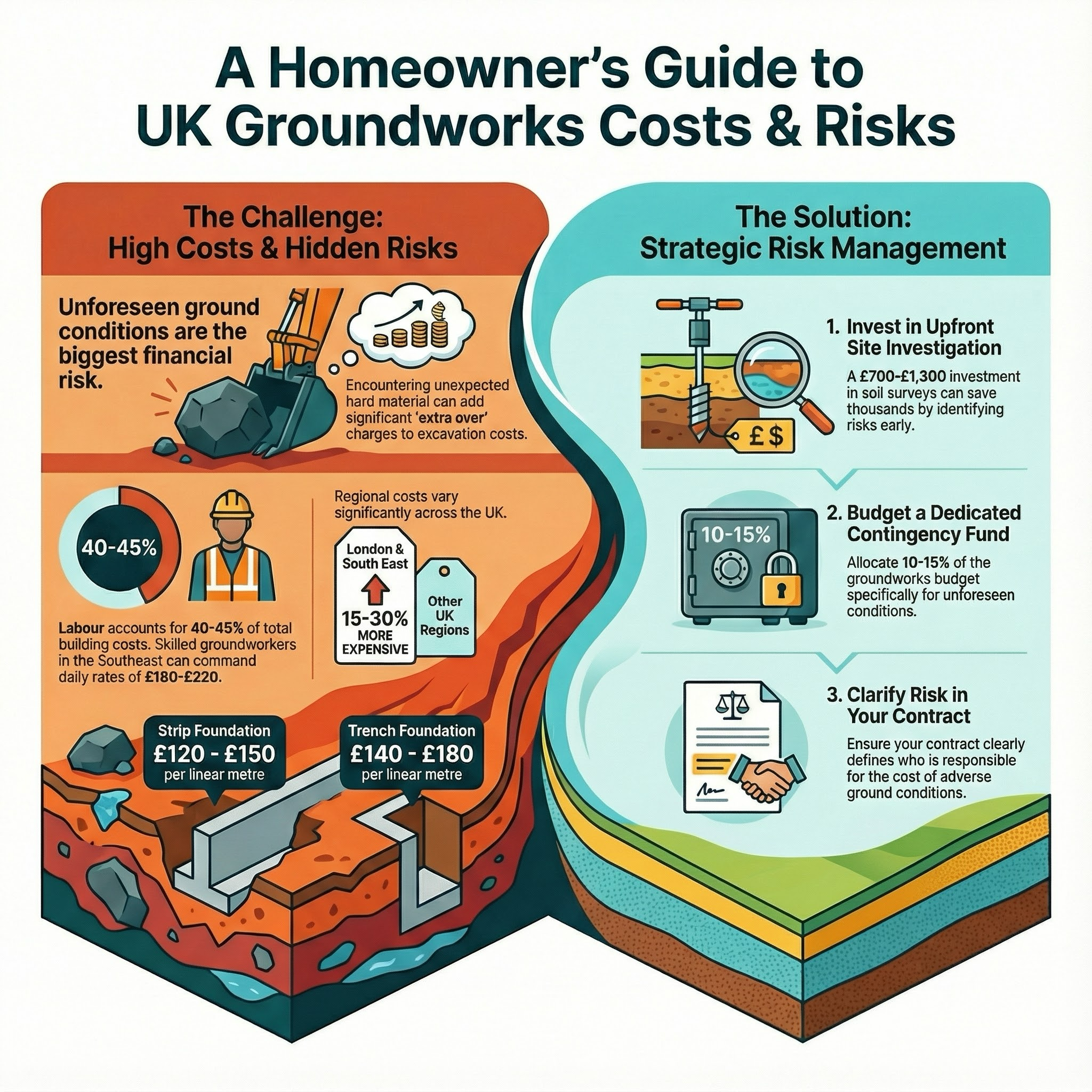
Groundworks explained
Everything you need to know before hiring a groundworks.
Groundworks represent the most critical phase of any construction project. Before a single brick is laid, groundworkers prepare the site, ensure the soil can support the load, and install the essential services that keep a home functional and dry.
For UK homeowners, hiring a groundworks specialist is usually the first step for extensions, new driveways, or resolving persistent drainage issues. This trade handles everything beneath the surface, from heavy excavation and muck-away to the precision installation of foundations and utility ducting.
Because this work is often covered up once completed, it must be done correctly the first time. Poorly executed groundworks can lead to structural subsidence, dampness, or costly drainage failures that are difficult and expensive to rectify later.
A groundworks project is typically the messiest and loudest part of a build, involving heavy machinery like 360-degree excavators and dumpers. Here is what you can expect during a standard engagement:
The process usually begins with a site survey to assess soil type and access. Once the work starts, the team will manage "muck-away"—the removal of excavated earth—using skips or grab lorries, ensuring the site remains workable.
While hiring a mini-digger for a weekend might seem tempting, groundworks are governed by strict UK Building Regulations. Professional groundworkers understand the nuances of Part A (Structure) and Part H (Drainage), ensuring your project passes mandatory inspections from local authority building control.
Structural integrity is the primary reason to go professional. A specialist can identify different soil types—such as heavy clay or peat—and adjust foundation depths accordingly to prevent future movement. They also hold the necessary Street Works (NRASWA) qualifications if they need to excavate near or connect to public highways and sewers.
Safety is another major factor. Professionals are trained to avoid underground utility lines and are insured against the significant costs of damaging water mains or fibre-optic cables. They also have the expertise to manage trench shoring, preventing collapses during the digging phase.
Groundworks costs are heavily influenced by your local geography, soil conditions, and how easily machinery can access the site. Below are estimated costs for common residential groundworks in the UK for 2025/26.
| Service | Low £ | High £ | Notes |
|---|---|---|---|
| Standard Extension Foundations | £120 | £180 | Per linear metre (inc. concrete) |
| Drainage Installation | £80 | £140 | Per linear metre (pipes and bedding) |
| Site Clearance & Muck-away | £450 | £750 | Per 8-wheel grab lorry load |
| Digger & Driver Hire | £350 | £550 | Per day (inc. fuel and insurance) |
| Soakaway Installation | £800 | £1,500 | Using plastic crates and geotextile |
| Concrete Over-site (Slab) | £50 | £90 | Per square metre |
Note: Factors such as high water tables, contaminated land, or the need for specialist piling instead of standard trenches can significantly increase these figures. Always ensure your quote specifies whether VAT and waste disposal fees are included.
Selecting the right contractor is vital, as their work supports everything else you build. Use this checklist to vet potential groundworks firms:
Questions to ask before hiring:
Yes, almost all groundworks related to foundations and drainage require approval. Your local Building Control officer will usually need to inspect the open trenches before concrete is poured to ensure they are deep enough and the soil is suitable.
For a standard domestic extension, the groundworks phase—including clearance, digging, and pouring concrete—typically takes between 3 to 7 working days, depending on weather conditions and soil stability.
Muck-away is the process of removing excavated soil and debris from your site. It is expensive due to Landfill Tax and the high fuel and maintenance costs of the grab lorries or skips required to transport heavy waste.
Yes, but it is more challenging. Heavy rain can cause trenches to collapse or become waterlogged, and concrete cannot be poured if the temperature is below 5°C and falling, as it may fail to set correctly.
Describe the job in plain English. The AI asks a few smart questions, then tells you whether a groundworks is the right call, what it should cost, and what to ask before they start.
Concrete slab for floors, garages and bases. UK costs and grades.
READ GUIDE →GuideDeep foundation pile driving is a critical structural process used when the surface soil is too weak to support the weight of a new building or extension. By dr...
READ GUIDE →GuideNew driveway installation. UK costs for tarmac, paving and concrete.
READ GUIDE →GuideFrench drains for garden waterlogging. UK costs and benefits.
READ GUIDE →GuideEarthworks for garden landscaping. UK costs for excavation and grading.
READ GUIDE →GuideTrenching for ground source heat pump loops. UK costs.
READ GUIDE →GuideWhat groundworks really cost in the UK in 2026. Complete pricing reference.
READ GUIDE →GuideFoundations for new builds and extensions. UK costs by type and soil.
READ GUIDE →GuideMini piles for restricted access or poor soil. UK costs and applications.
READ GUIDE →GuideFull new-build foundation slab. UK costs and Building Regs.
READ GUIDE →GuideSub-base preparation for patios. UK costs and what makes a quality base.
READ GUIDE →GuidePiling is a deep foundation technique used when the surface soil is too weak to support a standard trench or strip foundation. For many UK homeowners, this beco...
READ GUIDE →GuideReinforced concrete walls for basements and retaining. UK costs and applications.
READ GUIDE →GuideRetaining walls hold back earth on slopes. UK costs by wall type.
READ GUIDE →GuideConnecting new build to utilities. UK costs for water, gas, electric.
READ GUIDE →GuidePreparing site for building work. UK costs for clearance and grading.
READ GUIDE →GuideSurface water drainage for new build. UK costs and SuDS compliance.
READ GUIDE →GuideTrenching for water, gas, electric and drainage. UK costs and process.
READ GUIDE →Emergency stabilisation works are the critical first response to sudden structural failure or ground instability. Whether caused by extreme weather, a burst wat...
READ GUIDE →GuideFoundation issues are among the most significant concerns for UK homeowners. Whether caused by subsidence, heave, or historical poor construction, ensuring your...
READ GUIDE →GuideGarden excavation is the essential foundation of almost every major outdoor project, from installing a new patio or driveway to levelling a sloped lawn. While i...
READ GUIDE →GuideA leaking kitchen sink is one of the most common domestic headaches for UK homeowners. While a small drip might seem minor, it can quickly lead to blown kitchen...
READ GUIDE →GuideQuality topsoil is the biological engine of any healthy UK garden. Whether you are preparing for a new lawn, building raised beds, or levelling a tired landscap...
READ GUIDE →Foundations for home extensions. UK costs and Building Regs process.
READ GUIDE →GuideUnderpinning to stabilise sinking foundations. UK costs and process.
READ GUIDE →GuideUnderpinning is a critical structural intervention used to strengthen and stabilise the foundations of a property. For UK homeowners, this is typically necessar...
READ GUIDE →GuideUnderpinning is a critical structural intervention used to strengthen and stabilise a property's foundations. It is most commonly required when a building’s ori...
READ GUIDE →