Instant
01 · Ask
Ask the AI a follow-up
Got more questions about air Conditioning Maintenance? Describe the bit you're unsure about — the AI explains options, sequencing and what to ask the air conditioning.

Filter cleans, coil checks and refrigerant top-ups — the small jobs that keep cooling costs sane.
You've read the brief on air Conditioning Maintenance. Now lean on us to find the right air conditioning — and stay in control of the job.
Got more questions about air Conditioning Maintenance? Describe the bit you're unsure about — the AI explains options, sequencing and what to ask the air conditioning.
Costs, timelines, pitfalls and the right questions to ask before any air conditioning starts on air Conditioning Maintenance.
Itemised quotes from up to 3 local air conditionings on air Conditioning Maintenance — so you can compare like-for-like, not lump sums.
Ready when you are
Enter your postcode and get free quotes from local pros.
Four moves that separate a smooth job from a nightmare.
Usually caused by a blocked drain line or a failed condensate pump. Regular flushing prevents this.
Often due to dirty filters or a clogged outdoor coil restricting airflow.
Known as "Dirty Sock Syndrome," this is caused by bacteria and mould growing on the damp evaporator coil.
If you see ice on the copper pipes, it usually indicates a refrigerant leak or a severe airflow restriction.
Indicative UK ranges and what affects price.
By job type
Quote spread is typically ± 18% — always get 3 quotes.
Air Conditioning quick-view
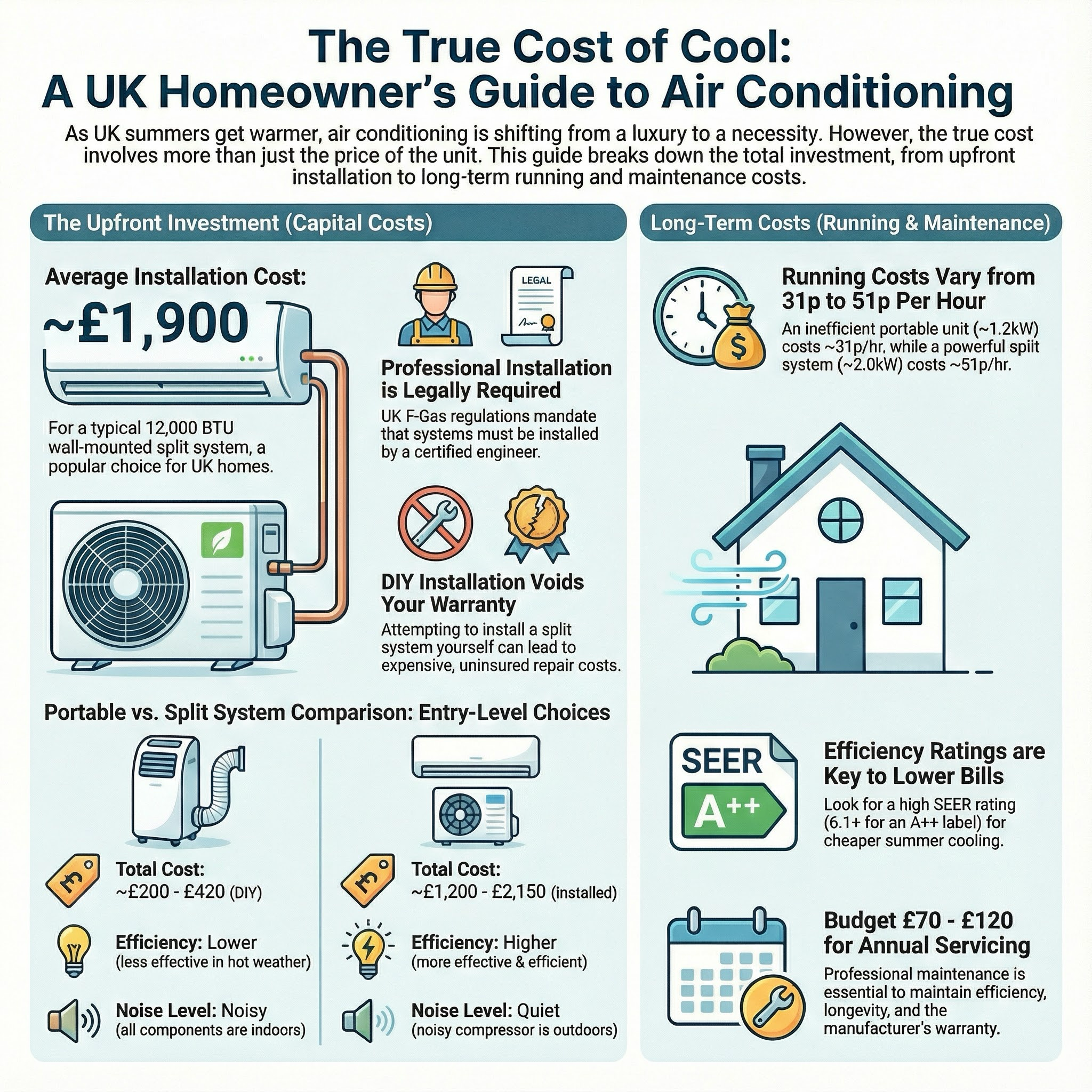
Air Conditioning explained
Neglecting your unit can lead to a 5% drop in efficiency every year, significantly increasing your energy bills. A well-maintained system not only lasts longer but also ensures your manufacturer’s warranty remains valid, protecting your investment for the long term.
| Service Type | Low £ | High £ | Notes |
|---|---|---|---|
| Single Split System Service | £80 | £160 | Standard annual check for one indoor and one outdoor unit. |
| Multi-Split Service (3 Units) | £180 | £300 | Includes one outdoor condenser and three indoor heads. |
| Deep Clean / Mould Removal | £150 | £250 | Involves stripping the unit to clean the blower wheel and tray. |
| Refrigerant Leak Test & Repair | £120 | £400+ | Excludes the cost of replacement gas (R32 or R410A). |
| Emergency Call-Out Fee | £70 | £150 | Usually covers the first 30-60 minutes of fault finding. |
Prices vary based on your location in the UK and the accessibility of the outdoor condenser. Systems mounted high on walls or requiring scaffolding for access will attract higher labour charges. Most reputable companies offer a discount for multi-year maintenance contracts.
Homeowners can safely perform basic maintenance, such as hoovering the dust filters every few months. However, anything involving the internal components, electrical wiring, or the refrigerant circuit must be handled by a professional. In the UK, it is a legal requirement for anyone working on the gas circuit to be F-Gas certified.
Attempting to top up refrigerant or dismantle the unit yourself can void your warranty, lead to significant fines for environmental damage, and risk electrical shock.
For most UK homes, an annual service is sufficient. If you use your system for both heating and cooling year-round, or if you have pets, a bi-annual service is recommended to prevent hair and dust buildup.
This is caused by bacteria buildup on the indoor coil. A professional service includes an anti-bacterial chemical wash that kills these microbes and removes the smell.
No. Air conditioning is a sealed system. If the gas is low, there is a leak that must be found and repaired before any new gas is added.
Yes. A clean system moves air more easily and transfers heat more efficiently, meaning the compressor doesn't have to run as long or as hard to reach your target temperature.
Almost all modern split-system air conditioners sold in the UK are "reverse cycle" heat pumps, meaning they can provide highly efficient heating in the winter as well as cooling in the summer.
This guide was written with AI assistance and is intended for general information only. Prices are estimates based on UK averages and may vary by region. Always get at least three quotes and consult a qualified professional before starting any work.
Ask follow-ups in plain English. The AI explains options, sequencing and what to ask the air conditioning — so you walk in informed.
As UK summers become increasingly warmer, air conditioning has transitioned from a high-end luxury to a common feature in many British homes. Whether you have a...
READ GUIDE →GuideAn air conditioning assessment is a vital health check for your home's climate control system. Beyond ensuring you stay cool during a UK heatwave, a professiona...
READ GUIDE →GuideAs UK summers become increasingly intense, domestic air conditioning has shifted from a luxury to a necessity for many homeowners. When a system fails, prompt r...
READ GUIDE →GuideMaintaining a commercial air conditioning system is essential for business continuity, energy efficiency, and legal compliance. In the UK, businesses are bound ...
READ GUIDE →GuidePortable air conditioners are a popular choice for UK homeowners looking to combat increasingly hot summers without the permanence or expense of a fixed split-s...
READ GUIDE →GuideAir conditioning is rapidly transitioning from a luxury to a necessity for many UK homeowners. As summer heatwaves become more frequent, these systems—technical...
READ GUIDE →