Instant
01 · Ask
Ask the AI a follow-up
Got more questions about hard Water Scale & Boiler Protection? Describe the bit you're unsure about — the AI explains options, sequencing and what to ask the central heating.

Scale reducer, water softener or descaler — what stops limescale wrecking your boiler in hard-water areas.
You've read the brief on hard Water Scale & Boiler Protection. Now lean on us to find the right central heating — and stay in control of the job.
Got more questions about hard Water Scale & Boiler Protection? Describe the bit you're unsure about — the AI explains options, sequencing and what to ask the central heating.
Costs, timelines, pitfalls and the right questions to ask before any central heating starts on hard Water Scale & Boiler Protection.
Itemised quotes from up to 3 local central heatings on hard Water Scale & Boiler Protection — so you can compare like-for-like, not lump sums.
Ready when you are
Enter your postcode and get free quotes from local pros.
Four moves that separate a smooth job from a nightmare.
No protection in hard water area = boiler fails at 8–10 years. With protection: 18+ years.
Owner must top up salt every 1–3 months. Easy to forget.
Independent testing shows mixed results. Salt softeners are the proven approach.
Bypass arrangement gives unsoftened cold water at the kitchen tap. Cheap installs skip this.
Indicative UK ranges and what affects price.
By job type
Quote spread is typically ± 18% — always get 3 quotes.
Central Heating quick-view
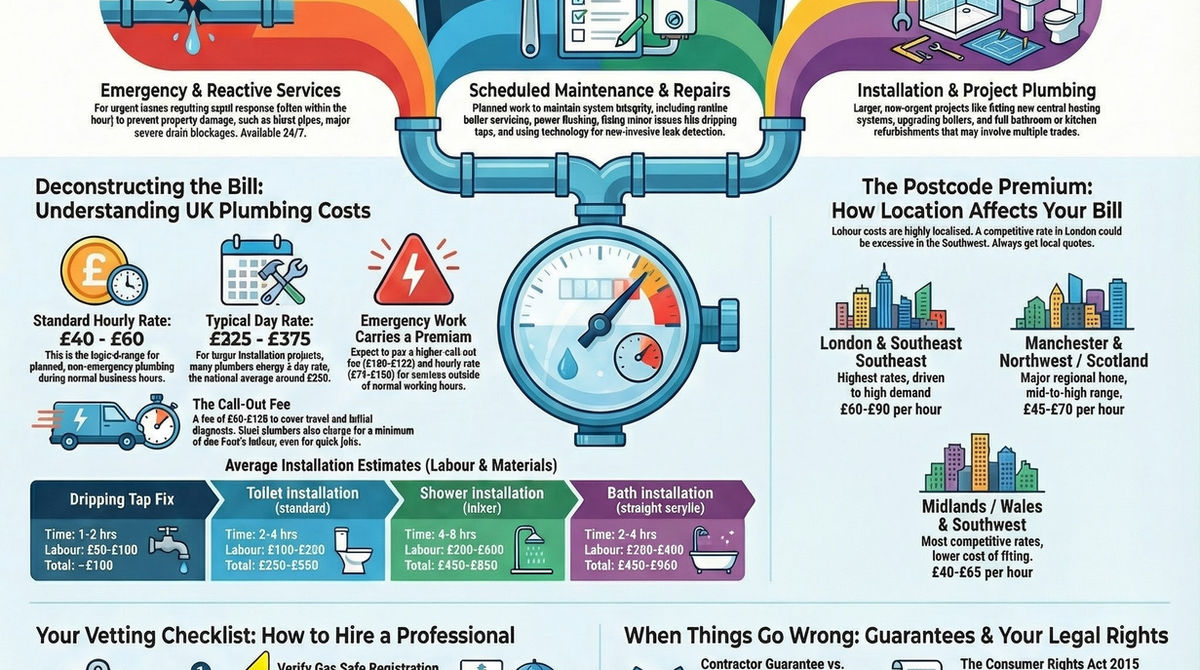
The UK has some of the hardest water in Europe — southeast England especially. Hard water destroys combi boiler heat exchangers, blocks pipework, and shortens system life. Expect to pay £350–£2,500 for protection systems depending on type.
Three main approaches. Water softener: ion-exchange salt-regenerated unit replaces calcium with sodium. Scale inhibitor: phosphate-dosing unit reduces scale formation. Electromagnetic: magnet or coil around pipework physically modifies calcium crystallisation. All install on main cold water supply just after stopcock.
| Item | Low (£) | High (£) | Notes |
|---|---|---|---|
| Salt water softener (Harvey, Kinetico) | 1,200 | 2,500 | Most effective |
| Scale inhibitor (phosphate) | 250 | 500 | Polyphosphate cartridge |
| Electromagnetic descaler | 200 | 500 | Eddy, Halo, Calmag |
| Annual salt for softener | 50 | 150 | 200L+ per year typical |
| Annual phosphate cartridge replace | 30 | 80 | Per cartridge |
| Install labour | 180 | 400 | Plumber, 2–4 hours |
| Cost per year (running) | 50 | 200 | Salt or cartridges |
Water softener install: 2–4 hours. Scale inhibitor or electromagnetic: 1–2 hours.
Plumber installation recommended. Cutting into mains cold supply needs experience to avoid leaks and ensure correct fitting.
Plumber or water softener specialist (Harvey installers, Kinetico). Confirm warranty terms — Harvey lifetime warranty on body. Get installed location confirmed before cutting pipes.
WRAS approval required on water-contact components. Softened water should bypass kitchen tap (cold drinking supply unchanged — sodium content high).
Most of southeast and east England: very hard. Northwest, Scotland: soft. Test with home test kit or check your water supplier's website.
Water softener (salt): most effective, premium price. Scale inhibitor (phosphate): cheaper, less effective. Salt is the proven choice for hard water areas.
Yes — it can be plumbed to only feed the boiler and hot water. Cold drinking supply unchanged.
Mid-range (BWT, Harvey, Kinetico): 15–25 years. Cheap brands: 8–12 years.
In very hard water areas: yes — protect £2,500+ boiler investment and extend pipework life. £1,500 softener pays back through extended equipment life.
Independent testing mixed. Less effective than salt softeners. Best for soft-to-medium-hard water areas.
This guide was written with AI assistance and is intended for general information only. Prices are estimates based on UK averages and may vary by region. Always get at least three quotes and consult a qualified professional before starting any work.
Ask follow-ups in plain English. The AI explains options, sequencing and what to ask the central heating — so you walk in informed.
A heater matrix is essentially a small radiator located deep behind your vehicle's dashboard. It is a critical component of your car's heating system, responsib...
READ GUIDE →GuideGround source heat pumps (GSHPs) are widely considered the "gold standard" of renewable heating for UK homeowners. By extracting solar energy stored in the eart...
READ GUIDE →GuideA reliable heating system is the backbone of any UK home, especially during the damp winter months. When a boiler fails or radiators stay cold, it often signals...
READ GUIDE →GuideFor the four million UK households not connected to the mains gas grid, oil-fuelled central heating remains one of the most reliable and cost-effective ways to ...
READ GUIDE →GuideAn oil leak is a serious matter for any UK homeowner. Beyond the immediate loss of expensive heating fuel, a leak poses significant fire risks and can cause dev...
READ GUIDE →GuideAir source heat pumps (ASHPs) have become the leading low-carbon heating solution for UK homeowners looking to move away from fossil fuels. By extracting heat f...
READ GUIDE →