Instant
01 · Ask
Ask the AI a follow-up
Got more questions about panel Fencing Installation? Describe the bit you're unsure about — the AI explains options, sequencing and what to ask the fencing & gates.

Lap, overlap or close-board panels — concrete or timber posts, gravel boards and capping.
You've read the brief on panel Fencing Installation. Now lean on us to find the right fencing & gates — and stay in control of the job.
Got more questions about panel Fencing Installation? Describe the bit you're unsure about — the AI explains options, sequencing and what to ask the fencing & gates.
Costs, timelines, pitfalls and the right questions to ask before any fencing & gates starts on panel Fencing Installation.
Itemised quotes from up to 3 local fencing & gatess on panel Fencing Installation — so you can compare like-for-like, not lump sums.
Ready when you are
Enter your postcode and get free quotes from local pros.
Four moves that separate a smooth job from a nightmare.
If posts aren't deep enough, the wind will act as a sail and pull the fence over. Holes should be at least 1/3 of the post's total height.
Placing timber panels directly on soil leads to rapid rot. Always use a concrete or pressure-treated timber gravel board.
Concrete footings should be finished with a slight "weathering" slope at the top to shed water away from the timber post.
Using non-galvanised nails or screws will lead to rust streaks and eventual structural failure.
Indicative UK ranges and what affects price.
By job type
Quote spread is typically ± 18% — always get 3 quotes.
Fencing & Gates quick-view
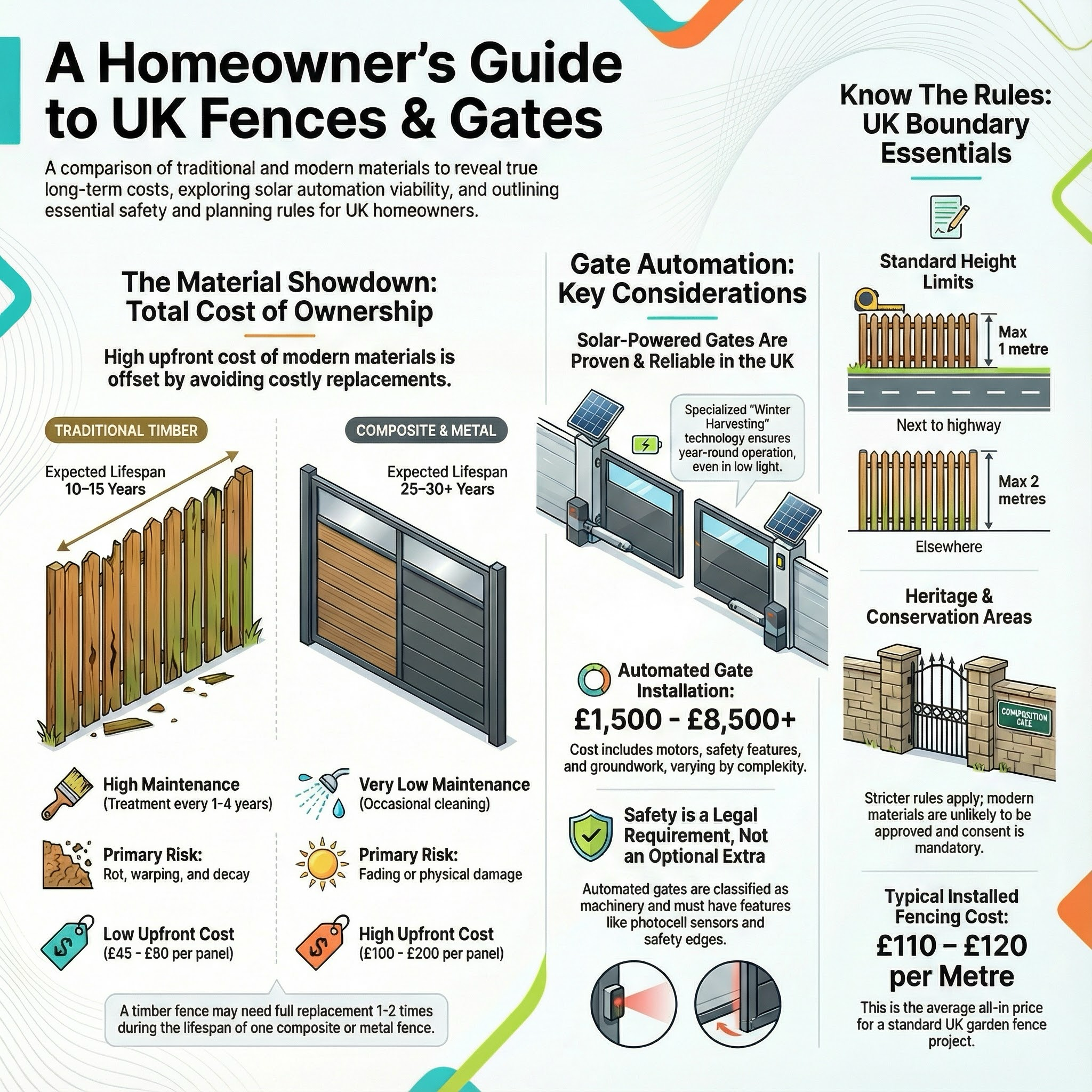
Fencing & Gates explained
A well-installed fence does more than just mark a line; it adds significant kerb appeal and can even increase your property value. However, the longevity of your fence depends entirely on the quality of the installation and the materials chosen to withstand the unpredictable British weather.
Prices vary based on the type of panel (lap, closeboard, or decorative) and the choice between timber and concrete posts. The following figures include materials, labour, and VAT at 20%.
| Item | Low £ | High £ | Notes |
|---|---|---|---|
| Standard 6ft Lap Panel (Supply only) | £35 | £60 | Per 1.8m wide panel. |
| Premium Closeboard Panel (Supply only) | £60 | £95 | Stronger, more durable option. |
| Installation Labour (Per day) | £250 | £450 | Usually a two-person team. |
| Full 10m Run (Installed) | £800 | £1,400 | Includes posts, gravel boards, and waste removal. |
| Waste Removal / Disposal | £100 | £250 | Cost to skip or tip old fencing. |
Factors that increase the price include steep slopes requiring "stepping," exceptionally hard or stony ground, and the need to remove significant amounts of ivy or old concrete footings.
Always confirm if your quote includes the removal and legal disposal of your old fencing, as skip hire or waste transfer fees can be a significant hidden cost.
While a basic panel replacement is a manageable DIY task, installing a full run of fencing is physically demanding and requires precision. If posts are not perfectly aligned and vertical, panels will not fit, or the fence will lean and eventually fail during high winds.
Professionals have the heavy-duty equipment needed to dig through roots and rubble. Furthermore, they understand the nuances of boundary law and can ensure your fence is compliant with local regulations, saving you from potential disputes with neighbours.
If the fence is on your land and within height limits, you don't legally need permission, but it is common courtesy to inform them. If the fence is shared or on the boundary line, you must reach an agreement before work begins.
Concrete posts are more expensive but won't rot and can last 20+ years. Timber posts look more natural but are prone to ground-level rot, even when pressure-treated, typically lasting 10-15 years.
Lap panels use horizontal slats and are the cheaper, lighter option. Closeboard (or featheredge) panels use vertical, overlapping slats and are much stronger and more resistant to wind damage.
If the timber is "green" from pressure treatment, it is best to wait 2-3 months for it to dry out fully before applying a DIY stain or paint to ensure it adheres properly.
Fences on slopes are usually "stepped." This means the panels remain level, but each subsequent panel is set slightly lower or higher than the last, creating a staggered effect. The gaps underneath are filled with custom-cut gravel boards.
This guide was written with AI assistance and is intended for general information only. Prices are estimates based on UK averages and may vary by region. Always get at least three quotes and consult a qualified professional before starting any work.
Ask follow-ups in plain English. The AI explains options, sequencing and what to ask the fencing & gates — so you walk in informed.
A high-quality garden fence is essential for UK homeowners, providing privacy, security, and a vital windbreak against the British weather. Beyond aesthetics, a...
READ GUIDE →GuideA well-installed wooden gate is more than just a boundary; it provides essential security, privacy, and kerb appeal for your property. In the UK, where wind and...
READ GUIDE →GuideA high-quality fence is more than just a boundary; it provides security, privacy, and essential shelter for your garden. In the UK, our fences must withstand ev...
READ GUIDE →GuideCrash barrier cutting, often referred to as Armco cutting, is a specialist task typically required when a barrier has been damaged by a vehicle or needs modifyi...
READ GUIDE →GuideA sturdy fence is the backbone of UK garden security, privacy, and aesthetic appeal. Whether your panels have succumbed to a winter gale or your posts have fina...
READ GUIDE →GuideA well-installed front fence does more than just mark your property boundary; it enhances kerb appeal, provides security, and keeps pets or children safe from t...
READ GUIDE →