Instant
01 · Ask
Ask the AI a follow-up
Got more questions about carpet Installation? Describe the bit you're unsure about — the AI explains options, sequencing and what to ask the flooring.

Measured, supplied and fitted in 1–2 days — underlay, grippers and clean trimmed edges.
You've read the brief on carpet Installation. Now lean on us to find the right flooring — and stay in control of the job.
Got more questions about carpet Installation? Describe the bit you're unsure about — the AI explains options, sequencing and what to ask the flooring.
Costs, timelines, pitfalls and the right questions to ask before any flooring starts on carpet Installation.
Itemised quotes from up to 3 local floorings on carpet Installation — so you can compare like-for-like, not lump sums.
Ready when you are
Enter your postcode and get free quotes from local pros.
Four moves that separate a smooth job from a nightmare.
Carpet not properly stretched on install. Fix is to re-stretch (often free in warranty).
Cheap fitters don't run the pile direction consistently. Always run pile in the same direction.
High-traffic areas wear flat. Twist-pile recovers better than loop-pile.
Old carpets without stain protection lock in spills. Treat new carpets with Scotchgard or specify Polypropylene stain-resistant fibres.
Indicative UK ranges and what affects price.
By job type
Quote spread is typically ± 18% — always get 3 quotes.
Flooring quick-view
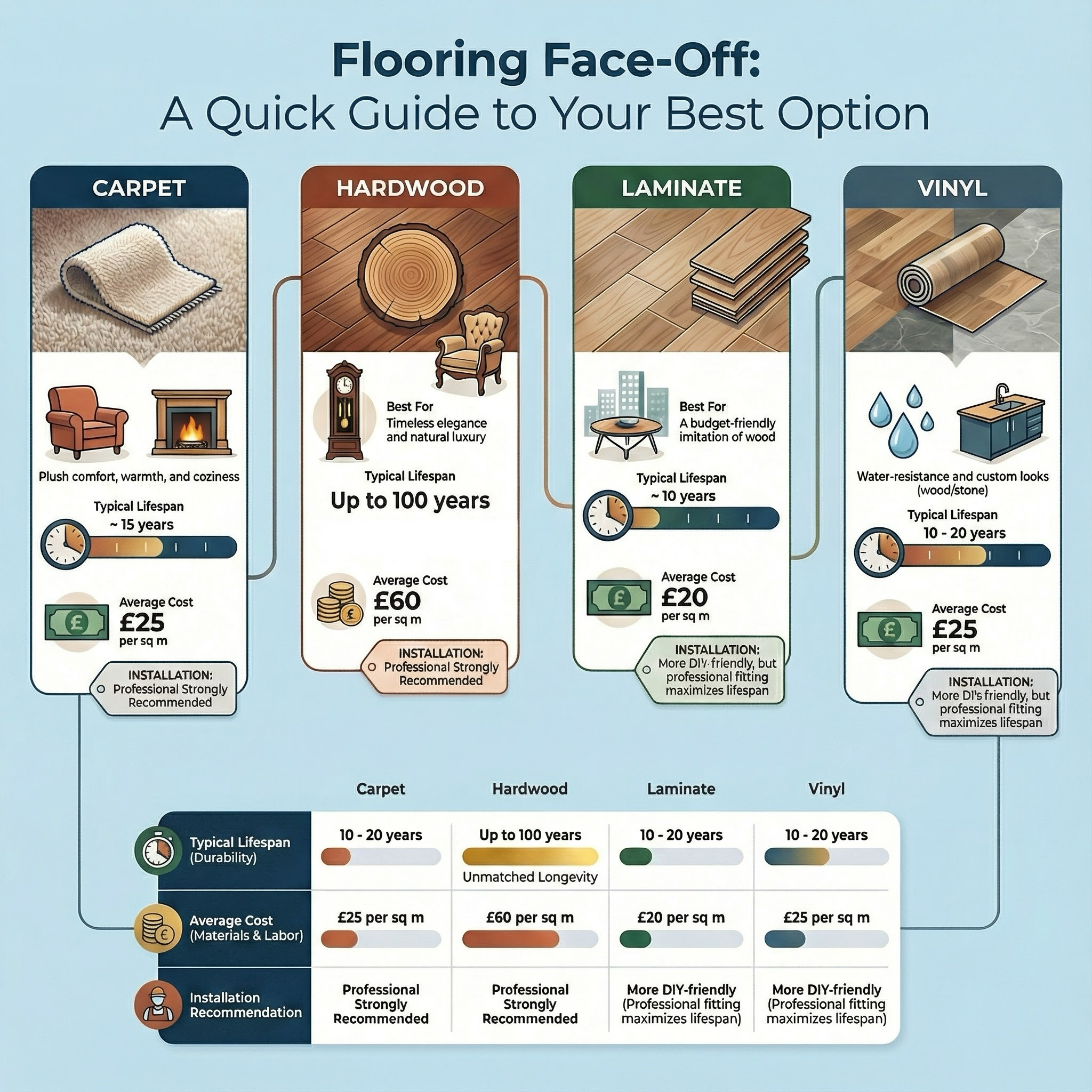
Flooring explained
Carpet remains the UK's most popular bedroom flooring — warm, quiet, and now with stain-resistant treatments that handle family life. Expect to pay £18–£70 per m² fitted including underlay, depending on fibre, pile and quality.
The fitter measures the room and orders carpet plus underlay. Gripper rod (timber strip with carpet tacks) is fixed around the perimeter. Underlay is laid and taped at seams. Carpet is rolled out, stretched onto the gripper, trimmed at edges, and finished into door bars. Stairs are individually wrapped or capped. The whole job is precision work — visible joins or stretch marks are the giveaway of a poor fit.
| Item | Low (£) | High (£) | Notes |
|---|---|---|---|
| Budget synthetic per m² | 8 | 20 | Polypropylene, twist pile |
| Mid-range wool blend per m² | 20 | 40 | 80/20 wool/synthetic |
| Premium 100% wool per m² | 35 | 80 | Brintons, Cormar, Axminster |
| Premium loop pile per m² | 30 | 70 | Berber, sisal-look |
| PU foam underlay per m² | 4 | 12 | Cosi 7–11mm |
| Wool felt underlay per m² | 6 | 15 | Tredaire, Aria |
| Install labour per m² | 4 | 10 | Plus gripper, smooth-edge |
Single bedroom: 2–3 hours. Whole-house (5–6 rooms + stairs + landing): 1–2 days. Stairs alone: 2–4 hours.
Professional. Carpet stretching requires a knee-kicker and power stretcher; without them the carpet ripples within months. Joining seams invisibly is also skilled work.
An experienced carpet fitter (not a general handyman). The carpet shop usually provides a fitter — confirm they're employed by the retailer, not subbed out. Ask the warranty on workmanship — 12 months is standard.
Building Regs Part E (acoustic) in flats — most carpets with foam underlay easily meet the dB requirement. Fire-retardant rating BS 5287:1988 is required for commercial/HMO use, not domestic.
Wool: warmer, softer feel, naturally fire-retardant, more sustainable. Synthetic: cheaper, more stain-resistant, easier to clean. 80/20 wool/synthetic blends combine both strengths.
Twist (cut pile): soft underfoot, hides marks, traditional. Loop (Berber, sisal-look): harder-wearing, modern look, can snag on pet claws.
PU foam (Cosi, Tredaire) 9–11mm thick is the modern standard — warm, quiet, comfortable. Wool felt is the heritage option but less common now.
Budget synthetic: 5–8 years. Mid wool blend: 10–15 years. Premium wool: 15–25 years with good care.
Yes — most carpets are UFH-compatible. Use a thinner underlay (5–7mm not 11mm) so heat transfers through.
Solution-dyed polypropylene or solution-dyed nylon. The colour is part of the fibre so bleach won't strip it. Common in family-home ranges.
This guide was written with AI assistance and is intended for general information only. Prices are estimates based on UK averages and may vary by region. Always get at least three quotes and consult a qualified professional before starting any work.
Ask follow-ups in plain English. The AI explains options, sequencing and what to ask the flooring — so you walk in informed.
Laminate is the UK's most popular hard floor. Costs by AC rating, install methods, underlay and how long it lasts.
READ GUIDE →GuideLVT has overtaken laminate as the premium hard floor of choice. UK costs, click vs glue-down and where it suits best.
READ GUIDE →GuideEngineered wood gives the look of solid timber with greater dimensional stability. UK costs, plank sizes and finishes.
READ GUIDE →GuideSolid hardwood is the heritage gold standard. UK costs for oak, walnut and reclaimed boards, and where solid still beats engineered.
READ GUIDE →GuideParquet is the geometric wood-block floor with herringbone, chevron and basket-weave patterns. UK costs and the look's resurgence.
READ GUIDE →GuideSheet vinyl is the cheapest waterproof floor. UK costs, install methods and where modern designer vinyl beats LVT on value.
READ GUIDE →