Instant
01 · Ask
Ask the AI a follow-up
Got more questions about engineered Wood Flooring? Describe the bit you're unsure about — the AI explains options, sequencing and what to ask the flooring.

Real-oak top layer on plywood core — stable over UFH, glue-down or click-lock install.
You've read the brief on engineered Wood Flooring. Now lean on us to find the right flooring — and stay in control of the job.
Got more questions about engineered Wood Flooring? Describe the bit you're unsure about — the AI explains options, sequencing and what to ask the flooring.
Costs, timelines, pitfalls and the right questions to ask before any flooring starts on engineered Wood Flooring.
Itemised quotes from up to 3 local floorings on engineered Wood Flooring — so you can compare like-for-like, not lump sums.
Ready when you are
Enter your postcode and get free quotes from local pros.
Four moves that separate a smooth job from a nightmare.
Boards over 220mm wide can cup if subfloor moisture is high. Test moisture before laying.
2mm wear-layer can only be sanded once or twice; 4mm+ can be sanded 3–4 times over the floor's life.
Max surface 27°C. Higher and the boards dry-shrink and gap.
Budget lacquers chip and scuff in 5–7 years. Quality UV-cured lacquer or hardwax oil lasts 15+ years.
Indicative UK ranges and what affects price.
By job type
Quote spread is typically ± 18% — always get 3 quotes.
Flooring quick-view
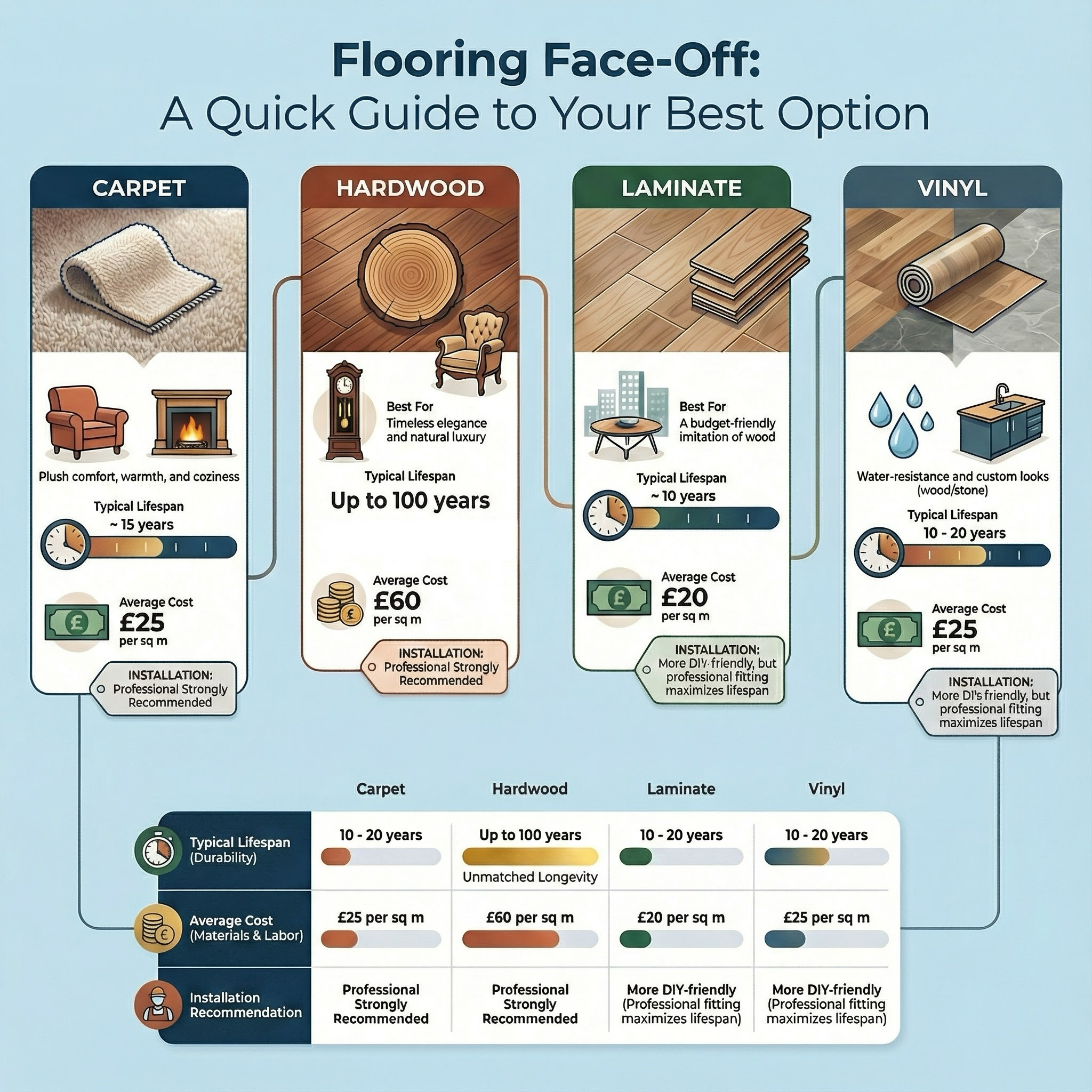
Flooring explained
Engineered wood gives the look and feel of solid timber with much greater dimensional stability — won't warp, swell or contract the way solid wood does. Expect to pay £35–£140 per m² fitted in the UK depending on species, plank size and wear-layer thickness.
Engineered boards are a real-wood top layer (2–6mm thick) bonded onto a stable plywood or HDF core. Install methods: floating (clicked over underlay, fastest), glue-down (most stable, best for UFH), or secret nail (traditional method into timber joists or battens). Boards arrive 48 hours before fitting to acclimatise.
| Item | Low (£) | High (£) | Notes |
|---|---|---|---|
| Entry engineered oak per m² | 25 | 50 | 2mm wear layer, 14mm thick |
| Mid-range engineered oak per m² | 40 | 75 | 3–4mm wear, 18mm thick |
| Premium engineered oak per m² | 65 | 120 | 6mm wear, wide-plank, brushed/oiled |
| Engineered walnut/maple per m² | 55 | 140 | Premium species |
| Install floating per m² | 10 | 22 | Click-fit |
| Install glue-down per m² | 15 | 35 | UFH or large open-plan |
| Install secret-nail per m² | 20 | 40 | Onto joists/battens |
Floating install in a 20 m² room: 6–8 hours. Glue-down: 1–2 days per room. Secret-nail: 1–2 days per room. Allow 48 hours acclimatisation.
Floating engineered floors are DIY-able for confident householders. Glue-down and secret-nail are professional work — adhesive open-time and nail spacing matter for longevity.
A wood flooring specialist or general flooring fitter. Ask the wear-layer thickness they recommend — 3mm minimum for living areas, 4mm+ for kitchens. Confirm finish: lacquered (low-maintenance, can't be sanded easily), oiled (more natural feel, can be re-oiled and patched).
Building Regs Part E (acoustic) in flats — acoustic underlay needed. No other specific regulations.
Engineered wins for: stability with UFH, basements, modern centrally-heated homes. Solid wins for: heritage properties, character (period homes), refinishing potential (can be sanded many times).
Yes — engineered is the recommended choice for UFH. Solid wood often warps and gaps over UFH; engineered is dimensionally stable.
2mm for bedrooms; 3–4mm for living areas; 4–6mm for kitchens and high-traffic. Wear layer determines how many times the floor can be sanded over its life.
Lacquered: low-maintenance, plasticky-feel, hard to patch-repair. Oiled: natural matte feel, easy to refresh and patch with hardwax oil. Most premium installs are now oiled.
Standard 130–190mm; wide-plank 200–260mm. Anything wider needs careful subfloor moisture testing.
20–40 years for the floor itself. Wear layer determines refinish potential — 4mm+ can give two or three full sand-and-refinish cycles.
This guide was written with AI assistance and is intended for general information only. Prices are estimates based on UK averages and may vary by region. Always get at least three quotes and consult a qualified professional before starting any work.
Ask follow-ups in plain English. The AI explains options, sequencing and what to ask the flooring — so you walk in informed.
Laminate is the UK's most popular hard floor. Costs by AC rating, install methods, underlay and how long it lasts.
READ GUIDE →GuideLVT has overtaken laminate as the premium hard floor of choice. UK costs, click vs glue-down and where it suits best.
READ GUIDE →GuideSolid hardwood is the heritage gold standard. UK costs for oak, walnut and reclaimed boards, and where solid still beats engineered.
READ GUIDE →GuideParquet is the geometric wood-block floor with herringbone, chevron and basket-weave patterns. UK costs and the look's resurgence.
READ GUIDE →GuideSheet vinyl is the cheapest waterproof floor. UK costs, install methods and where modern designer vinyl beats LVT on value.
READ GUIDE →GuideCarpet is still the UK's most popular bedroom flooring. Costs, pile types, underlay choices and the modern stain-resistant range.
READ GUIDE →