Instant
01 · Ask
Ask the AI a follow-up
Got more questions about solid Hardwood Flooring? Describe the bit you're unsure about — the AI explains options, sequencing and what to ask the flooring.

Solid oak, walnut or ash — secret-nailed to joists or batten-fixed, hand-finished after sand and stain.
You've read the brief on solid Hardwood Flooring. Now lean on us to find the right flooring — and stay in control of the job.
Got more questions about solid Hardwood Flooring? Describe the bit you're unsure about — the AI explains options, sequencing and what to ask the flooring.
Costs, timelines, pitfalls and the right questions to ask before any flooring starts on solid Hardwood Flooring.
Itemised quotes from up to 3 local floorings on solid Hardwood Flooring — so you can compare like-for-like, not lump sums.
Ready when you are
Enter your postcode and get free quotes from local pros.
Four moves that separate a smooth job from a nightmare.
Solid wood swells 1–2% in summer, shrinks 1–2% in winter. Visible gaps appear in winter — that's normal, not a defect.
Most solid wood is not UFH-rated. Use engineered for UFH.
Subfloor moisture too high before laying. Always test with a moisture meter.
Cheap nails or wrong angle pop through the surface over time. Use proper 50mm cleats at the correct 45° angle.
Indicative UK ranges and what affects price.
By job type
Quote spread is typically ± 18% — always get 3 quotes.
Flooring quick-view
Flooring explained
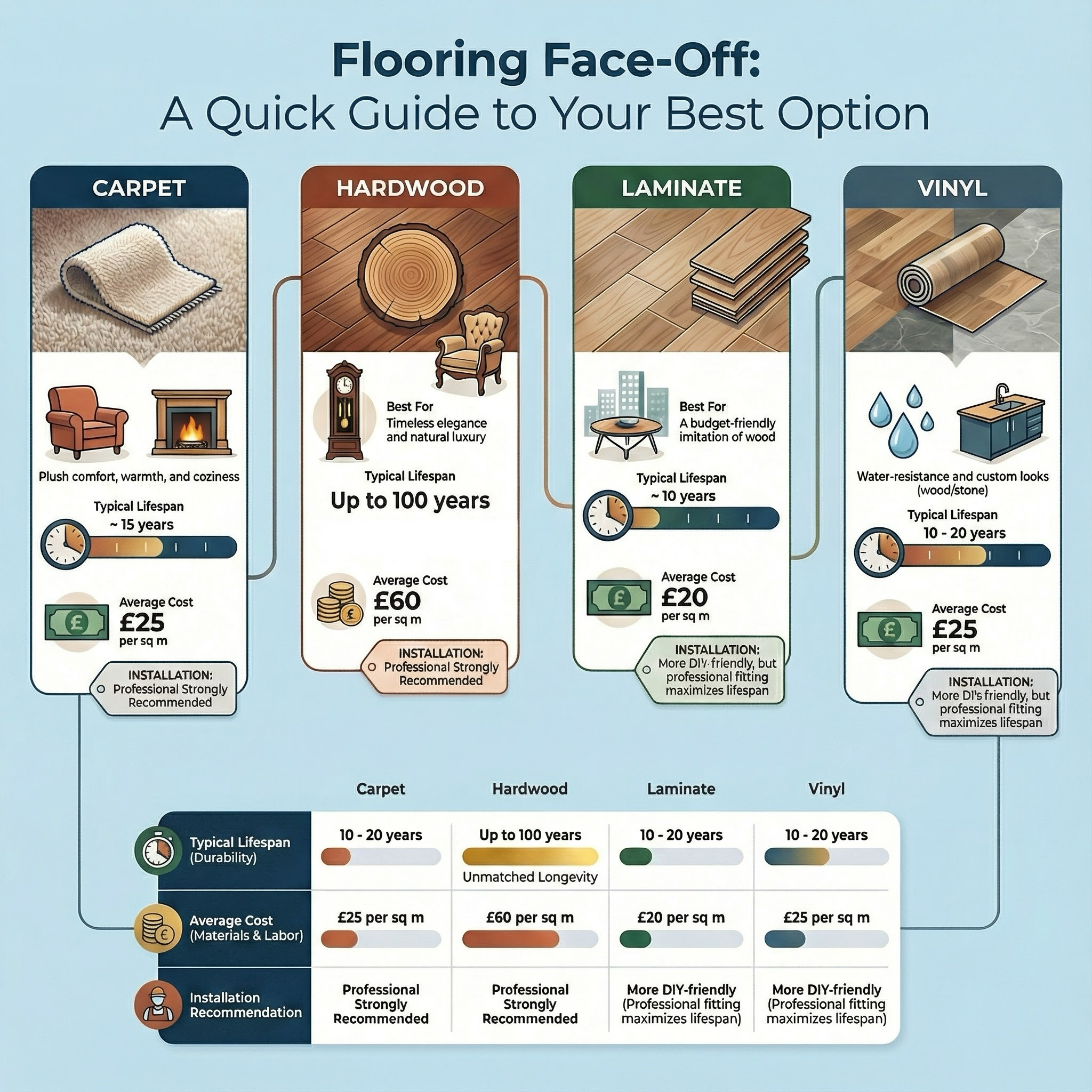
Solid hardwood is the heritage gold standard for UK flooring. Real oak, walnut or maple, milled into tongue-and-groove boards 18–22mm thick. Expect to pay £45–£180 per m² fitted depending on species, board width, and finish. Lasts 80–100+ years with the right care.
Solid wood is heavier and less dimensionally stable than engineered. Install methods: secret-nail (traditional, onto joists or battens — the classic method), glue-down (onto concrete subfloor with elastomeric adhesive), or floating (less common, only narrow boards). The room must be at 18–22°C and 40–60% humidity for 7+ days before laying. Boards are sanded after laying (if not pre-finished) and oiled, waxed or lacquered.
| Item | Low (£) | High (£) | Notes |
|---|---|---|---|
| Solid oak boards per m² | 35 | 90 | 18mm × 130mm |
| Solid walnut/cherry per m² | 70 | 140 | Premium species |
| Reclaimed pine boards per m² | 45 | 110 | Victorian or pitch pine |
| Solid oak parquet per m² | 55 | 140 | Herringbone, chevron |
| Subfloor prep & battens | 15 | 40 | Per m², where needed |
| Install secret-nail per m² | 20 | 45 | Skilled work |
| Sand and finish per m² | 15 | 40 | Three coats hardwax oil |
20 m² room: 2–3 days laying, plus 1 day sanding and finishing. Acclimatisation: 7+ days. Total project: 10–14 days from delivery.
Professional. Secret-nailing solid wood requires a pneumatic flooring nailer (hire £30/day), and the boards must be planed and shimmed to fit. Sanding and finishing requires a hired drum sander and experience to avoid swirl marks.
A wood flooring specialist (not a general fitter). Ask the species and grade — Prime oak (almost no knots, premium) vs Rustic oak (knotty, character grade). Confirm finish: hardwax oil is the modern standard; lacquer is glossy and harder to patch.
Building Regs Part E (acoustic) in flats. Solid wood alone doesn't meet the required dB rating — acoustic underlay layer needed beneath. Listed buildings often require like-for-like timber replacement.
Engineered uses a thin top layer of real wood over plywood; solid is real wood all the way through. Solid takes more wood, costs more to mill, and is heavier to ship.
Most cannot. Some narrow-board solid woods (110mm wide max) are UFH-rated; check manufacturer's spec sheet. Engineered is the safer choice for UFH.
80–100+ years with care. Can be sanded and refinished 5–8 times over its lifetime — essentially indefinite if maintained.
Yes for character — Victorian pine, pitch pine, oak from old barns. Costs similar to new prime oak. Inspect for woodworm and old nails before buying.
Prime is clean — almost no knots, even colour. Rustic has knots and colour variation — characterful. Personal preference; rustic is cheaper.
110–180mm is standard. Above 180mm wide boards become unstable — engineered is better for wide-plank looks.
This guide was written with AI assistance and is intended for general information only. Prices are estimates based on UK averages and may vary by region. Always get at least three quotes and consult a qualified professional before starting any work.
Ask follow-ups in plain English. The AI explains options, sequencing and what to ask the flooring — so you walk in informed.
Laminate is the UK's most popular hard floor. Costs by AC rating, install methods, underlay and how long it lasts.
READ GUIDE →GuideLVT has overtaken laminate as the premium hard floor of choice. UK costs, click vs glue-down and where it suits best.
READ GUIDE →GuideEngineered wood gives the look of solid timber with greater dimensional stability. UK costs, plank sizes and finishes.
READ GUIDE →GuideParquet is the geometric wood-block floor with herringbone, chevron and basket-weave patterns. UK costs and the look's resurgence.
READ GUIDE →GuideSheet vinyl is the cheapest waterproof floor. UK costs, install methods and where modern designer vinyl beats LVT on value.
READ GUIDE →GuideCarpet is still the UK's most popular bedroom flooring. Costs, pile types, underlay choices and the modern stain-resistant range.
READ GUIDE →