Instant
01 · Ask
Ask the AI a follow-up
Got more questions about floor Levelling Compound? Describe the bit you're unsure about — the AI explains options, sequencing and what to ask the flooring.

Self-levelling compound poured to fix uneven concrete or screed — ready for tile, LVT or wood.
You've read the brief on floor Levelling Compound. Now lean on us to find the right flooring — and stay in control of the job.
Got more questions about floor Levelling Compound? Describe the bit you're unsure about — the AI explains options, sequencing and what to ask the flooring.
Costs, timelines, pitfalls and the right questions to ask before any flooring starts on floor Levelling Compound.
Itemised quotes from up to 3 local floorings on floor Levelling Compound — so you can compare like-for-like, not lump sums.
Ready when you are
Enter your postcode and get free quotes from local pros.
Four moves that separate a smooth job from a nightmare.
Cement compound on dusty concrete doesn't bond — lifts within weeks. Always prime with acrylic primer first.
Compound traps air during pour — surface gets pitted. Always spike-roll to release bubbles.
Existing concrete cracks telegraph through compound. Address the underlying crack first.
Feather-finish at 10mm cracks; standard at 30mm cracks. Use the right grade for the depth.
Indicative UK ranges and what affects price.
By job type
Quote spread is typically ± 18% — always get 3 quotes.
Flooring quick-view
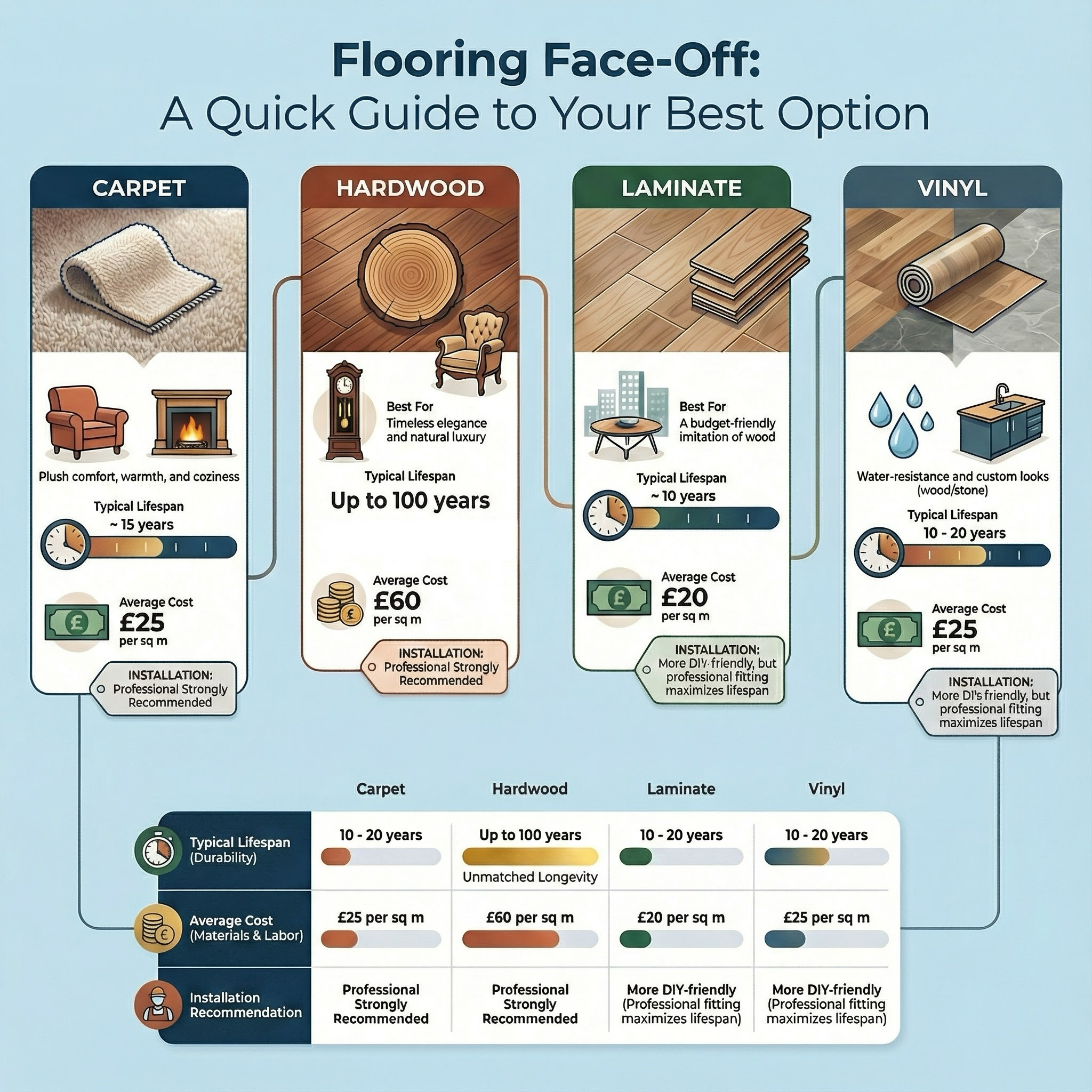
Flooring explained
Self-levelling compound is a pourable cementitious mix that flows out flat to fix dips and unevenness in concrete subfloors. Expect to pay £10–£35 per m² for UK self-levelling depending on depth and grade.
The substrate is cleaned, swept and primed (acrylic primer brushed on). Compound is mixed (3–4 litres of water per 25kg bag) and poured. Smoothed with a notched spreader or trowel, then spike-rolled to release air. Cures in 4–24 hours for foot traffic, 24–48 hours for the finish floor. Maximum pour depth depends on product: feather-finish 0–10mm; standard 3–15mm; high-build 10–50mm.
| Item | Low (£) | High (£) | Notes |
|---|---|---|---|
| Compound supply per 25kg bag | 15 | 35 | Covers ~3 m² at 5mm |
| Primer per litre | 10 | 25 | Covers 5–8 m² |
| Self-level 3–5mm fitted | 10 | 22 | Per m² |
| Self-level 5–10mm fitted | 15 | 30 | Per m² |
| High-build 10–25mm fitted | 22 | 40 | Per m² |
| Feather-finish per m² | 8 | 15 | 0–3mm |
| Hire spike roller | 10 | 20 | Per day |
20 m² self-levelling: 3–4 hours work, 24 hours cure to walk on, 48 hours for finish floor. The work itself is fast — drying time is the bottleneck.
DIY-friendly for small areas (under 15 m²). Larger areas need two people working continuously — once mixed, the compound has to be poured within 15–25 minutes. Cracking the timing means an uneven finish.
Any flooring fitter or general builder. The skill is in the priming and the timing — quality fitters spike-roll to remove bubbles. Brands: Mapei, Ardex, Sika, F. Ball are the UK leaders.
No specific regulations. Cement-based products are slightly alkaline — wear gloves and eye protection.
Depends on the product. Feather-finish 0–10mm; standard 3–15mm; high-build 10–50mm. Always check the bag spec.
Yes — with the right primer (Ardex P82 or similar). Avoid loose tiles which lift the compound.
With a flexible compound (Ardex K28 fibre-reinforced or similar) and a primer. Standard self-levelling cracks on timber.
Foot traffic: 4–24 hours depending on product. Finish floor: 24–48 hours.
Quality self-leveller, properly primed, at the right depth: no. Cracking is almost always wrong product depth, no primer, or compound mixed too dry.
A very thin (0–3mm) levelling compound for cosmetic smoothing. Won't fix structural unevenness — use over already-flat subfloors only.
This guide was written with AI assistance and is intended for general information only. Prices are estimates based on UK averages and may vary by region. Always get at least three quotes and consult a qualified professional before starting any work.
Ask follow-ups in plain English. The AI explains options, sequencing and what to ask the flooring — so you walk in informed.
Laminate is the UK's most popular hard floor. Costs by AC rating, install methods, underlay and how long it lasts.
READ GUIDE →GuideLVT has overtaken laminate as the premium hard floor of choice. UK costs, click vs glue-down and where it suits best.
READ GUIDE →GuideEngineered wood gives the look of solid timber with greater dimensional stability. UK costs, plank sizes and finishes.
READ GUIDE →GuideSolid hardwood is the heritage gold standard. UK costs for oak, walnut and reclaimed boards, and where solid still beats engineered.
READ GUIDE →GuideParquet is the geometric wood-block floor with herringbone, chevron and basket-weave patterns. UK costs and the look's resurgence.
READ GUIDE →GuideSheet vinyl is the cheapest waterproof floor. UK costs, install methods and where modern designer vinyl beats LVT on value.
READ GUIDE →