Instant
01 · Ask
Ask the AI a follow-up
Got more questions about floor Sanding & Refinishing? Describe the bit you're unsure about — the AI explains options, sequencing and what to ask the flooring.

Hardwood, parquet or pine sanded back, stained and sealed — restored to factory finish.
You've read the brief on floor Sanding & Refinishing. Now lean on us to find the right flooring — and stay in control of the job.
Got more questions about floor Sanding & Refinishing? Describe the bit you're unsure about — the AI explains options, sequencing and what to ask the flooring.
Costs, timelines, pitfalls and the right questions to ask before any flooring starts on floor Sanding & Refinishing.
Itemised quotes from up to 3 local floorings on floor Sanding & Refinishing — so you can compare like-for-like, not lump sums.
Ready when you are
Enter your postcode and get free quotes from local pros.
Four moves that separate a smooth job from a nightmare.
Cheap fitters with worn-out sanders leave visible circular swirls. Insist on machine-checked equipment.
Edge sander can dig in if not handled carefully. Visible "dipped" edges around the perimeter.
Some woods (pine, certain oaks) absorb stain unevenly. Always test on a corner first.
Cheap lacquer can yellow over white oak. Use water-based lacquer for pale woods.
Indicative UK ranges and what affects price.
By job type
Quote spread is typically ± 18% — always get 3 quotes.
Flooring quick-view
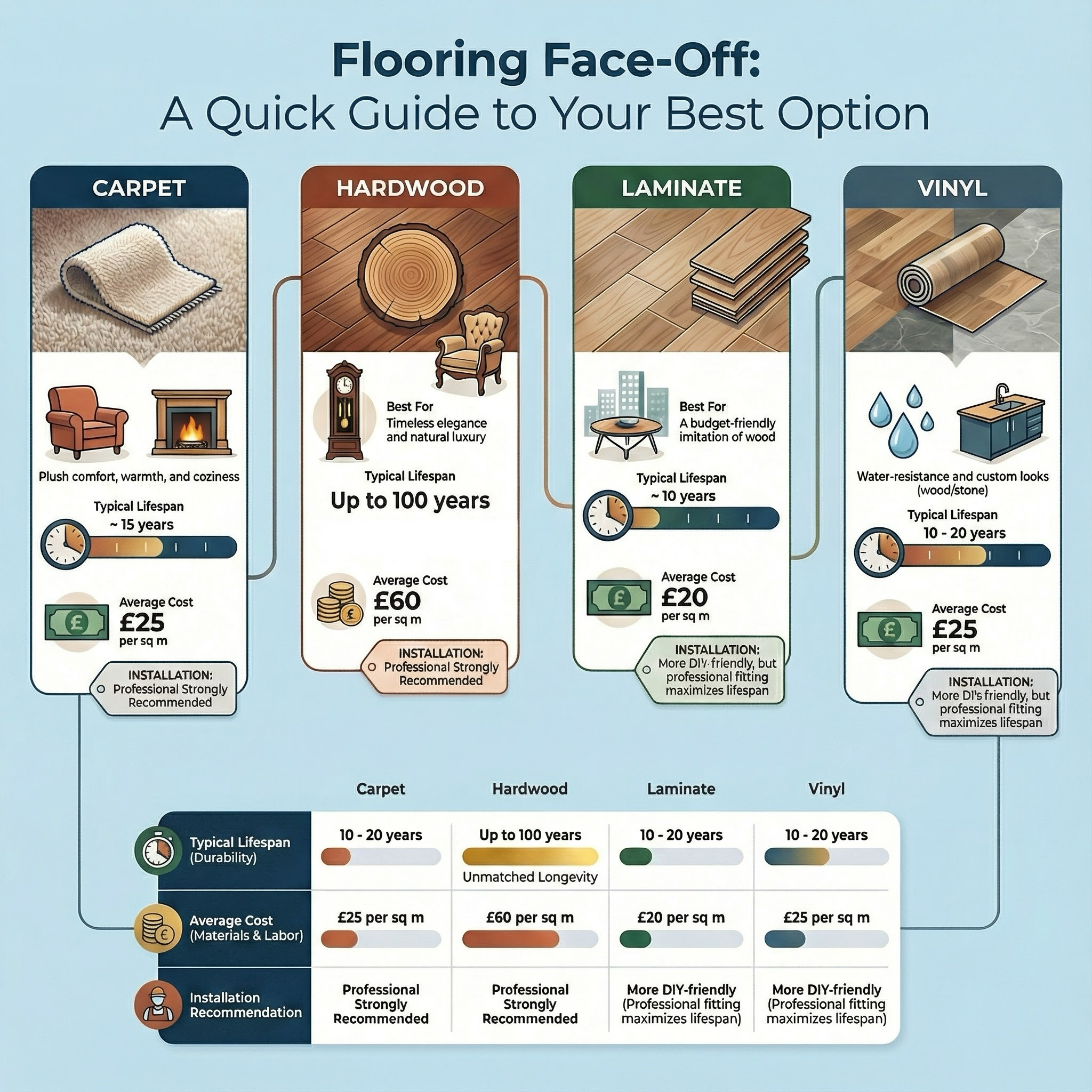
Flooring explained
Existing solid wood and parquet floors can be sanded back to fresh wood and refinished — usually transformatively. Expect to pay £15–£50 per m² for UK floor sanding and refinishing, depending on condition and finish.
The fitter clears the room, fixes loose boards or nails, fills gaps (resin sawdust filler or natural fibre tape), then sands in three passes: coarse (36–60 grit) removes the old finish and visible damage; medium (80–100 grit) smooths the surface; fine (120–150 grit) prepares for finishing. Edge sander deals with the perimeter. Then finishing: hardwax oil (3 coats) or polyurethane lacquer (3 coats).
| Item | Low (£) | High (£) | Notes |
|---|---|---|---|
| Plank sanding per m² | 12 | 25 | Single sand pass |
| Full sand & 3-coat finish per m² | 20 | 50 | Standard package |
| Parquet sanding per m² | 25 | 55 | More complex, takes longer |
| Gap-filling per m² | 5 | 15 | If needed |
| Board-fixing & repairs | 20 | 60 | Per board replaced |
| Hardwax oil upgrade | +5 | +15 | Per m² vs lacquer |
| Stain colour application | +8 | +25 | Per m² |
20 m² room: 1 day sanding, 1 day finishing with cures between coats. Total: 2–3 days. Parquet adds 1 extra day. Stains add 1 extra day for colour application.
Sander hire is £40–£60/day and DIY is possible but the results are usually visibly amateur — swirl marks, missed edges, uneven absorption of finish. Hire a professional for visible rooms; DIY for utility spaces.
Specialist floor sanding contractor — many advertise on local Facebook groups. Ask to see previous work and confirm the finishing system (Bona, Loba, Junckers, Osmo are the UK brands). Insist on dust-free sanding (Bona DCS or Festool).
No specific regulations. Listed buildings need consent for major work.
If it's solid wood and at least 4mm of wear-layer left, yes. Engineered wood with 3mm+ wear-layer can also be sanded. Laminate and LVT cannot.
Solid wood 18–22mm: 5–8 times over its life. Engineered 4mm wear: 2–3 times. Engineered 2mm wear: 1 time only.
Hardwax oil (Osmo, Fiddes): natural matte feel, can be patch-repaired, requires re-oiling every 2–3 years. Lacquer: harder, more durable, can't be patched (whole floor must be sanded again).
Yes — staining or whitewashing is common. Test on a corner first as different woods absorb differently.
Sanding day: rooms must be empty. Finishing: 24 hours per coat for foot traffic, 7 days for full cure (no rugs or heavy furniture).
Surface stains and discolouration can be sanded out. Deep water damage (black stains, cupping) usually requires board replacement.
This guide was written with AI assistance and is intended for general information only. Prices are estimates based on UK averages and may vary by region. Always get at least three quotes and consult a qualified professional before starting any work.
Ask follow-ups in plain English. The AI explains options, sequencing and what to ask the flooring — so you walk in informed.
Laminate is the UK's most popular hard floor. Costs by AC rating, install methods, underlay and how long it lasts.
READ GUIDE →GuideLVT has overtaken laminate as the premium hard floor of choice. UK costs, click vs glue-down and where it suits best.
READ GUIDE →GuideEngineered wood gives the look of solid timber with greater dimensional stability. UK costs, plank sizes and finishes.
READ GUIDE →GuideSolid hardwood is the heritage gold standard. UK costs for oak, walnut and reclaimed boards, and where solid still beats engineered.
READ GUIDE →GuideParquet is the geometric wood-block floor with herringbone, chevron and basket-weave patterns. UK costs and the look's resurgence.
READ GUIDE →GuideSheet vinyl is the cheapest waterproof floor. UK costs, install methods and where modern designer vinyl beats LVT on value.
READ GUIDE →