Instant
01 · Ask
Ask the AI a follow-up
Got more questions about stair Flooring & Carpet? Describe the bit you're unsure about — the AI explains options, sequencing and what to ask the flooring.

Stairs trimmed, runners or full carpet fitted — proper grippers and bound edges where needed.
You've read the brief on stair Flooring & Carpet. Now lean on us to find the right flooring — and stay in control of the job.
Got more questions about stair Flooring & Carpet? Describe the bit you're unsure about — the AI explains options, sequencing and what to ask the flooring.
Costs, timelines, pitfalls and the right questions to ask before any flooring starts on stair Flooring & Carpet.
Itemised quotes from up to 3 local floorings on stair Flooring & Carpet — so you can compare like-for-like, not lump sums.
Ready when you are
Enter your postcode and get free quotes from local pros.
Four moves that separate a smooth job from a nightmare.
The tread nose takes the most wear. Specify cut-pile (twist) over loop for stairs.
Wrong stretching technique leaves carpet that ripples. Premium fitters use a power stretcher.
Cheap install glues treads with wrong adhesive. Use polyurethane (Soudal or similar).
Without proper rods at each tread, runners walk down the stairs. Each rod must be properly screwed.
Indicative UK ranges and what affects price.
By job type
Quote spread is typically ± 18% — always get 3 quotes.
Flooring quick-view
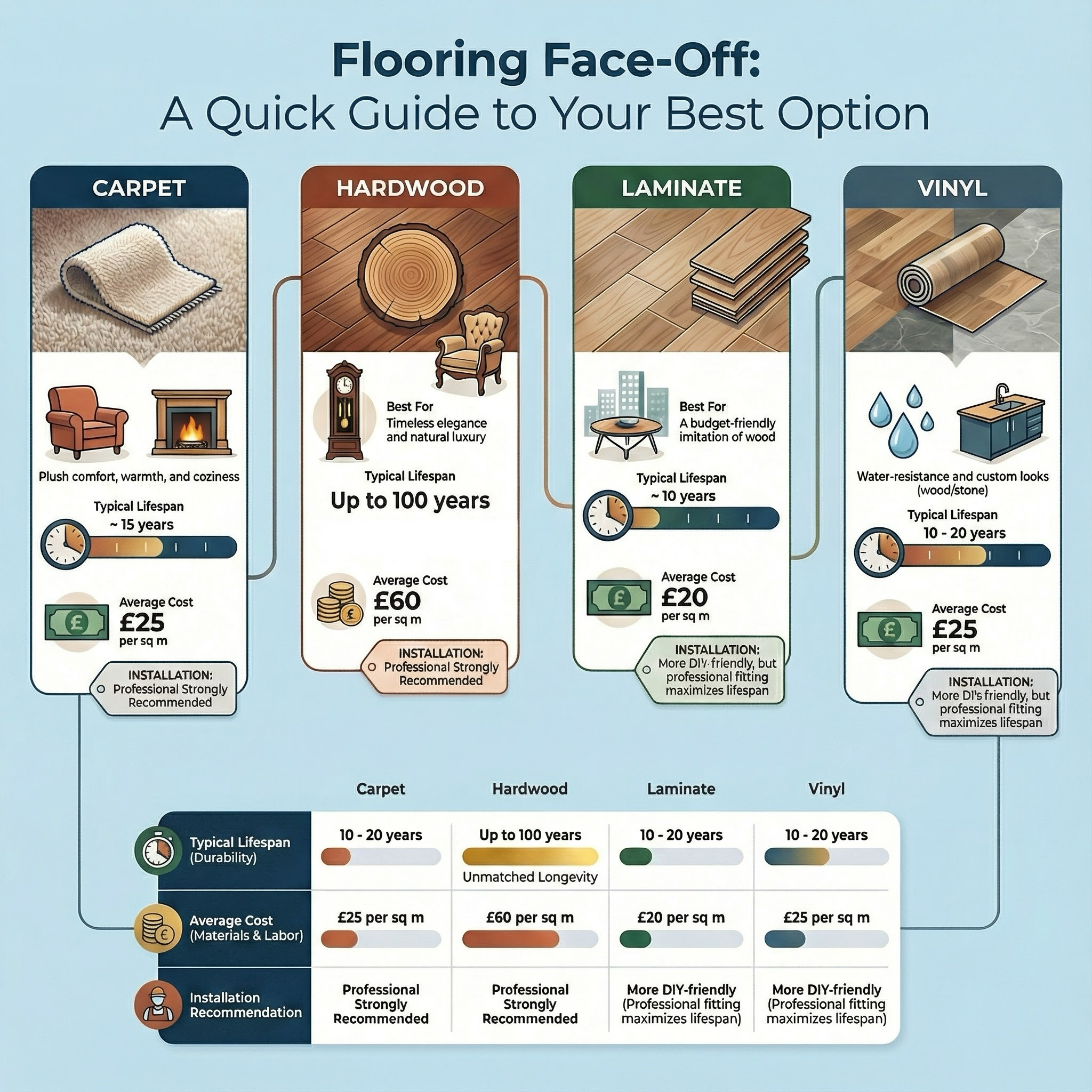
Flooring explained
Stairs need their own approach — high-traffic, visible, and a safety risk if wrong. Expect to pay £35–£250 per stair fitted in the UK depending on whether you're carpeting, wood-cladding, or fitting a runner. A typical 13-step staircase costs £450–£3,250.
Carpet: gripper rod fixed to nose and back of each tread, underlay laid, carpet stretched and tucked. Wood treads: existing tread cladded with new oak or engineered wood, riser faced separately, nosing piece mitred. Runner: central strip of carpet over wood treads, secured with stair rods. Spindles and newel posts must be cut around carefully for runners — bespoke work.
| Item | Low (£) | High (£) | Notes |
|---|---|---|---|
| Standard carpet per stair (mid-grade) | 30 | 70 | Including underlay |
| Premium wool carpet per stair | 50 | 120 | Including underlay |
| Oak tread cladding per stair | 80 | 180 | Solid oak tread, riser, nosing |
| Engineered wood treads per stair | 60 | 140 | Pre-finished engineered |
| Runner with stair rods per stair | 50 | 150 | Plus rod cost |
| Brass or chrome stair rods (each) | 15 | 50 | Per stair |
| Full staircase carpet fit (13 steps) | 450 | 1,500 | Bound stair carpet |
Carpet a 13-step staircase: 4–6 hours. Wood tread cladding: 1–2 days for 13 steps. Runner with rods: 1 day.
Professional only. Stair carpet is the highest-skill carpet job — corners, wraps and tucks all show on a stair. Wood tread cladding requires careful templating around spindles. Runner installation needs precise centring.
A carpet fitter with stair experience (not all carpet fitters do stairs). For wood treads, use a carpenter — preferably one who has done stair work before. Brass stair rods from Brass Crafts, Heritage Brass, or Tudor House.
Building Regs Part K (stairs and ramps) — minimum tread 220mm, maximum rise 220mm, max pitch 42°. Adding tread thickness must not breach these requirements. Listed buildings: heritage stair retention.
Patterned carpet hides wear and dirt; plain colours look more modern but show every mark. Stripes can make stairs feel longer or shorter.
Carpet: quieter, safer (less slip), warmer. Wood: more architectural, modern look, lasts longer. Runner is the compromise — wood underneath with central carpet runner.
Allow 5 cm per stair (tread + riser). 13 steps = approximately 6.5m running length plus 0.5m for tucking. Plus landing area.
Both decorative and functional — they hold the runner in place and create the heritage look. Modern alternative: hidden gripper system.
Carpet must be removed first. Wood treads then fit directly to the existing structural treads. Check Part K rise/tread compliance.
Painted: traditional cottage look, hides cheap timber. Varnished: shows wood grain. Painted treads with stained risers (or vice versa) is the heritage combination.
This guide was written with AI assistance and is intended for general information only. Prices are estimates based on UK averages and may vary by region. Always get at least three quotes and consult a qualified professional before starting any work.
Ask follow-ups in plain English. The AI explains options, sequencing and what to ask the flooring — so you walk in informed.
Laminate is the UK's most popular hard floor. Costs by AC rating, install methods, underlay and how long it lasts.
READ GUIDE →GuideLVT has overtaken laminate as the premium hard floor of choice. UK costs, click vs glue-down and where it suits best.
READ GUIDE →GuideEngineered wood gives the look of solid timber with greater dimensional stability. UK costs, plank sizes and finishes.
READ GUIDE →GuideSolid hardwood is the heritage gold standard. UK costs for oak, walnut and reclaimed boards, and where solid still beats engineered.
READ GUIDE →GuideParquet is the geometric wood-block floor with herringbone, chevron and basket-weave patterns. UK costs and the look's resurgence.
READ GUIDE →GuideSheet vinyl is the cheapest waterproof floor. UK costs, install methods and where modern designer vinyl beats LVT on value.
READ GUIDE →