Instant
01 · Ask
Ask the AI a follow-up
Got more questions about stone Flooring (Limestone, Travertine, Slate)? Describe the bit you're unsure about — the AI explains options, sequencing and what to ask the flooring.

Limestone, travertine or slate — natural stone, sealed and laid on a level, drained sub-base.
You've read the brief on stone Flooring (Limestone, Travertine, Slate). Now lean on us to find the right flooring — and stay in control of the job.
Got more questions about stone Flooring (Limestone, Travertine, Slate)? Describe the bit you're unsure about — the AI explains options, sequencing and what to ask the flooring.
Costs, timelines, pitfalls and the right questions to ask before any flooring starts on stone Flooring (Limestone, Travertine, Slate).
Itemised quotes from up to 3 local floorings on stone Flooring (Limestone, Travertine, Slate) — so you can compare like-for-like, not lump sums.
Ready when you are
Enter your postcode and get free quotes from local pros.
Four moves that separate a smooth job from a nightmare.
Limestone and marble etch from acidic spills (wine, vinegar, citrus). Re-seal annually.
Timber floors flex; stone tiles crack. Always use 6mm+ tile-backer board.
Porous stones (limestone) absorb stains. Seal before grouting and reapply periodically.
Marble scratches easily from grit dragged across by shoes. Use entrance mats.
Indicative UK ranges and what affects price.
By job type
Quote spread is typically ± 18% — always get 3 quotes.
Flooring quick-view
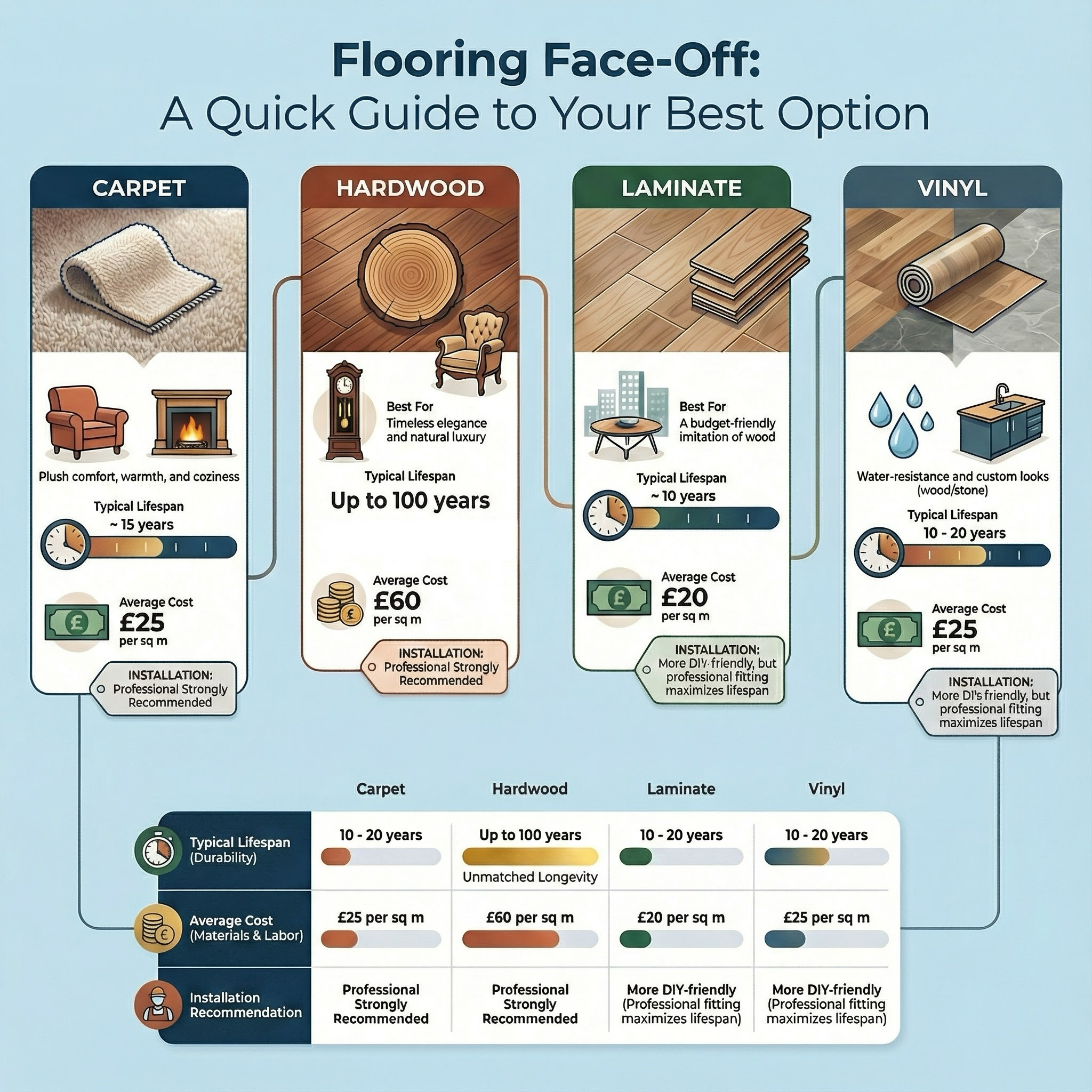
Flooring explained
Natural stone flooring — limestone, travertine, slate, marble and sandstone — is the heritage hard floor of choice for kitchens, hallways and orangeries. Expect to pay £60–£200 per m² fitted in the UK depending on stone type, finish, and slab size.
Stone is heavy (40–80 kg/m² for typical 20mm tiles). The subfloor must be checked for adequate load capacity — most timber floors need reinforcement or NoMorePly backer board. Tiles are laid like ceramic but with thicker adhesive bed and tighter joints (2–4mm). Stone is sealed with impregnating sealer before and after grouting. Periodic re-sealing every 1–3 years.
| Item | Low (£) | High (£) | Notes |
|---|---|---|---|
| Limestone tiles per m² | 30 | 90 | Honed, tumbled |
| Travertine tiles per m² | 25 | 80 | Filled or unfilled |
| Slate tiles per m² | 30 | 75 | Welsh or Indian |
| Sandstone tiles per m² | 40 | 90 | York stone, similar |
| Marble tiles per m² | 50 | 150 | Carrara, Calacatta |
| Subfloor prep (timber reinforce) | 15 | 50 | Per m² |
| Install labour per m² | 30 | 70 | More skilled than ceramic |
| Initial seal & post-grout seal | 5 | 15 | Per m² |
Kitchen 15 m² stone install: 2–3 days laying, 1 day for sealing and grouting. Add 1 day for subfloor preparation.
Professional only. Natural stone is variable — colour-matching slabs, blending tiles for visual flow, and dealing with the inherent fissures all require experience. Cracking from inadequate subfloor support is the most common defect.
A specialist stone tiler (not a general bathroom tiler). Ask to see previous stone installations. Confirm sealing system — Lithofin, Aqua-Mix, Fila are the UK brands. Insist on pre-grout sealing of porous stones like limestone.
Building Regs Part E (acoustic) — stone is dense but transmits impact noise; use acoustic underlay in flats. No specific stone regulations otherwise.
Limestone (tumbled or honed) is the classic UK kitchen stone. Slate is more durable. Marble is decadent but stains easily. Travertine is mid-range and forgiving.
Stone is the ideal floor for UFH — conducts heat brilliantly. Use flexible adhesive to accommodate thermal movement.
Yes — all natural stone needs impregnating sealer before grouting and periodic re-sealing (annually for high-traffic; every 2–3 years for lower use).
Real stone has natural variation, true depth, can be honed/repolished. Porcelain stone-effect is cheaper, lower-maintenance, more uniform. Most homeowners can't tell from 1m away.
Quality limestone, slate or marble: 50–100+ years. Travertine: 30–50. Many heritage stone floors are centuries old.
Yes — most stones (sealed) are suitable. Marble can dull from soap residue. Slate is best in wet rooms — naturally non-slip when textured.
This guide was written with AI assistance and is intended for general information only. Prices are estimates based on UK averages and may vary by region. Always get at least three quotes and consult a qualified professional before starting any work.
Ask follow-ups in plain English. The AI explains options, sequencing and what to ask the flooring — so you walk in informed.
Laminate is the UK's most popular hard floor. Costs by AC rating, install methods, underlay and how long it lasts.
READ GUIDE →GuideLVT has overtaken laminate as the premium hard floor of choice. UK costs, click vs glue-down and where it suits best.
READ GUIDE →GuideEngineered wood gives the look of solid timber with greater dimensional stability. UK costs, plank sizes and finishes.
READ GUIDE →GuideSolid hardwood is the heritage gold standard. UK costs for oak, walnut and reclaimed boards, and where solid still beats engineered.
READ GUIDE →GuideParquet is the geometric wood-block floor with herringbone, chevron and basket-weave patterns. UK costs and the look's resurgence.
READ GUIDE →GuideSheet vinyl is the cheapest waterproof floor. UK costs, install methods and where modern designer vinyl beats LVT on value.
READ GUIDE →