Instant
01 · Ask
Ask the AI a follow-up
Got more questions about subfloor Preparation? Describe the bit you're unsure about — the AI explains options, sequencing and what to ask the flooring.

Level, dry and sound — the bit that decides whether laminate, tile or LVT lasts 10 or 25 years.
You've read the brief on subfloor Preparation. Now lean on us to find the right flooring — and stay in control of the job.
Got more questions about subfloor Preparation? Describe the bit you're unsure about — the AI explains options, sequencing and what to ask the flooring.
Costs, timelines, pitfalls and the right questions to ask before any flooring starts on subfloor Preparation.
Itemised quotes from up to 3 local floorings on subfloor Preparation — so you can compare like-for-like, not lump sums.
Ready when you are
Enter your postcode and get free quotes from local pros.
Four moves that separate a smooth job from a nightmare.
Wood and laminate cup within 6 months. Always test moisture.
Bumps and dips telegraph through laminate as hollow sounds and click failures. Self-level to 3mm in 2m.
6mm minimum for tile; 18mm structural ply for stability over springy joists.
Always lift and inspect existing timber subfloors. Treat or replace damaged boards.
Indicative UK ranges and what affects price.
By job type
Quote spread is typically ± 18% — always get 3 quotes.
Flooring quick-view
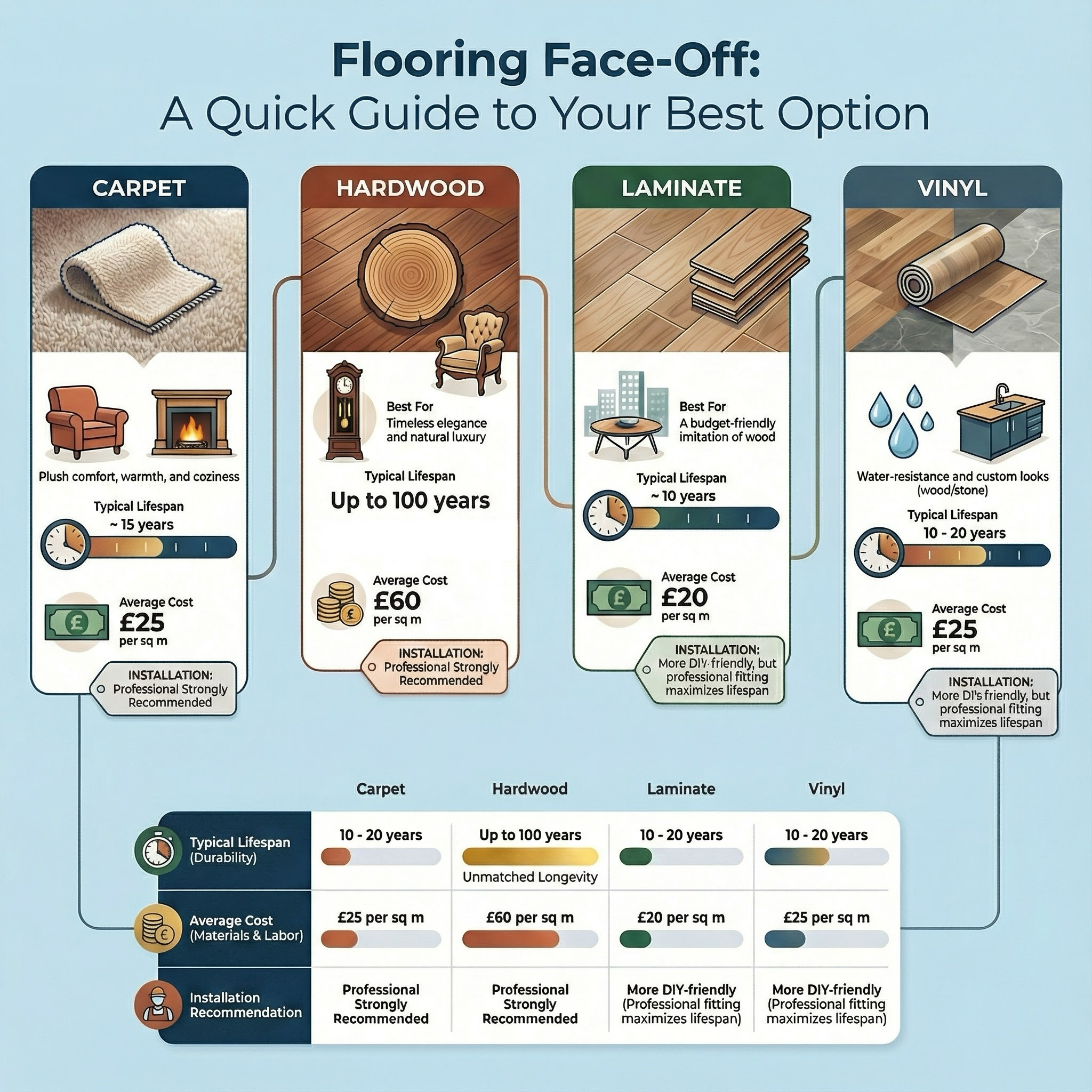
Flooring explained
A flat, dry, sound subfloor is the foundation of every successful floor install. Skipped or rushed subfloor prep is the single biggest cause of premature floor failure in UK homes. Expect to pay £8–£40 per m² for proper subfloor preparation depending on the work needed.
The fitter checks the existing subfloor for: flatness (3mm in 2m for most floors; 1mm for large-format tile or LVT), moisture (max 3% CM for concrete; 18% for timber), soundness (loose boards or cracks fixed), and damp ingress. Common remedies: self-levelling compound (3–10mm thick to smooth concrete), ply-lining (6mm tile-backer or 18mm WBP over timber joists), DPM (liquid epoxy moisture barrier on damp concrete).
| Item | Low (£) | High (£) | Notes |
|---|---|---|---|
| Self-levelling 3–5mm per m² | 10 | 25 | Concrete subfloor |
| Self-levelling 5–10mm per m² | 15 | 35 | Heavier dips |
| Ply-lining (6mm) per m² | 12 | 25 | For tile-on-timber |
| WBP ply (18mm) per m² | 20 | 40 | Structural overlay |
| Liquid DPM epoxy per m² | 15 | 30 | Two-coat moisture barrier |
| Board fixing & repair per m² | 8 | 20 | Loose boards screwed down |
| Moisture meter test | 0 | 50 | Free with most quotes |
Self-levelling 20 m²: 4 hours work, 24 hours cure. Ply-lining 20 m²: 1 day. DPM epoxy: 1 day. Total prep often 1–2 days before the finish floor goes down.
Self-levelling is DIY-able with care. Moisture testing and DPM application are professional — moisture content is critical and easy to get wrong.
The flooring fitter normally handles subfloor prep. Always insist on a moisture test before any wood or vinyl floor is laid — cheap fitters skip this step and the floor fails. Get the moisture reading in writing.
No specific regulations. Manufacturer warranties on flooring are usually void if substrate prep doesn't meet their spec.
3mm in 2m for laminate, vinyl, carpet. 1mm in 2m for LVT and large-format tile (600 × 1200mm+).
Yes — Ardex, Mapei or Sika compounds are user-friendly. The trick is mixing to the right consistency and finishing the edges.
Damp-Proof Membrane. Either a plastic sheet under the slab (during construction) or a liquid epoxy applied to existing concrete to block residual moisture.
Concrete: pin-type moisture meter or hygrometer test (best). Timber: pin-type meter. Or hire a Tramex CME4 from local hire shop.
Yes — within 6–18 months typically. Wood cups, laminate joints fail, vinyl bubbles, tile cracks. Subfloor prep is the most important step.
For tile and LVT yes — chipboard moves too much. For laminate and carpet, sound chipboard is fine.
This guide was written with AI assistance and is intended for general information only. Prices are estimates based on UK averages and may vary by region. Always get at least three quotes and consult a qualified professional before starting any work.
Ask follow-ups in plain English. The AI explains options, sequencing and what to ask the flooring — so you walk in informed.
Laminate is the UK's most popular hard floor. Costs by AC rating, install methods, underlay and how long it lasts.
READ GUIDE →GuideLVT has overtaken laminate as the premium hard floor of choice. UK costs, click vs glue-down and where it suits best.
READ GUIDE →GuideEngineered wood gives the look of solid timber with greater dimensional stability. UK costs, plank sizes and finishes.
READ GUIDE →GuideSolid hardwood is the heritage gold standard. UK costs for oak, walnut and reclaimed boards, and where solid still beats engineered.
READ GUIDE →GuideParquet is the geometric wood-block floor with herringbone, chevron and basket-weave patterns. UK costs and the look's resurgence.
READ GUIDE →GuideSheet vinyl is the cheapest waterproof floor. UK costs, install methods and where modern designer vinyl beats LVT on value.
READ GUIDE →