Instant
01 · Ask
Ask the AI a follow-up
Got more questions about cavity Wall Insulation? Describe the bit you're unsure about — the AI explains options, sequencing and what to ask the insulation.

Blown bead, mineral wool or foam injected into cavity — cuts heating bills 20–30% in suitable homes.
You've read the brief on cavity Wall Insulation. Now lean on us to find the right insulation — and stay in control of the job.
Got more questions about cavity Wall Insulation? Describe the bit you're unsure about — the AI explains options, sequencing and what to ask the insulation.
Costs, timelines, pitfalls and the right questions to ask before any insulation starts on cavity Wall Insulation.
Itemised quotes from up to 3 local insulations on cavity Wall Insulation — so you can compare like-for-like, not lump sums.
Ready when you are
Enter your postcode and get free quotes from local pros.
Four moves that separate a smooth job from a nightmare.
This usually occurs if the cavity was already full of debris (rubble) or if the property is in an area of extreme wind-driven rain.
If the drill pattern is too sparse, "cold spots" can form, leading to localised condensation.
Failure to sleeve air bricks can lead to poor sub-floor ventilation and eventual dry rot in timber floors.
Poorly matched mortar can leave the house looking like it has "measles" with visible drill spots.
Indicative UK ranges and what affects price.
By job type
Quote spread is typically ± 18% — always get 3 quotes.
Insulation quick-view
Insulation explained
Most UK properties built between 1920 and 1990 were designed with a cavity that was originally left empty. Filling this void creates a thermal barrier, making your home easier to heat in winter and cooler in summer while reducing your carbon footprint.
Prices vary based on the size of your property and the type of material used. Bonded beads are generally more expensive than mineral wool but offer superior thermal performance and moisture resistance.
| Property Type | Low £ | High £ | Notes |
|---|---|---|---|
| Flat / Apartment | £450 | £700 | Assumes ground or first-floor access. |
| Mid-Terrace House | £600 | £900 | Front and rear elevations only. |
| Semi-Detached House | £900 | £1,400 | The most common UK installation type. |
| Detached House | £1,600 | £2,800 | Price scales with total wall surface area. |
| Borescope Survey | £0 | £150 | Often free if the installation proceeds. |
Costs are influenced by property height (scaffolding requirements), the width of the cavity, and your geographical location. Prices listed include VAT at the standard rate, though some energy-saving measures may qualify for 0% VAT under current UK government incentives.
Cavity wall insulation must be installed by a professional. It requires specialist blowing equipment and a technical understanding of building physics to prevent future damp issues.
Attempting to fill a cavity yourself can lead to "bridging," where moisture travels from the outer leaf to the inner leaf, causing severe rising or penetrating damp that is incredibly expensive to rectify.
Furthermore, without a professional installation, you will not receive a CIGA (Cavity Insulation Guarantee Agency) certificate, which is essential when selling your home.
If your home was built after 1920, it likely has cavities. Look at your brickwork: if the bricks are all the same length (stretcher bond), you have a cavity. If you see some bricks end-on (header bond), you likely have solid walls.
When installed correctly in a suitable property, it will not cause damp. However, if your walls have existing cracks or the cavity is bridged by rubble, moisture can transfer to the interior. A proper pre-install survey is vital to avoid this.
Under the UK government's ECO4 or Great British Insulation Scheme, many households (particularly those on certain benefits or in lower council tax bands) may qualify for free or heavily subsidised insulation.
Bonded polystyrene beads are generally considered superior as they do not settle over time and allow the cavity to "breathe" better, making them safer for homes in wetter climates.
According to the Energy Saving Trust, a typical semi-detached house can save between £200 and £300 per year at current energy prices, meaning the measure often pays for itself within 4–5 years.
This guide was written with AI assistance and is intended for general information only. Prices are estimates based on UK averages and may vary by region. Always get at least three quotes and consult a qualified professional before starting any work.
Ask follow-ups in plain English. The AI explains options, sequencing and what to ask the insulation — so you walk in informed.
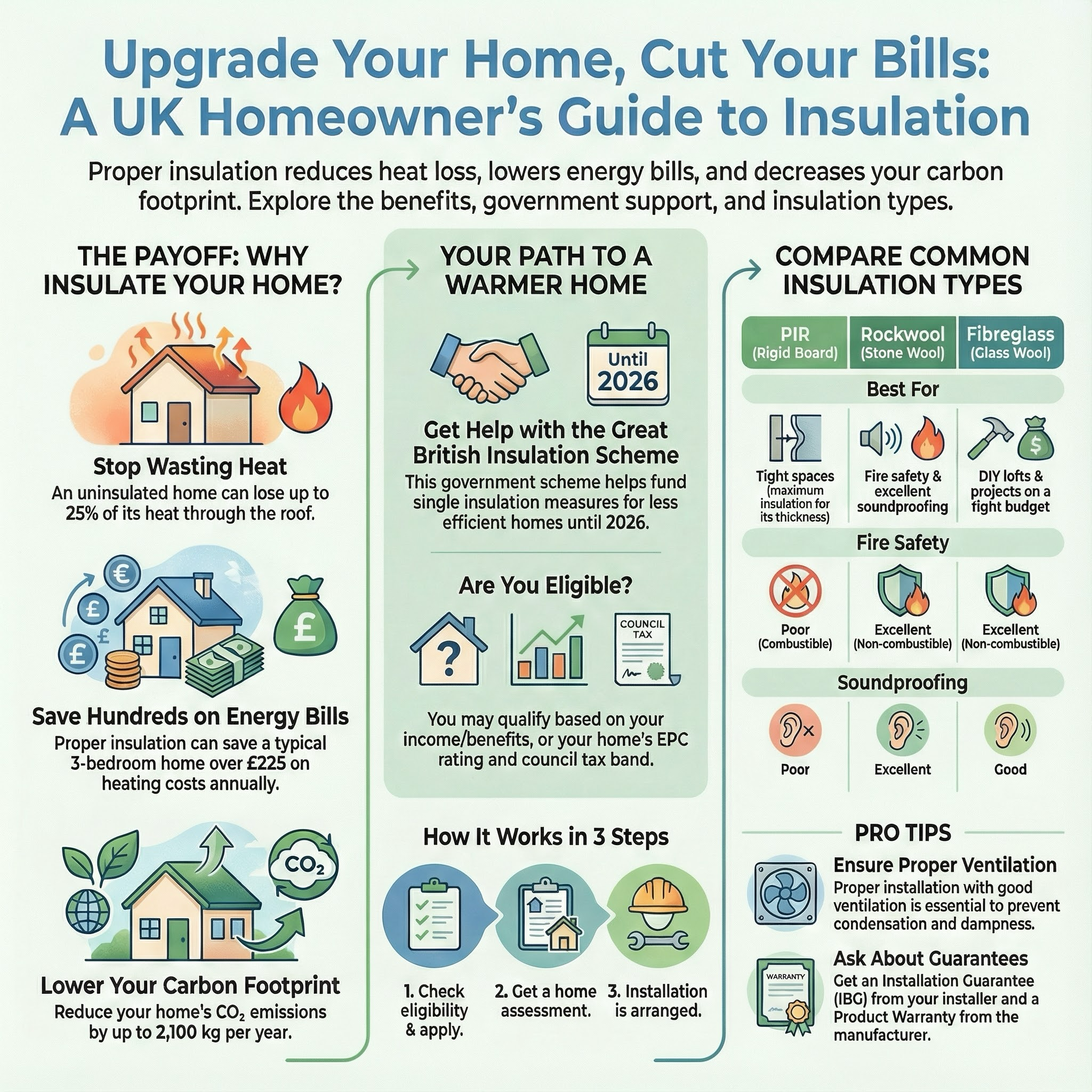
UK homes lose approximately 25% of their heat through an uninsulated roof. Installing high-quality insulation is one of the most effective ways to lower your en...
READ GUIDE →GuideWhether you are dealing with noisy neighbours in a terraced house or trying to create a quiet home office, professional soundproofing is a transformative invest...
READ GUIDE →GuideSuspended timber floors are a common feature in UK homes built before the 1950s. While they provide necessary ventilation for the building's structure, they are...
READ GUIDE →GuideAcoustic panels have transitioned from professional recording studios into the heart of modern UK homes. As open-plan living and hard flooring become more preva...
READ GUIDE →GuideInternal wall insulation (IWI) is a transformative upgrade for the millions of UK homes built with solid walls, typically those constructed before 1930. Unlike ...
READ GUIDE →GuideInsulating a solid concrete floor is one of the most effective ways to stop heat escaping through the ground in UK properties, particularly those built before t...
READ GUIDE →