Instant
01 · Ask
Ask the AI a follow-up
Got more questions about solid Floor Insulation? Describe the bit you're unsure about — the AI explains options, sequencing and what to ask the insulation.

Concrete floor insulation — under-screed PIR or above-screed multi-layer — for kitchens, extensions and conversions.
You've read the brief on solid Floor Insulation. Now lean on us to find the right insulation — and stay in control of the job.
Got more questions about solid Floor Insulation? Describe the bit you're unsure about — the AI explains options, sequencing and what to ask the insulation.
Costs, timelines, pitfalls and the right questions to ask before any insulation starts on solid Floor Insulation.
Itemised quotes from up to 3 local insulations on solid Floor Insulation — so you can compare like-for-like, not lump sums.
Ready when you are
Enter your postcode and get free quotes from local pros.
Four moves that separate a smooth job from a nightmare.
Adding insulation on top of a slab can raise the floor by 70mm–100mm, meaning doors must be planed and radiators moved upwards.
If the floor DPM is not properly integrated with the wall's Damp Proof Course (DPC), moisture can be "pushed" into the walls.
Using the wrong type of insulation can cause the floor to "bounce" or sink under the weight of heavy furniture.
Gaps between boards or at the edges allow cold spots to form, leading to localised condensation and skirting board rot.
Indicative UK ranges and what affects price.
By job type
Quote spread is typically ± 18% — always get 3 quotes.
Insulation quick-view
Insulation explained
For most UK homeowners, this process involves laying high-performance rigid insulation boards over the existing concrete or, in more extensive renovations, digging up the floor to install insulation beneath a new slab. This guide focuses on the practicalities, costs, and regulations involved in upgrading your solid floor's thermal performance.
The cost of solid floor insulation varies significantly depending on whether you are laying insulation on top of the existing slab or excavating the floor to maintain ceiling heights. Prices below include professional labour and materials for 2025/26.
| Item | Low £ | High £ | Notes |
|---|---|---|---|
| Over-slab Insulation (per m²) | £75 | £110 | Includes PIR boards, DPM, and chipboard finish. |
| Full Excavation & Re-pour (per m²) | £160 | £250 | Digging out old concrete, new hardcore, insulation, and screed. |
| Damp Proof Membrane (DPM) | £150 | £300 | Fixed cost for materials and installation in a standard room. |
| Skilled Labour (per day) | £250 | £400 | Specialist insulation or flooring contractor. |
| Waste Removal (Skip hire) | £250 | £450 | Necessary if removing old screed or concrete. |
Factors that influence the final price include the thickness of the insulation required to meet Building Regulations, the need to trim doors or raise skirting boards, and the type of final floor finish selected.
While laying insulation boards is theoretically a DIY-friendly task, the implications of getting it wrong are severe. Incorrectly installed DPMs can lead to rising damp, while poor joint sealing creates "thermal bridges" that encourage mould growth at the base of walls.
Professional installation is highly recommended to ensure compliance with UK Building Regulations and to manage the technical challenges of floor heights and door clearances.
Solid floor insulation is covered by Building Regulations Part L (Conservation of Fuel and Power). If you are "renovating" more than 50% of a floor's surface, you are legally required to upgrade the insulation to meet current standards.
It won't make the room narrower, but it will reduce the floor-to-ceiling height. Typically, you will lose between 75mm and 125mm of height depending on the thickness of the insulation and the topping used.
Yes. Even if your concrete slab seems dry, moisture vapour can rise through it. Without a DPM, this moisture gets trapped under your insulation or flooring, leading to mould, smells, and structural damage.
No, you cannot lay carpet directly onto insulation boards. You must install a load-bearing layer, such as 18mm or 22mm moisture-resistant chipboard or a fibre-reinforced screed, before laying your final floor covering.
For a typical semi-detached house, you can expect to save between £80 and £150 per year. However, the primary benefit is the significant increase in comfort and the reduction in draughts.
PIR (Polyisocyanurate) boards, such as those made by Celotex or Kingspan, are the UK industry standard because they offer high thermal resistance with minimal thickness.
This guide was written with AI assistance and is intended for general information only. Prices are estimates based on UK averages and may vary by region. Always get at least three quotes and consult a qualified professional before starting any work.
Ask follow-ups in plain English. The AI explains options, sequencing and what to ask the insulation — so you walk in informed.
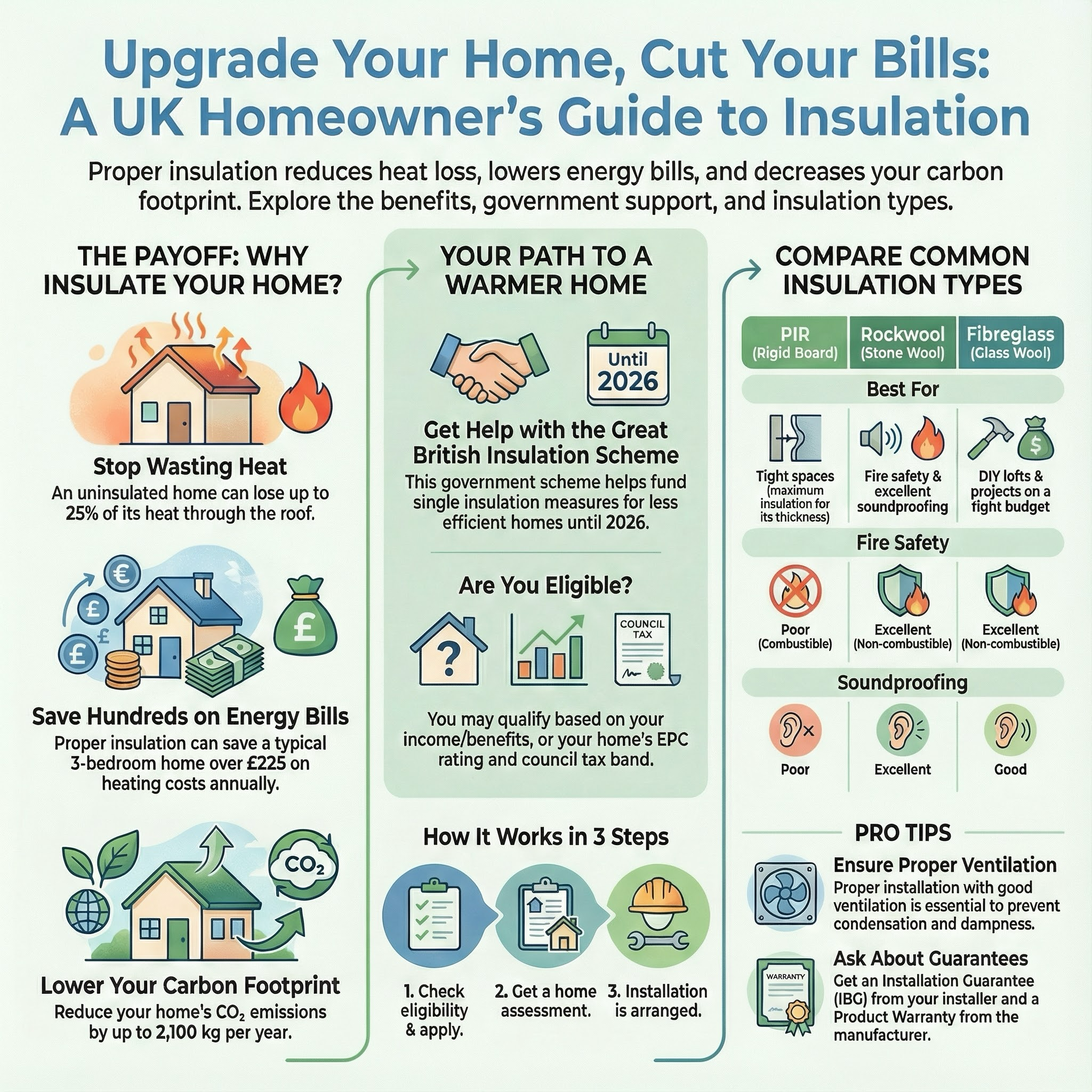
UK homes lose approximately 25% of their heat through an uninsulated roof. Installing high-quality insulation is one of the most effective ways to lower your en...
READ GUIDE →GuideWhether you are dealing with noisy neighbours in a terraced house or trying to create a quiet home office, professional soundproofing is a transformative invest...
READ GUIDE →GuideSuspended timber floors are a common feature in UK homes built before the 1950s. While they provide necessary ventilation for the building's structure, they are...
READ GUIDE →GuideCavity wall insulation is one of the most cost-effective ways to improve your home’s energy efficiency. By filling the gap between your inner and outer walls, y...
READ GUIDE →GuideAcoustic panels have transitioned from professional recording studios into the heart of modern UK homes. As open-plan living and hard flooring become more preva...
READ GUIDE →GuideInternal wall insulation (IWI) is a transformative upgrade for the millions of UK homes built with solid walls, typically those constructed before 1930. Unlike ...
READ GUIDE →