Instant
01 · Ask
Ask the AI a follow-up
Got more questions about soundproofing Installation? Describe the bit you're unsure about — the AI explains options, sequencing and what to ask the insulation.

Wall, ceiling or floor soundproofing — measured dB reduction, by acoustic insulation specialists.
You've read the brief on soundproofing Installation. Now lean on us to find the right insulation — and stay in control of the job.
Got more questions about soundproofing Installation? Describe the bit you're unsure about — the AI explains options, sequencing and what to ask the insulation.
Costs, timelines, pitfalls and the right questions to ask before any insulation starts on soundproofing Installation.
Itemised quotes from up to 3 local insulations on soundproofing Installation — so you can compare like-for-like, not lump sums.
Ready when you are
Enter your postcode and get free quotes from local pros.
Four moves that separate a smooth job from a nightmare.
You soundproof the wall, but the sound travels through the floorboards or the ceiling void instead.
Using the wrong fixings that bridge the gap between the soundproofing layer and the original wall.
A heavily soundproofed wall is useless if the room has a standard hollow-core door with a large gap at the bottom.
Making a room "airtight" for sound can lead to condensation if mechanical ventilation isn't considered.
Indicative UK ranges and what affects price.
By job type
Quote spread is typically ± 18% — always get 3 quotes.
Insulation quick-view
Insulation explained
Effective soundproofing isn't just about adding thickness; it involves a combination of adding mass, improving absorption, and "decoupling" structures to stop vibrations. This guide explores the costs, methods, and regulations involved in soundproofing your UK home.
| Item | Low £ | High £ | Notes |
|---|---|---|---|
| Party Wall (Direct to wall) | £1,400 | £2,200 | Per average 12m² wall; basic mass-loaded vinyl/board. |
| Independent Stud Wall | £2,000 | £3,500 | The "Gold Standard" for noise; requires 100mm+ room loss. |
| Acoustic Ceiling (Dropped) | £1,800 | £3,000 | Includes resilient bars and mineral wool. |
| Floor Soundproofing | £800 | £1,800 | Acoustic underlays or "floating" floor systems. |
| Labour (Daily Rate) | £250 | £400 | Per person; usually requires a two-person team. |
Prices include VAT and high-quality materials. Costs vary significantly based on the "room-within-a-room" approach versus simple board overlays, as well as your location in the UK.
Pro Tip: Sound acts like water. If there is a gap for air to pass through, sound will find it. Cutting corners on sealants can render expensive acoustic boards almost useless.
While DIYers can install basic acoustic panels, structural soundproofing is best left to professionals. Incorrectly driving a single screw through a resilient bar into a stud "short-circuits" the system, allowing vibrations to bypass the insulation entirely.
Furthermore, any work involving electrical socket relocation must comply with Part P regulations, and changes to ceilings must maintain the fire integrity of the room.
A basic high-mass board system takes up about 30mm-50mm. A high-performance independent stud wall will take up roughly 100mm-150mm of your floor space.
Yes, airborne noises like shouting or the TV are highly treatable. An independent wall or a resilient bar system can typically reduce this noise by 50% to 70%.
Bass is the hardest sound to stop because the wavelengths are so long. It requires significant mass and deep decoupling to be effective.
No. Foam "egg crates" are for acoustic treatment (stopping echoes inside a room); they have almost zero effect on stopping sound from entering or leaving a room.
For most internal retrofits in a single-family home, no. However, if you are converting a house into flats, you must meet strict Part E standards and undergo sound testing.
This guide was written with AI assistance and is intended for general information only. Prices are estimates based on UK averages and may vary by region. Always get at least three quotes and consult a qualified professional before starting any work.
Ask follow-ups in plain English. The AI explains options, sequencing and what to ask the insulation — so you walk in informed.
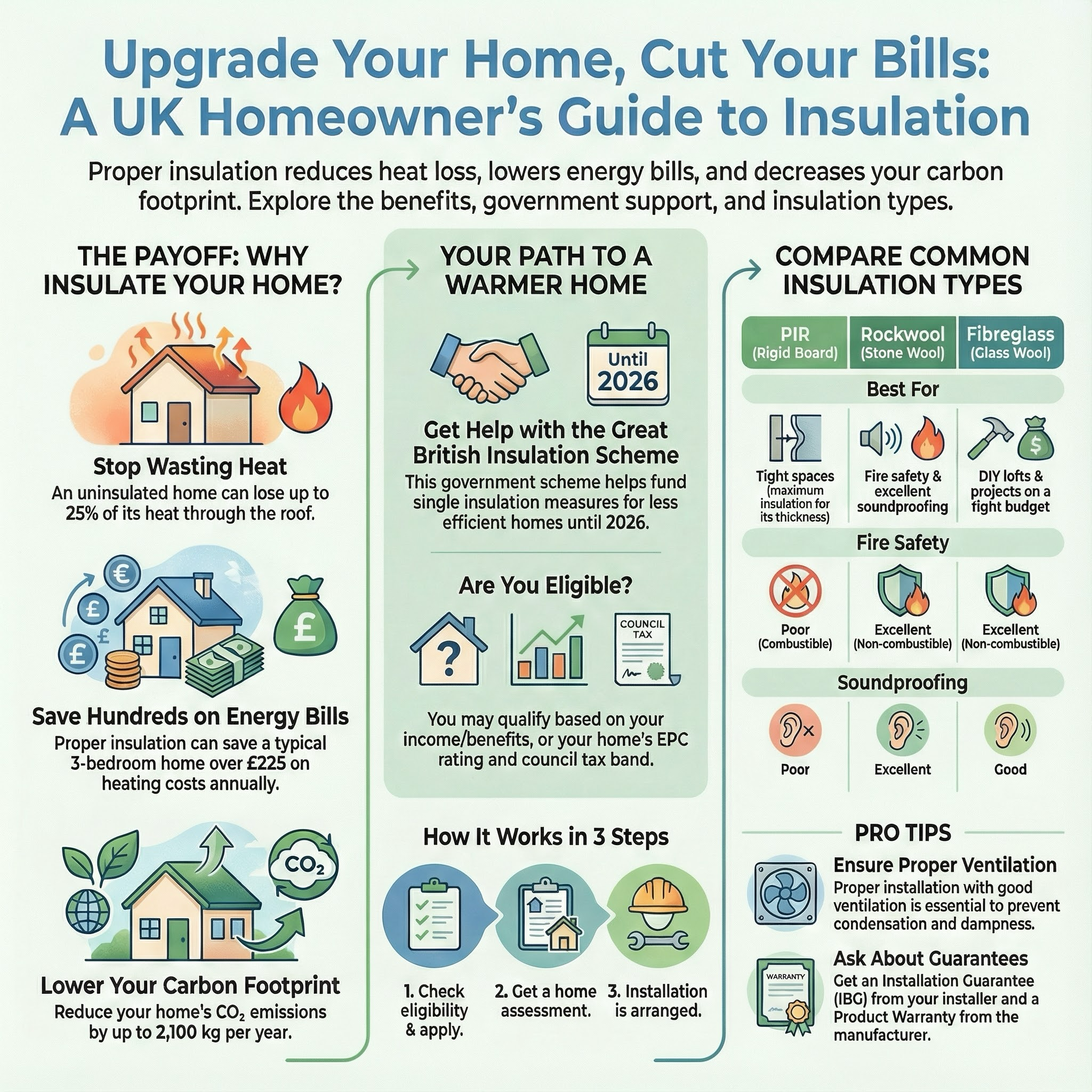
UK homes lose approximately 25% of their heat through an uninsulated roof. Installing high-quality insulation is one of the most effective ways to lower your en...
READ GUIDE →GuideSuspended timber floors are a common feature in UK homes built before the 1950s. While they provide necessary ventilation for the building's structure, they are...
READ GUIDE →GuideCavity wall insulation is one of the most cost-effective ways to improve your home’s energy efficiency. By filling the gap between your inner and outer walls, y...
READ GUIDE →GuideAcoustic panels have transitioned from professional recording studios into the heart of modern UK homes. As open-plan living and hard flooring become more preva...
READ GUIDE →GuideInternal wall insulation (IWI) is a transformative upgrade for the millions of UK homes built with solid walls, typically those constructed before 1930. Unlike ...
READ GUIDE →GuideInsulating a solid concrete floor is one of the most effective ways to stop heat escaping through the ground in UK properties, particularly those built before t...
READ GUIDE →