Instant
01 · Ask
Cavity, loft or solid wall?
Different house ages, different methods. Describe the property and the AI tells you which insulation type and grants apply.

Loft, cavity wall, underfloor and spray foam — quoted with U-value, grant eligibility and payback.
Read the brief on cavity surveys, grants and PAS 2035 — then let Three local installers quote.
Different house ages, different methods. Describe the property and the AI tells you which insulation type and grants apply.
U-values, ECO4 eligibility, PAS 2035, CIGA guarantee, breathability rules. Know what to ask for.
Three local installers quote on the same spec — survey, depth, materials, guarantee — so the warmth is real, not on paper.
Ready when you are
Enter your postcode and get free quotes from local pros.
Four moves that separate a smooth job from a nightmare.
Some cavities can't be filled — too narrow, exposed walls, wind-driven rain zones. A reputable installer surveys before quoting; cowboys don't.
Building Regs require 270mm of mineral wool (or equivalent). Older lofts often have 100mm or less. Top-up is cheap and pays back in a year.
External or internal solid-wall insulation can trap moisture. PAS 2035 retrofit assessment first — skip this and the wall rots from the inside.
ECO4 covers full insulation costs for qualifying households. Check before paying — many installers won't mention it because it caps their margin.
Indicative UK ranges and what affects price.
By job type
Quote spread is typically ± 18% — always get 3 quotes.
Visual breakdown of costs, timelines and the questions you should be asking.
Insulation quick-view
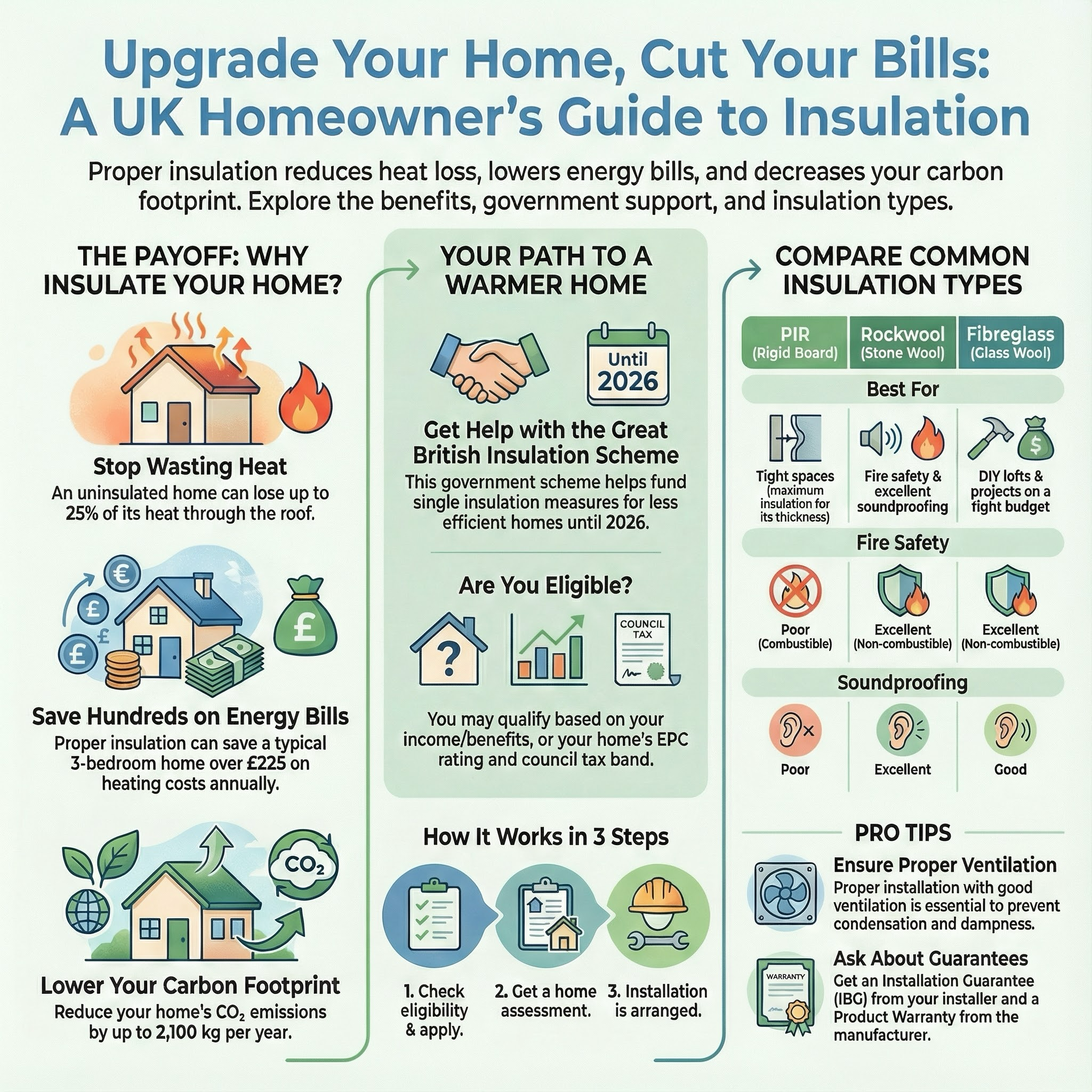
Insulation explained
Everything you need to know before hiring a insulation.
Insulation is one of the most effective ways to reduce energy bills and improve the comfort of your home. In the UK, where many properties feature ageing brickwork and draughty lofts, professional insulation installers provide a critical service in making homes more thermally efficient and sustainable.
Specialist installers work across various areas of the property, from the foundations to the rafters. Whether you are looking to top up existing loft insulation, fill cavity walls, or install advanced spray foam solutions, these tradespeople ensure your home meets modern thermal standards while maintaining essential ventilation.
Beyond simple heat retention, professional insulation helps with soundproofing and prevents issues such as damp and mould caused by condensation. With fluctuating energy prices and government initiatives like the ECO4 scheme, hiring a qualified expert is a direct investment in your property's long-term value and EPC rating.
The process of insulating a home is more technical than it first appears. Here is the typical journey when you hire a professional:
While rolling out loft insulation is a common DIY task, many insulation projects require professional expertise to avoid structural damage. Incorrectly installed insulation can lead to interstitial condensation, where moisture becomes trapped within your walls or roof, eventually causing timber rot or damp patches on internal decorations.
Professional installers understand Building Regulations Part L, which dictates the thermal performance standards required for UK homes. They are also trained to handle specialist equipment, such as the high-pressure pumps used for cavity wall beads or the protective gear required for spray foam application. Furthermore, many energy grants and insurance-backed guarantees are only available if the work is carried out by a registered professional under the PAS 2035 framework.
Costs for insulation vary significantly depending on the size of your property, the accessibility of the area, and the materials used. Below are realistic estimates for 2025/26 UK pricing including VAT and labour.
| Service | Low £ | High £ | Notes |
|---|---|---|---|
| Loft Insulation (Top-up) | £400 | £900 | Adding 100mm-200mm to existing layers. |
| Cavity Wall Insulation | £1,200 | £3,500 | Based on a standard semi-detached or detached home. |
| Underfloor Insulation | £1,500 | £4,000 | Suspended timber floors via crawl space. |
| Spray Foam (Roof) | £2,500 | £6,000 | Price depends on open vs closed cell foam. |
| Solid Wall (Internal) | £5,000 | £12,000 | Involves fitting boards and re-plastering. |
Prices are influenced by the complexity of the job. For example, if your loft requires "boarding out" on stilts to preserve the insulation's effectiveness, or if old, failing cavity wall insulation needs to be extracted first, labour costs will increase significantly.
Choosing the right trade professional is essential to ensure your home remains breathable and safe. Follow these steps to find a reputable installer:
Questions to ask before hiring:
Many UK homeowners are eligible for free or subsidised insulation through the ECO4 or Great British Insulation Scheme. Eligibility usually depends on your household income, whether you receive certain benefits, or the current EPC rating of your home (usually D or below).
Some mortgage lenders are cautious about spray foam insulation, particularly if it was applied to the roof timbers without a proper survey. If you are considering spray foam, ensure you use a reputable installer who provides a full pre-install structural report and uses "open-cell" foam where appropriate to allow timbers to breathe.
Loft insulation is one of the fastest-paying investments, often recouping its cost in energy savings within 2 to 3 years. Cavity wall insulation typically pays for itself within 5 years, depending on your heating system and usage habits.
Open-cell foam is flexible and breathable, making it more suitable for residential roof spaces to prevent timber rot. Closed-cell foam is rigid and provides better structural strength and a higher U-value, but it acts as a vapour barrier and is generally more suited to industrial applications or specific flood-prone areas.
Describe the job in plain English. The AI asks a few smart questions, then tells you whether a insulation is the right call, what it should cost, and what to ask before they start.
GBIS ends 31 March 2026. UK last chance insulation guide.
READ GUIDE →GuideLoft, cavity wall, underfloor, internal or external — every UK insulation upgrade with costs, paybacks and grant eligibility.
READ GUIDE →GuideLoft insulation is one of the most cost-effective ways to improve your home’s energy efficiency and slash heating bills. With approximately 25% of a home’s heat...
READ GUIDE →GuideWarm Homes Plan replaces ECO4 January 2027. UK guide.
READ GUIDE →Acoustic panels have transitioned from professional recording studios into the heart of modern UK homes. As open-plan living and hard flooring become more preva...
READ GUIDE →GuideWhether you are dealing with noisy neighbours in a terraced house or trying to create a quiet home office, professional soundproofing is a transformative invest...
READ GUIDE →