Instant
01 · Ask
Ask the AI a follow-up
Got more questions about commercial Oven Maintenance? Describe the bit you're unsure about — the AI explains options, sequencing and what to ask the oven cleaning.

Annual or quarterly commercial oven service — burner check, deep clean and re-calibration.
You've read the brief on commercial Oven Maintenance. Now lean on us to find the right oven cleaning — and stay in control of the job.
Got more questions about commercial Oven Maintenance? Describe the bit you're unsure about — the AI explains options, sequencing and what to ask the oven cleaning.
Costs, timelines, pitfalls and the right questions to ask before any oven cleaning starts on commercial Oven Maintenance.
Itemised quotes from up to 3 local oven cleanings on commercial Oven Maintenance — so you can compare like-for-like, not lump sums.
Ready when you are
Enter your postcode and get free quotes from local pros.
Four moves that separate a smooth job from a nightmare.
Often caused by failing thermostats or damaged door seals; this can lead to undercooked food and health violations.
Usually a sign of a blocked injector or a failing thermocouple, requiring immediate professional attention.
In convection ovens, this often points to a failing fan motor or a build-up of debris on the fan blades.
Typically caused by carbonised food waste on the floor of the oven or around the elements, posing a significant fire risk.
Indicative UK ranges and what affects price.
By job type
Quote spread is typically ± 18% — always get 3 quotes.
Oven Cleaning quick-view
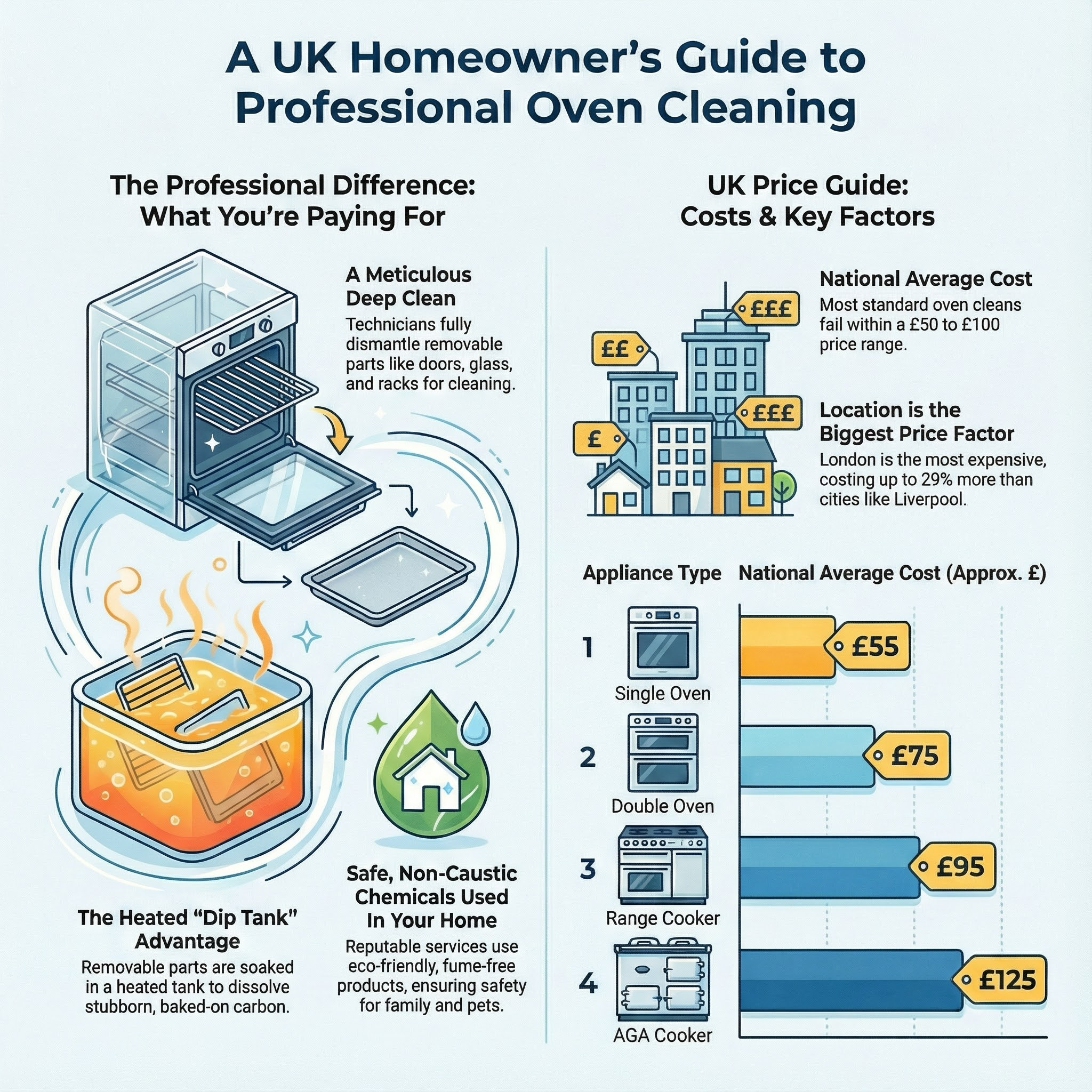
Oven Cleaning explained
Professional maintenance goes beyond a surface wipe-down. It ensures your equipment operates at peak efficiency, maintains food safety standards, and complies with strict UK insurance and fire safety regulations.
| Item | Low £ | High £ | Notes |
|---|---|---|---|
| Standard Service Call-out | £110 | £170 | Includes first hour of diagnostics/labour. |
| Hourly Labour Rate | £65 | £95 | Charged after the first hour. |
| Full Maintenance & Deep Clean | £250 | £550 | Price varies by oven size (e.g., 6-burner vs. 20-rack). |
| Replacement Door Seals | £40 | £120 | Per seal, depending on brand and model. |
| Replacement Heating Element | £80 | £220 | Cost of part plus fitting time. |
Prices are influenced primarily by the type of oven (gas vs. electric) and the complexity of the brand. High-end rational or combination ovens often require specialist technicians and more expensive OEM parts compared to standard convection models.
Commercial oven maintenance is strictly a professional-only task. In the UK, it is a legal requirement for anyone working on gas-fired catering equipment to be Gas Safe Registered with the specific "COMCAT" qualification.
Attempting DIY repairs on commercial equipment will likely void your manufacturer warranty and, more importantly, your business premises insurance.
Electrical commercial ovens also require professional attention due to the high voltages and three-phase power supplies often involved. A qualified technician ensures the unit meets Electricity at Work Regulations 1989.
3 Questions to Ask:
Most manufacturers and insurance providers recommend a full professional service every 6 to 12 months. High-volume kitchens may require quarterly inspections to prevent breakdowns during peak seasons.
A CP42 is a Commercial Catering Gas Safety Inspection report. If you have gas appliances in a commercial kitchen, you are legally required to have an annual inspection by a Gas Safe engineer to obtain this certificate.
This is usually caused by a failing heating element (in electric ovens) or a faulty burner/thermostat (in gas ovens). It can also be caused by worn door seals allowing heat to escape.
Daily cleaning is essential, but a "technical clean" by a professional involves removing panels to clear grease from fans and motors. This is a core part of maintenance that prevents mechanical failure.
It is not recommended. Commercial ovens often use specific metals and coatings that can be damaged by caustic domestic cleaners. Use only manufacturer-approved chemicals to avoid damaging the interior or seals.
This guide was written with AI assistance and is intended for general information only. Prices are estimates based on UK averages and may vary by region. Always get at least three quotes and consult a qualified professional before starting any work.
Ask follow-ups in plain English. The AI explains options, sequencing and what to ask the oven cleaning — so you walk in informed.
Professional oven cleaning is more than just a cosmetic fix; it is a vital maintenance task for any UK household. Over time, carbonised grease and burnt-on food...
READ GUIDE →GuideFor UK homeowners with high-end range cookers, such as AGAs, Wolf, or Lacanche, or those managing light commercial kitchens, standard supermarket sprays rarely ...
READ GUIDE →GuideA professional heavy-duty oven clean is a transformative service that goes far beyond a standard domestic wipe-down. For UK homeowners, it is an essential maint...
READ GUIDE →GuideProfessional electric oven cleaning is one of the most effective ways to restore your kitchen's efficiency and hygiene. Over time, carbon deposits and burnt-on ...
READ GUIDE →GuideOven Cleaning Cost Guide Scope of Works Survey & protect surrounding worktops/floor with heat‑proof sheets. Remove racks, trays, glass panels and fan guard ...
READ GUIDE →GuideProfessional oven cleaning is one of the most popular home maintenance services in the UK, transforming a greasy, carbon-caked appliance back to near-showroom c...
READ GUIDE →