Instant
01 · Ask
Which pest, how long?
Wasps, rats, fleas, bed bugs — different chemicals, different protocols. Describe the problem and the AI tells you scope.

How mouse treatment works — what each method does, when each is best and what to expect over the treatment cycle.
Read the brief on BPCA registration, treatment plans and proofing — then let Three local controllers quote.
Wasps, rats, fleas, bed bugs — different chemicals, different protocols. Describe the problem and the AI tells you scope.
Approved chemicals, visit counts, proofing requirements, pet-safe alternatives. Know what's being applied.
Three local controllers quote on the same problem — visits, chemicals, guarantee — so you don't get re-infested.
Ready when you are
Enter your postcode and get free quotes from local pros.
Four moves that separate a smooth job from a nightmare.
BPCA (British Pest Control Association) registration means trained, certified and insured. Anyone using poisons or traps without BPCA training is risky.
Multi-visit treatments (rats, fleas, woodworm) need a documented plan: what's applied, where, when to expect results, when to re-treat.
Killing pests without sealing entry just creates a vacancy. Insist on proofing (block holes, gaps, vents) as part of the treatment — not an extra.
Tell the controller about pets and small children before they treat. Some chemicals require evacuation hours; some are pet-safe alternatives.
Indicative UK ranges and what affects price.
By job type
Quote spread is typically ± 18% — always get 3 quotes.
Pest Control quick-view
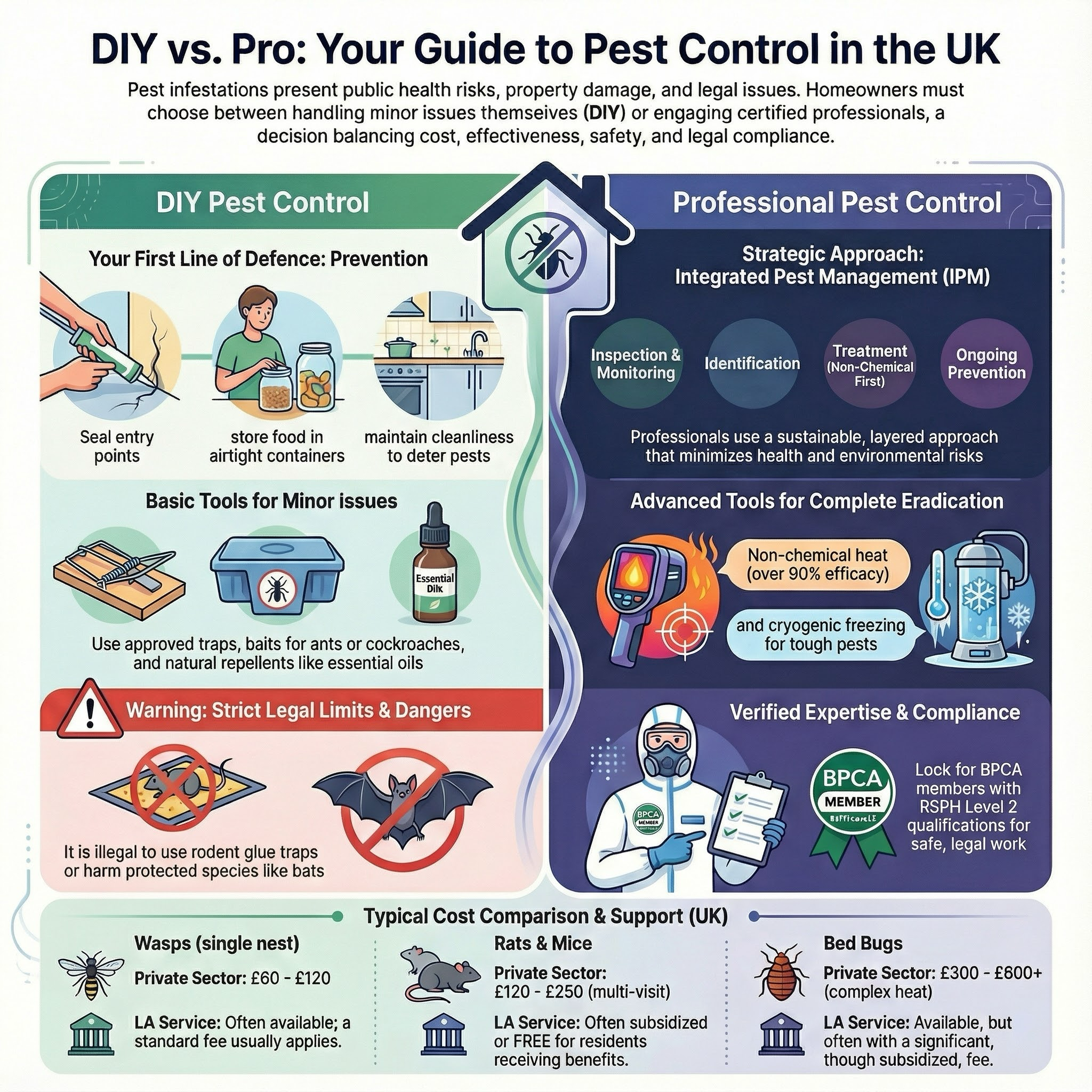
Pest Control explained
Mouse infestation treatment in the UK typically costs £100–£300 for a single property, with most cases resolved in 2-3 visits over 4-8 weeks. Local councils offer subsidised mouse treatment in many areas (£40-£90 per visit); private pest controllers offer faster response and broader services (£100-£300 per programme).
Mice are persistent because UK homes contain many hidden spaces (cavity walls, suspended floors, lofts) and an entry hole the size of a pencil tip is enough. Treatment focuses on baiting and entry-point sealing in equal measure.
| Service | Typical price |
|---|---|
| Council single visit | £0–£90 |
| Council multi-visit programme | £60–£180 |
| Private single property treatment | £100–£250 |
| Multi-visit programme (typical home) | £150–£300 |
| Entry-point sealing (proofing) | £100–£400 |
| Annual contract (typical home) | £200–£400 |
| Heavy infestation / commercial | £300–£800 |
Initial bait take 5-10 days, deaths visible in 1-2 weeks. Most mouse infestations resolved in 4-8 weeks of treatment. Single-visit "guarantees" for established infestations are unrealistic.
Modern bait stations are tamper-proof and pet/child-safe. Loose bait in cupboards is not. If a pet ingests bait, contact a vet immediately — vitamin K1 is the antidote for anticoagulant rodenticides.
Council: cheaper or free, slower response (1-2 weeks), limited service hours. Private: £100-£300 typically, faster response, more flexible visiting times. For non-urgent residential mice, council often best value.
Seal all gaps over 6 mm, store food in sealed containers, take up pet food at night, manage compost away from house, ensure waste bins close securely, fit door sweeps under external doors. Annual pest control inspection catches incursions early.
Rats and mice rarely coexist (rats are territorial and aggressive to mice). If you think you have both, get a professional inspection — usually only one species is present, and accurate identification matters for treatment.
Three reasons: warmth (UK winters), food (pet food, kitchen scraps, bird seed), and shelter (cavities, lofts, cellars). Address any one of these and pressure on the others reduces. Often the trigger is seasonal — autumn/winter incursions are common as mice seek warmth.
Want a local pro to handle this? Council pest control for routine cases, BPCA-member private specialists for urgent or complex situations. Combined treatment + entry sealing prevents recurrence; treatment without sealing means new mice within months.
This guide was written with AI assistance and is intended for general information only. Prices are estimates based on UK averages and may vary by region. Always get at least three quotes and consult a qualified professional before starting any work.
Ask follow-ups in plain English. The AI explains options, sequencing and what to ask the pest control — so you walk in informed.
Discovering a rat problem in your UK home is more than just an unpleasant surprise; it is a genuine risk to your property’s integrity and your family’s health. ...
READ GUIDE →GuideA fly infestation in a UK home is more than just a seasonal nuisance; it is a significant hygiene risk. Flies are known carriers of bacteria such as Salmonella ...
READ GUIDE →GuideDiscovering signs of rats in your home is more than just a nuisance; it is a significant health and safety risk. Rats can gnaw through electrical cables, damage...
READ GUIDE →GuideGrey squirrels are more than just a garden nuisance; they are a significant threat to the structural integrity and safety of UK homes. Once they gain access to ...
READ GUIDE →GuideDomestic Pest and Vermin Control Guide Scope of Works Inspect lofts, sub‑floors, kitchens and exterior for signs, entry points and species identification . Prod...
READ GUIDE →GuideFinding maggots in your home is a distressing experience for any UK homeowner. These larvae, typically from houseflies or blowflies, are not just unsightly; the...
READ GUIDE →