Instant
01 · Ask
Which pest, how long?
Wasps, rats, fleas, bed bugs — different chemicals, different protocols. Describe the problem and the AI tells you scope.

What wasp nest removal costs in 2026 — by location, accessibility and season.
Read the brief on BPCA registration, treatment plans and proofing — then let Three local controllers quote.
Wasps, rats, fleas, bed bugs — different chemicals, different protocols. Describe the problem and the AI tells you scope.
Approved chemicals, visit counts, proofing requirements, pet-safe alternatives. Know what's being applied.
Three local controllers quote on the same problem — visits, chemicals, guarantee — so you don't get re-infested.
Ready when you are
Enter your postcode and get free quotes from local pros.
Four moves that separate a smooth job from a nightmare.
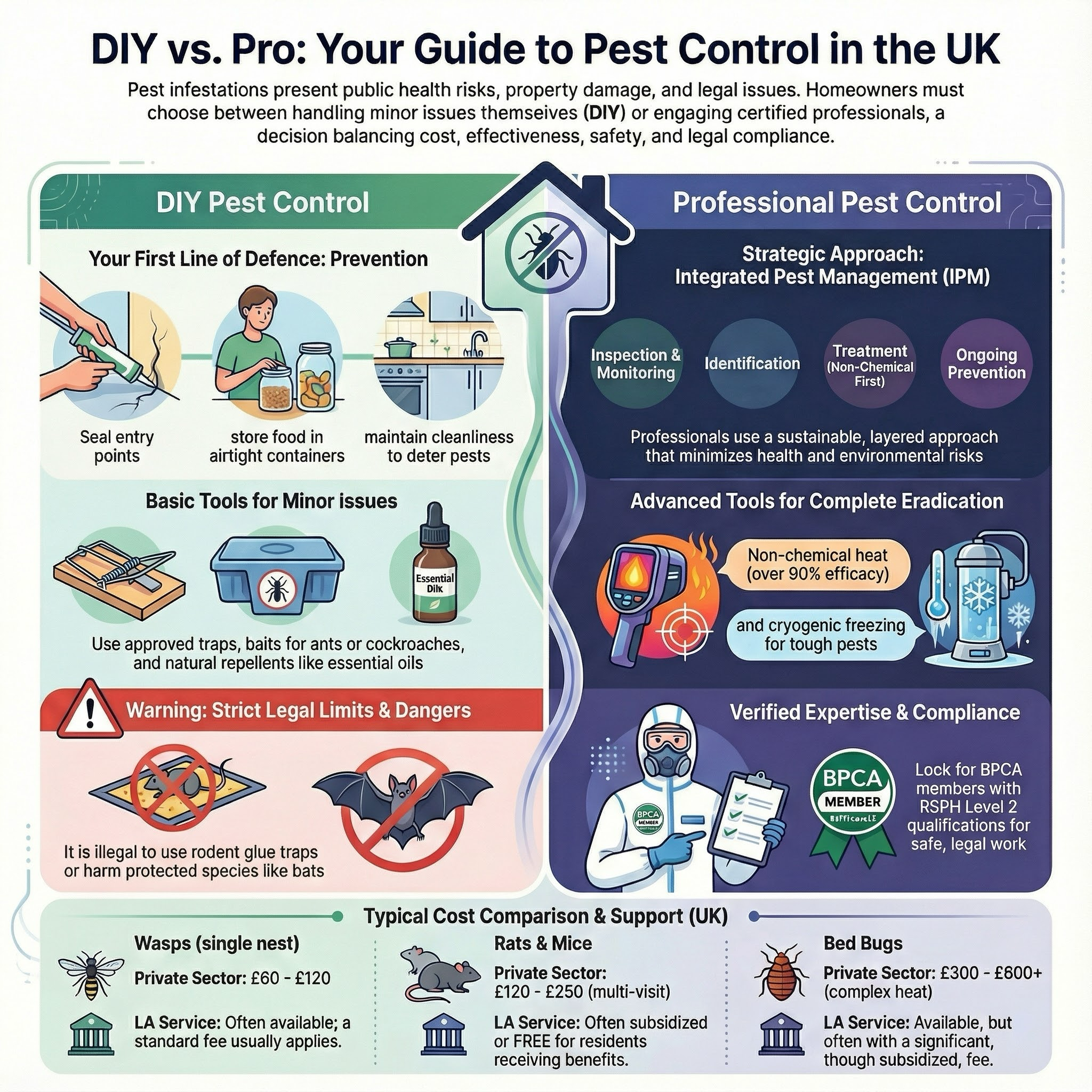
BPCA (British Pest Control Association) registration means trained, certified and insured. Anyone using poisons or traps without BPCA training is risky.
Multi-visit treatments (rats, fleas, woodworm) need a documented plan: what's applied, where, when to expect results, when to re-treat.
Killing pests without sealing entry just creates a vacancy. Insist on proofing (block holes, gaps, vents) as part of the treatment — not an extra.
Tell the controller about pets and small children before they treat. Some chemicals require evacuation hours; some are pet-safe alternatives.
Indicative UK ranges and what affects price.
By job type
Quote spread is typically ± 18% — always get 3 quotes.
Pest Control quick-view
Pest Control explained
Wasp nest removal in the UK typically costs £60–£150 for a single accessible nest, with most jobs completed in 30-60 minutes. Difficult-access nests (high rooflines, deep cavity walls, awkward loft positions) can run £150-£300. Most pest controllers offer same-day or next-day service for active nests; emergency / weekend rates add £20-£50.
The work is straightforward but should not be DIY without proper protective equipment — wasp stings during nest disturbance can cause anaphylactic reactions in 1-3% of people. The £60-£150 spend on a professional is good value for safety alone.
| Job | Typical price |
|---|---|
| Standard accessible nest | £60–£120 |
| Roof / loft nest (ladder access) | £90–£180 |
| Difficult access (high roof, scaffolding) | £150–£300 |
| Cavity wall nest | £100–£200 |
| Multiple nests same property | +£30–£60 per additional |
| Same-day / weekend callout | +£20–£50 |
| Hornet nest (often premium pricing) | £100–£250 |
| Bee swarm relocation (specialist) | £100–£300 |
Most pest controllers offer same-day or next-day callouts for accessible nests. Treatment itself takes 15-30 minutes. Activity drops dramatically within hours; complete colony death in 24-48 hours.
Optional. Once the colony is dead, the nest is harmless and can be left in place for years. Removal is mainly cosmetic. Some pest controllers include physical removal; others charge extra (£30-£80).
Same colony — no, wasps build a new nest each year and don't reuse old ones. New colonies may build in similar locations (good shelter, food access). To prevent recurrence, address attractants (open bins, fallen fruit, exposed sweet drinks).
Honey bees are not legally protected but are environmentally critical. Most pest controllers refuse to treat honey bee swarms; instead, they refer to local beekeepers for free relocation. Bumblebees and solitary bees are generally not killed for nests in UK homes.
It's their responsibility to address. Polite conversation is the first step; if they refuse and you're at risk, contact your local council Environmental Health team — they can issue an Abatement Notice in cases of statutory nuisance.
DIY products exist (wasp killer powders, sprays), but the safety risks are real for anyone allergic or near children/pets. Roof, loft, and cavity wall nests are particularly tricky for DIY. £60-£150 for a professional is excellent value.
Want a local pro to handle this? A pest control specialist with same-day response is the right call. Most are BPCA members and carry appropriate insurance. For honey bee swarms, find a local beekeeper through the BBKA — usually free relocation.
This guide was written with AI assistance and is intended for general information only. Prices are estimates based on UK averages and may vary by region. Always get at least three quotes and consult a qualified professional before starting any work.
Ask follow-ups in plain English. The AI explains options, sequencing and what to ask the pest control — so you walk in informed.
Discovering a rat problem in your UK home is more than just an unpleasant surprise; it is a genuine risk to your property’s integrity and your family’s health. ...
READ GUIDE →GuideA fly infestation in a UK home is more than just a seasonal nuisance; it is a significant hygiene risk. Flies are known carriers of bacteria such as Salmonella ...
READ GUIDE →GuideDiscovering signs of rats in your home is more than just a nuisance; it is a significant health and safety risk. Rats can gnaw through electrical cables, damage...
READ GUIDE →GuideGrey squirrels are more than just a garden nuisance; they are a significant threat to the structural integrity and safety of UK homes. Once they gain access to ...
READ GUIDE →GuideDomestic Pest and Vermin Control Guide Scope of Works Inspect lofts, sub‑floors, kitchens and exterior for signs, entry points and species identification . Prod...
READ GUIDE →GuideFinding maggots in your home is a distressing experience for any UK homeowner. These larvae, typically from houseflies or blowflies, are not just unsightly; the...
READ GUIDE →