Instant
01 · Ask
Single item or whole house?
One sofa, a garage clear, end-of-tenancy strip-out? Describe and the AI tells you which clearance type and price band.

What waste removal costs in 2026 — by volume, type and how the waste is disposed of.
Read the brief on waste carrier licences, recycling and hazardous handling — then let Three local firms quote.
One sofa, a garage clear, end-of-tenancy strip-out? Describe and the AI tells you which clearance type and price band.
EA licences, transfer notes, recycling rates, hazardous separation. Know what makes a firm legit.
Three local firms quote on the same load — pricing model, recycling, transfer notes — so you compare cleanly.
Ready when you are
Enter your postcode and get free quotes from local pros.
Four moves that separate a smooth job from a nightmare.
All UK waste carriers need an Environment Agency licence. Fly-tipping under your name is the alternative — and you get fined.
Some 'clearance' firms charge per load; others charge per volume. Get the price model in writing before they start.
Asbestos, paint, batteries, electronics — separate disposal routes. A reputable clearance firm handles or refers; cowboys dump.
Reputable firms recycle 60–80% of clearance. Ask what's recycled and what's landfill — and what affects price.
Indicative UK ranges and what affects price.
By job type
Quote spread is typically ± 18% — always get 3 quotes.
Rubbish Clearance quick-view
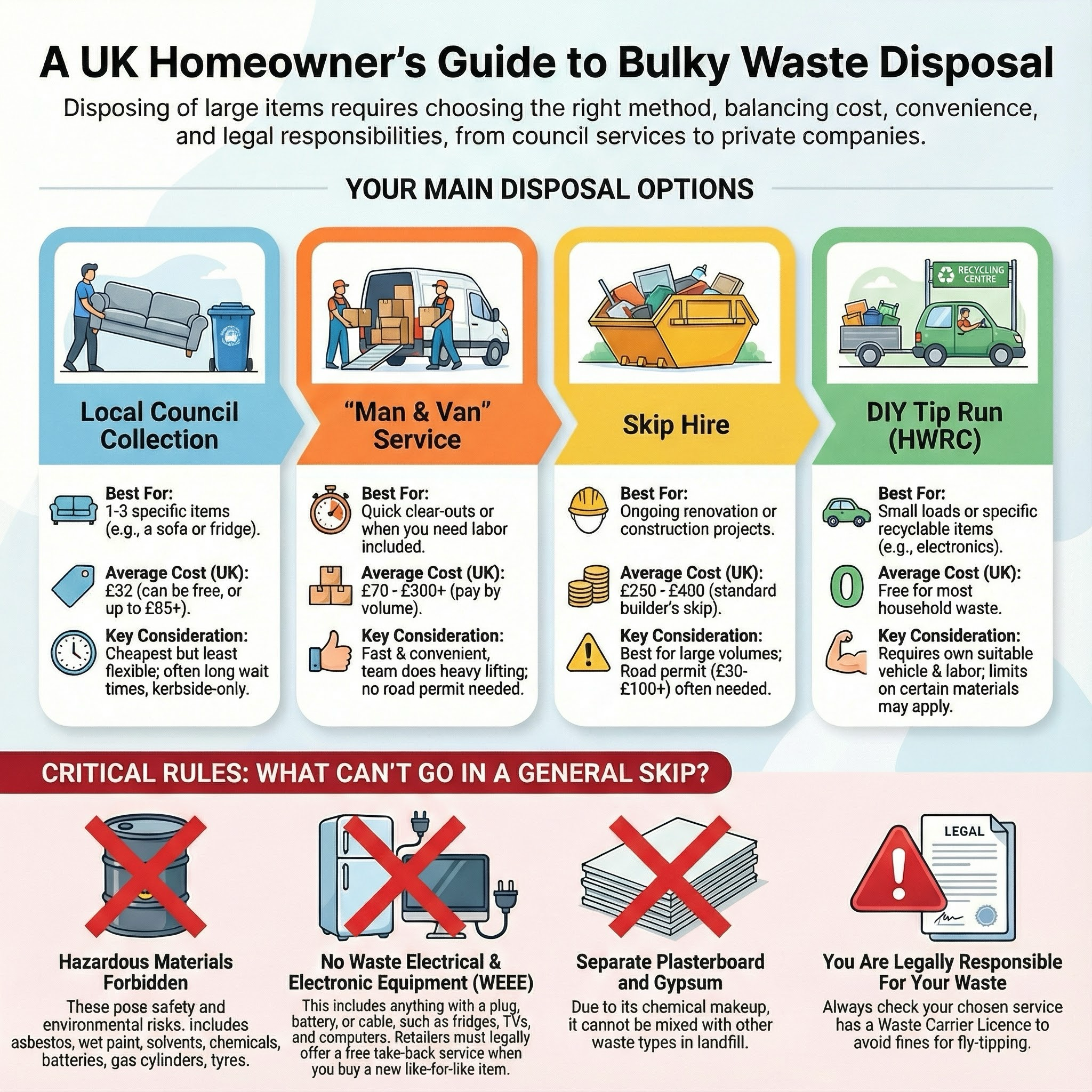
Rubbish Clearance explained
Household waste removal services in the UK typically cost £100–£500 per van load (Transit-sized), depending on what's being removed and your location. For one-off bulky waste (sofas, fridges, mattresses, garden waste), private waste removal is often cheaper and faster than waiting for council bulky-waste collections.
Local council bulky waste collections cost £20-£60 for 3-5 items in most areas; private services charge £100-£500 per van load. Choice depends on quantity and urgency.
| Service | Typical price |
|---|---|
| Single bulky item (sofa, mattress) | £40–£90 |
| Half Transit van load | £100–£200 |
| Full Transit van load | £200–£400 |
| Tipper / large van load | £300–£550 |
| Council bulky collection (3-5 items) | £20–£60 |
| Skip hire (4-yard, week) | £180–£280 |
| Skip hire (8-yard, week) | £280–£420 |
| Wait-and-load skip (same day) | £250–£500 |
| Garden waste removal (typical clearance) | £200–£500 |
environment.data.gov.uk. Without licence, fly-tipping risk falls back on YOU as waste producer.Council bulky waste: £15-£40 typically (varies by council). Private collection: £40-£90. Charity collection: free if usable. Tip yourself: free with own van.
Same-day or next-day in urban areas. 2-7 days in rural locations. Council collections typically 1-3 weeks notice required.
Surcharged £20-£60 above standard collection due to refrigerant handling. Some retailers (Currys, John Lewis) collect old appliances when delivering replacement, often free.
Only when scheduled by council. Random kerbside dumping is fly-tipping (£400 fixed penalty). Council bulky collections specify exact day and time; book first, then put items out.
Ask for their Waste Carrier Licence number, then check at environment.data.gov.uk/public-register/view/search-waste-carriers-brokers. Five seconds of work that protects you from fly-tipping liability.
For small volumes: take to your local Recycling Centre yourself (free). For medium volumes: council bulky waste collection (£20-£60). For larger volumes: skip hire if doing DIY over days, man-with-van if one visit suffices.
Want a local pro to handle this? Council bulky collection for cheapest small-volume disposal; licensed man-with-van for flexibility and speed; charity collection for usable items. Always verify the waste carrier licence before booking.
This guide was written with AI assistance and is intended for general information only. Prices are estimates based on UK averages and may vary by region. Always get at least three quotes and consult a qualified professional before starting any work.
Ask follow-ups in plain English. The AI explains options, sequencing and what to ask the rubbish clearance — so you walk in informed.
Disposing of an old mattress or a bulky bed frame is one of the more challenging tasks for UK homeowners. Beyond the physical strain of navigating heavy, awkwar...
READ GUIDE →GuideManaging commercial waste is a significantly different beast compared to standard residential rubbish. Whether you are a landlord clearing a shop unit, a home-b...
READ GUIDE →GuideDisposing of an old sofa or armchair in the UK has become more complex due to recent environmental legislation. Bulky furniture is difficult to move, and many i...
READ GUIDE →GuideScrapping a car in the UK is a straightforward process, but it is governed by strict environmental and legal regulations. Whether your vehicle is a non-runner, ...
READ GUIDE →GuideAccumulating black bin bags is a common headache for UK homeowners, whether it’s due to a missed council collection, a deep spring clean, or the aftermath of a ...
READ GUIDE →GuideWhether you are decommissioning a commercial suite or simply reclaiming a spare bedroom from years of "home office" clutter, a professional office clean-out is ...
READ GUIDE →