Instant
01 · Ask
Ask the AI a follow-up
Got more questions about office Clearance Cost &? Describe the bit you're unsure about — the AI explains options, sequencing and what to ask the rubbish clearance.

What office clearance costs in 2026 — by furniture count, IT volume and floor area.
You've read the brief on office Clearance Cost &. Now lean on us to find the right rubbish clearance — and stay in control of the job.
Got more questions about office Clearance Cost &? Describe the bit you're unsure about — the AI explains options, sequencing and what to ask the rubbish clearance.
Costs, timelines, pitfalls and the right questions to ask before any rubbish clearance starts on office Clearance Cost &.
Itemised quotes from up to 3 local rubbish clearances on office Clearance Cost & — so you can compare like-for-like, not lump sums.
Ready when you are
Enter your postcode and get free quotes from local pros.
Four moves that separate a smooth job from a nightmare.
Failing to mention that the office is on the 4th floor without a lift can lead to sudden price hikes on the day.
Leaving old hard drives or "confidential" bins for a general clearance team without verifying their data destruction process.
Not accounting for the "hidden" waste in cupboards or drawers, leading to the van being too small for the job.
Choosing the cheapest quote from social media often results in your office furniture being dumped in a lay-by, leading to a £5,000 fine for you.
Indicative UK ranges and what affects price.
By job type
Quote spread is typically ± 18% — always get 3 quotes.
Rubbish Clearance quick-view
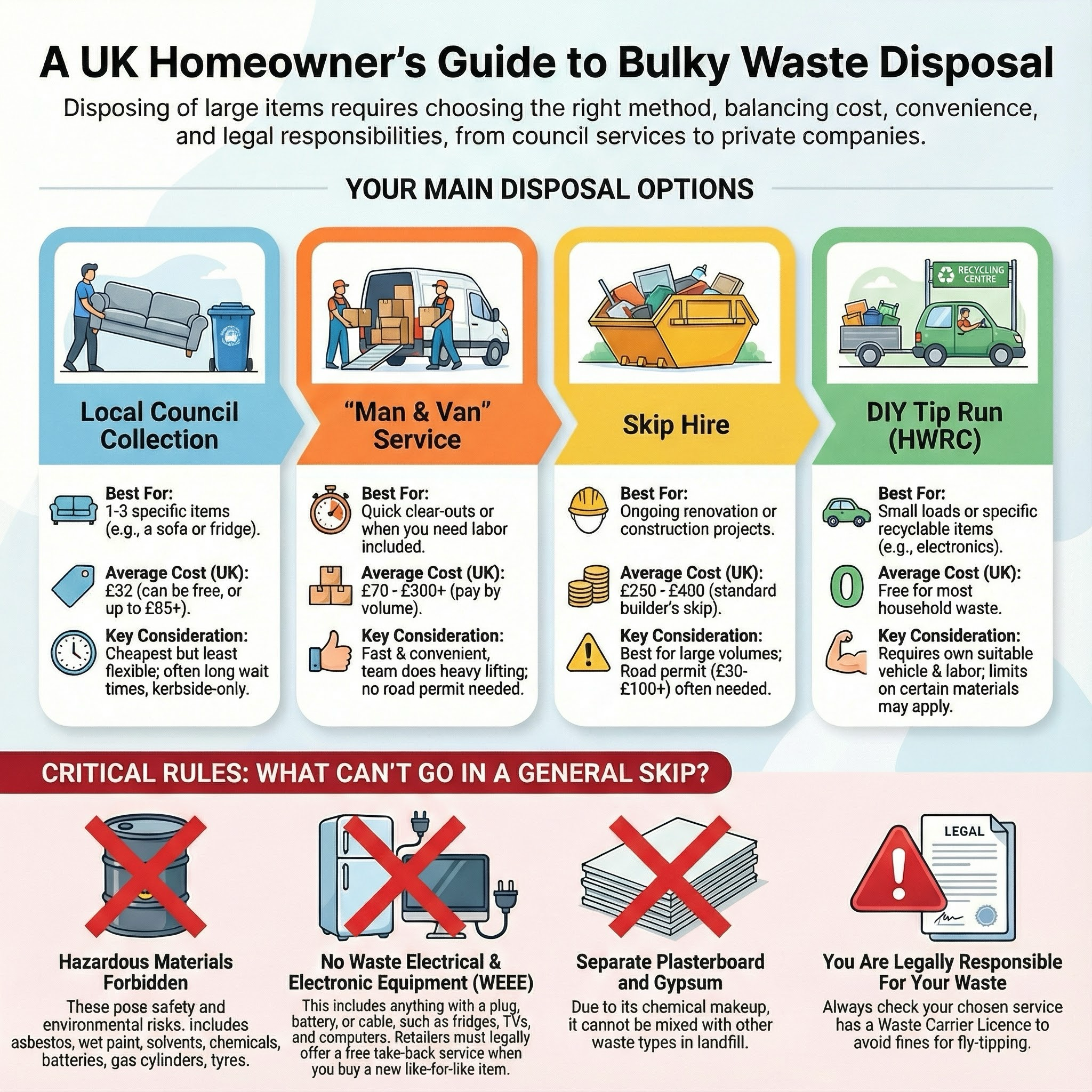
Rubbish Clearance explained
A professional clearance ensures that bulky furniture is removed safely, electronic waste is handled according to UK law, and sensitive documents are destroyed securely. This guide breaks down the costs, regulations, and practicalities of clearing an office space in 2025.
Office clearance pricing is usually based on the volume of waste (measured in cubic yards or van loads) and the weight of the materials. Special items like computer monitors or refrigeration units often incur additional surcharges due to hazardous waste regulations.
| Item / Service | Low £ | High £ | Notes |
|---|---|---|---|
| Minimum Call-out (Small load) | £90 | £150 | Up to 2 cubic yards; ideal for a single desk/chair. |
| Half Van Load (approx. 700kg) | £250 | £350 | Standard 3.5t caged tipper; includes 30 mins labour. |
| Full Van Load (approx. 1200kg) | £450 | £650 | Includes 1 hour of labour for two people. |
| WEEE Disposal (per Monitor/PC) | £15 | £45 | Covers specialist recycling and data destruction. |
| Confidential Shredding (per sack) | £8 | £15 | Includes a Certificate of Destruction. |
Prices vary significantly based on your location (London and the South East carry a 15-20% premium) and the ease of access to the office. If the team has to use stairs or pay for parking/congestion charges, expect these to be added to your final bill.
While you can take small items to a local Household Waste Recycling Centre (HWRC), many sites refuse "commercial" waste, even if it comes from a home office. Professional clearance is highly recommended for anything involving heavy furniture or electronic equipment.
Note: If you hire an unlicensed "man with a van" and your waste is fly-tipped, you remain legally liable for the fines. Always use a registered waste carrier.
Professionals carry the necessary insurance to prevent damage to your property during the move and provide a Waste Transfer Note (WTN), which is your legal proof of responsible disposal.
Most professional clearance companies offer a dismantling service, but they will charge for the extra labour time. If you have the tools and time, doing this yourself can reduce the overall cost.
Reputable firms often work with charities or second-hand furniture dealers. If your furniture has a resale value, some companies may offer a "rebate" or discount on the clearance cost to account for the value of the assets they are taking.
Yes, many commercial clearance specialists offer evening or weekend slots to avoid disrupting your business or neighbours. Expect to pay a premium for these "unsociable" hours.
A WTN is a legal document that tracks waste from the moment it leaves your property until it reaches its final destination. You must keep a copy of this for two years to prove you disposed of your waste legally.
Yes, but these are classified as WEEE waste. Printers contain toners and monitors contain hazardous chemicals, so they require specialist handling and usually carry a small surcharge per item.
Label items clearly as "STAY" or "GO" to avoid mistakes. Ensure all filing cabinets are emptied (unless agreed otherwise) and that there is a clear, safe path from the office to the loading area.
This guide was written with AI assistance and is intended for general information only. Prices are estimates based on UK averages and may vary by region. Always get at least three quotes and consult a qualified professional before starting any work.
Ask follow-ups in plain English. The AI explains options, sequencing and what to ask the rubbish clearance — so you walk in informed.
Disposing of an old mattress or a bulky bed frame is one of the more challenging tasks for UK homeowners. Beyond the physical strain of navigating heavy, awkwar...
READ GUIDE →GuideManaging commercial waste is a significantly different beast compared to standard residential rubbish. Whether you are a landlord clearing a shop unit, a home-b...
READ GUIDE →GuideDisposing of an old sofa or armchair in the UK has become more complex due to recent environmental legislation. Bulky furniture is difficult to move, and many i...
READ GUIDE →GuideScrapping a car in the UK is a straightforward process, but it is governed by strict environmental and legal regulations. Whether your vehicle is a non-runner, ...
READ GUIDE →GuideAccumulating black bin bags is a common headache for UK homeowners, whether it’s due to a missed council collection, a deep spring clean, or the aftermath of a ...
READ GUIDE →GuideWhether you are decommissioning a commercial suite or simply reclaiming a spare bedroom from years of "home office" clutter, a professional office clean-out is ...
READ GUIDE →