Instant
01 · Ask
Single item or whole house?
One sofa, a garage clear, end-of-tenancy strip-out? Describe and the AI tells you which clearance type and price band.

DVLA-compliant scrap car removal — paid by weight, recycling certificate, free collection.
Read the brief on waste carrier licences, recycling and hazardous handling — then let Three local firms quote.
One sofa, a garage clear, end-of-tenancy strip-out? Describe and the AI tells you which clearance type and price band.
EA licences, transfer notes, recycling rates, hazardous separation. Know what makes a firm legit.
Three local firms quote on the same load — pricing model, recycling, transfer notes — so you compare cleanly.
Ready when you are
Enter your postcode and get free quotes from local pros.
Four moves that separate a smooth job from a nightmare.
All UK waste carriers need an Environment Agency licence. Fly-tipping under your name is the alternative — and you get fined.
Some 'clearance' firms charge per load; others charge per volume. Get the price model in writing before they start.
Asbestos, paint, batteries, electronics — separate disposal routes. A reputable clearance firm handles or refers; cowboys dump.
Reputable firms recycle 60–80% of clearance. Ask what's recycled and what's landfill — and what affects price.
Indicative UK ranges and what affects price.
By job type
Quote spread is typically ± 18% — always get 3 quotes.
Rubbish Clearance quick-view
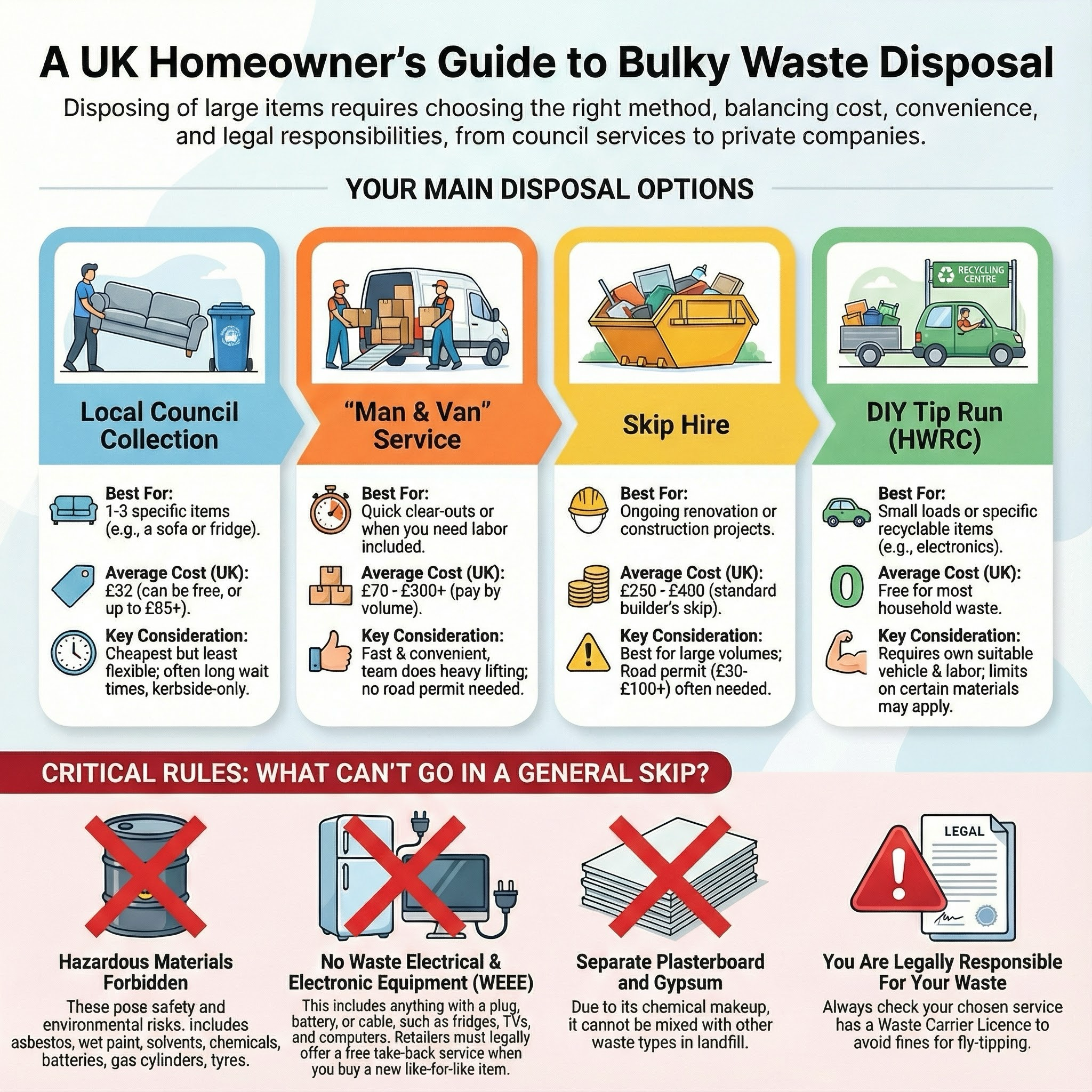
Rubbish Clearance explained
Whether your car has failed its MOT, been involved in an accident, or is simply past its prime, professional scrap car removal ensures the vehicle is de-polluted and the DVLA is notified correctly. This guide covers everything from current scrap values to the legal paperwork you must receive.
In most cases, you will be paid for your scrap car rather than charged for its removal. However, if a vehicle is an empty shell or in an extremely inaccessible location, a collection fee may apply.
| Item | Low £ | High £ | Notes |
|---|---|---|---|
| Scrap Value (Small Car) | -£150 | -£250 | Payment to you (Market dependent) |
| Scrap Value (Large SUV/Van) | -£300 | -£600 | Payment to you (Weight based) |
| Specialist Recovery Fee | £50 | £150 | Only for cars in gardens/basements |
| Admin/Paperwork Fee | £0 | £25 | Usually included in the quote |
Prices are heavily influenced by the global price of steel and the weight of your vehicle. Ensure your quote includes "free collection" to avoid hidden transport deductions from your final payout.
Scrapping a car is not a DIY task. Under the Scrap Metal Dealers Act 2013, it is illegal to scrap a vehicle yourself or sell it to anyone other than an Authorised Treatment Facility (ATF). You cannot legally be paid in cash for a scrap car in England and Wales; payments must be made via bank transfer or crossed cheque to maintain a clear audit trail.
Note: Attempting to dismantle a car at home can lead to environmental fines if fluids leak into the drainage system or soil.
Not every "man with a van" is licensed to carry scrap cars. To protect yourself legally, look for the following:
Yes, you can scrap a car without the logbook, provided you can prove ownership with a bill of sale and photo ID. You must inform the DVLA in writing that the vehicle has been scrapped.
Once the DVLA is notified that the car has been scrapped or sold to the trade, any full months of remaining road tax will be automatically refunded to the registered keeper.
The Scrap Metal Dealers Act 2013 banned cash payments to stop metal theft. All payments must be traceable via bank transfer or cheque.
No, the car does not need an MOT or insurance if it is being collected by a professional recovery truck. However, it must be kept off the road (SORN) while waiting for collection.
A CoD is an official DVLA document issued by an ATF. It proves the vehicle has been recycled and removes your name from the DVLA database as the registered keeper.
This guide was written with AI assistance and is intended for general information only. Prices are estimates based on UK averages and may vary by region. Always get at least three quotes and consult a qualified professional before starting any work.
Ask follow-ups in plain English. The AI explains options, sequencing and what to ask the rubbish clearance — so you walk in informed.
Disposing of an old mattress or a bulky bed frame is one of the more challenging tasks for UK homeowners. Beyond the physical strain of navigating heavy, awkwar...
READ GUIDE →GuideManaging commercial waste is a significantly different beast compared to standard residential rubbish. Whether you are a landlord clearing a shop unit, a home-b...
READ GUIDE →GuideDisposing of an old sofa or armchair in the UK has become more complex due to recent environmental legislation. Bulky furniture is difficult to move, and many i...
READ GUIDE →GuideScrapping a car in the UK is a straightforward process, but it is governed by strict environmental and legal regulations. Whether your vehicle is a non-runner, ...
READ GUIDE →GuideAccumulating black bin bags is a common headache for UK homeowners, whether it’s due to a missed council collection, a deep spring clean, or the aftermath of a ...
READ GUIDE →GuideWhether you are decommissioning a commercial suite or simply reclaiming a spare bedroom from years of "home office" clutter, a professional office clean-out is ...
READ GUIDE →