Instant
01 · Ask
Single item or whole house?
One sofa, a garage clear, end-of-tenancy strip-out? Describe and the AI tells you which clearance type and price band.

What different scrap items pay (or cost to remove) in 2026 — metal, electrical, car or commercial.
Read the brief on waste carrier licences, recycling and hazardous handling — then let Three local firms quote.
One sofa, a garage clear, end-of-tenancy strip-out? Describe and the AI tells you which clearance type and price band.
EA licences, transfer notes, recycling rates, hazardous separation. Know what makes a firm legit.
Three local firms quote on the same load — pricing model, recycling, transfer notes — so you compare cleanly.
Ready when you are
Enter your postcode and get free quotes from local pros.
Four moves that separate a smooth job from a nightmare.
All UK waste carriers need an Environment Agency licence. Fly-tipping under your name is the alternative — and you get fined.
Some 'clearance' firms charge per load; others charge per volume. Get the price model in writing before they start.
Asbestos, paint, batteries, electronics — separate disposal routes. A reputable clearance firm handles or refers; cowboys dump.
Reputable firms recycle 60–80% of clearance. Ask what's recycled and what's landfill — and what affects price.
Indicative UK ranges and what affects price.
By job type
Quote spread is typically ± 18% — always get 3 quotes.
Rubbish Clearance quick-view
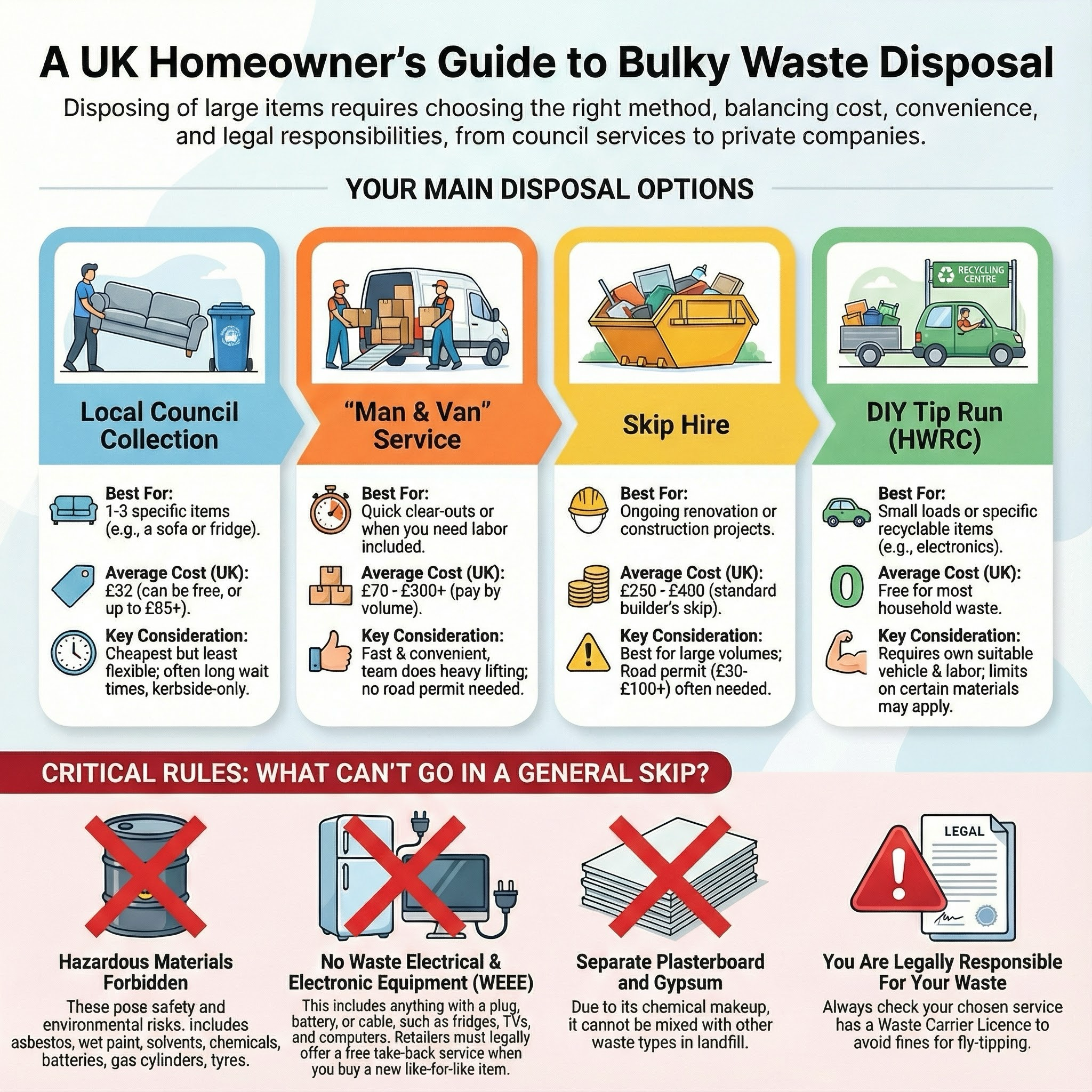
Rubbish Clearance explained
Scrap metal collection in the UK is often free for collectible quantities — most scrap dealers will collect metal items for free if they're driving past anyway, and pay you a small amount for valuable metals. For one-off items: £0–£60 typical (often free for fridges, washing machines, and scrap-suitable items they can recycle for value).
The economic logic: scrap metal has real recycling value (steel £100-£200/tonne, aluminium £700-£1,200/tonne, copper £4,000-£6,000/tonne in 2026 prices). Reputable scrap dealers absorb collection costs because they make money on the metal.
| Item / service | Typical price |
|---|---|
| Fridge / freezer collection | £0–£40 |
| Washing machine / tumble dryer | £0–£30 (often free) |
| Scrap car | Pay £30-£200+ to you |
| Catalytic converter (declared) | Pay £40-£300+ to you |
| Mixed scrap pile (per visit) | £0–£80 (often paid) |
| Cast iron items (radiators, baths) | £0–£40 (often free) |
| Aluminium items | Often paid |
| Copper / brass items | Paid |
| Sheet metal (radiators, gutters) | Often free |
For end-of-life UK vehicles:
Many local scrap dealers collect fridges and freezers free, especially modern ones with valuable copper. Some council bulky waste services charge £20-£40 per appliance — compare both before deciding.
£30-£200 typically for end-of-life UK vehicles, depending on weight (heavier = more) and any salvageable components. Premium for vehicles with intact catalytic converters, working batteries, or particular parts in demand.
Yes, but the dealer must hold a Scrap Metal Dealer Licence (issued by the local council under the Scrap Metal Dealers Act 2013). Always ask for licence number; verify with council if uncertain. Never accept cash payment — banned since 2013.
Both have significant scrap value (copper £4,000-£6,000/tonne). Pipes from heating systems, old plumbing, electrical mains cable. Expect £5-£20+ per kg of clean copper.
No — illegal in the UK since 2013. Bank transfer or cheque only. Anyone offering cash is operating illegally; their licence is at risk and you should refuse the transaction.
Scrap dealer: focuses on metal value, often pays you for valuable items, free or low-cost collection. Rubbish removal: charges by volume regardless of contents, takes everything to mixed disposal. For metal-heavy waste, scrap dealer is much cheaper.
Want a local pro to handle this? A licensed Scrap Metal Dealer (council-licensed) is the right choice for metal items. For end-of-life vehicles, an Authorised Treatment Facility (ATF) provides legal Certificate of Destruction. Always check licence before transacting.
This guide was written with AI assistance and is intended for general information only. Prices are estimates based on UK averages and may vary by region. Always get at least three quotes and consult a qualified professional before starting any work.
Ask follow-ups in plain English. The AI explains options, sequencing and what to ask the rubbish clearance — so you walk in informed.
Disposing of an old mattress or a bulky bed frame is one of the more challenging tasks for UK homeowners. Beyond the physical strain of navigating heavy, awkwar...
READ GUIDE →GuideManaging commercial waste is a significantly different beast compared to standard residential rubbish. Whether you are a landlord clearing a shop unit, a home-b...
READ GUIDE →GuideDisposing of an old sofa or armchair in the UK has become more complex due to recent environmental legislation. Bulky furniture is difficult to move, and many i...
READ GUIDE →GuideScrapping a car in the UK is a straightforward process, but it is governed by strict environmental and legal regulations. Whether your vehicle is a non-runner, ...
READ GUIDE →GuideAccumulating black bin bags is a common headache for UK homeowners, whether it’s due to a missed council collection, a deep spring clean, or the aftermath of a ...
READ GUIDE →GuideWhether you are decommissioning a commercial suite or simply reclaiming a spare bedroom from years of "home office" clutter, a professional office clean-out is ...
READ GUIDE →