Instant
01 · Ask
Ask the AI a follow-up
Got more questions about commercial microwave repair? Describe the bit you're unsure about — the AI explains options, sequencing and what to ask the appliance repair.

Magnetron, control board, door switch — fixed on-site so the kitchen keeps moving.
You've read the brief on commercial microwave repair. Now lean on us to find the right appliance repair — and stay in control of the job.
Got more questions about commercial microwave repair? Describe the bit you're unsure about — the AI explains options, sequencing and what to ask the appliance repair.
Costs, timelines, pitfalls and the right questions to ask before any appliance repair starts on commercial microwave repair.
Itemised quotes from up to 3 local appliance repairs on commercial microwave repair — so you can compare like-for-like, not lump sums.
Ready when you are
Enter your postcode and get free quotes from local pros.
Four moves that separate a smooth job from a nightmare.
Usually caused by a damaged wave-guide cover or food build-up; if caught early, this is a cheap and easy fix.
Often indicates a blown high-voltage fuse or a failed magnetron, which is the heart of the microwave.
If the door doesn't latch perfectly, the safety sensors will prevent the unit from starting.
Common in steam-heavy kitchens where moisture penetrates the control panel membrane.
Indicative UK ranges and what affects price.
By job type
Quote spread is typically ± 18% — always get 3 quotes.
Appliance Repair quick-view
Appliance Repair explained
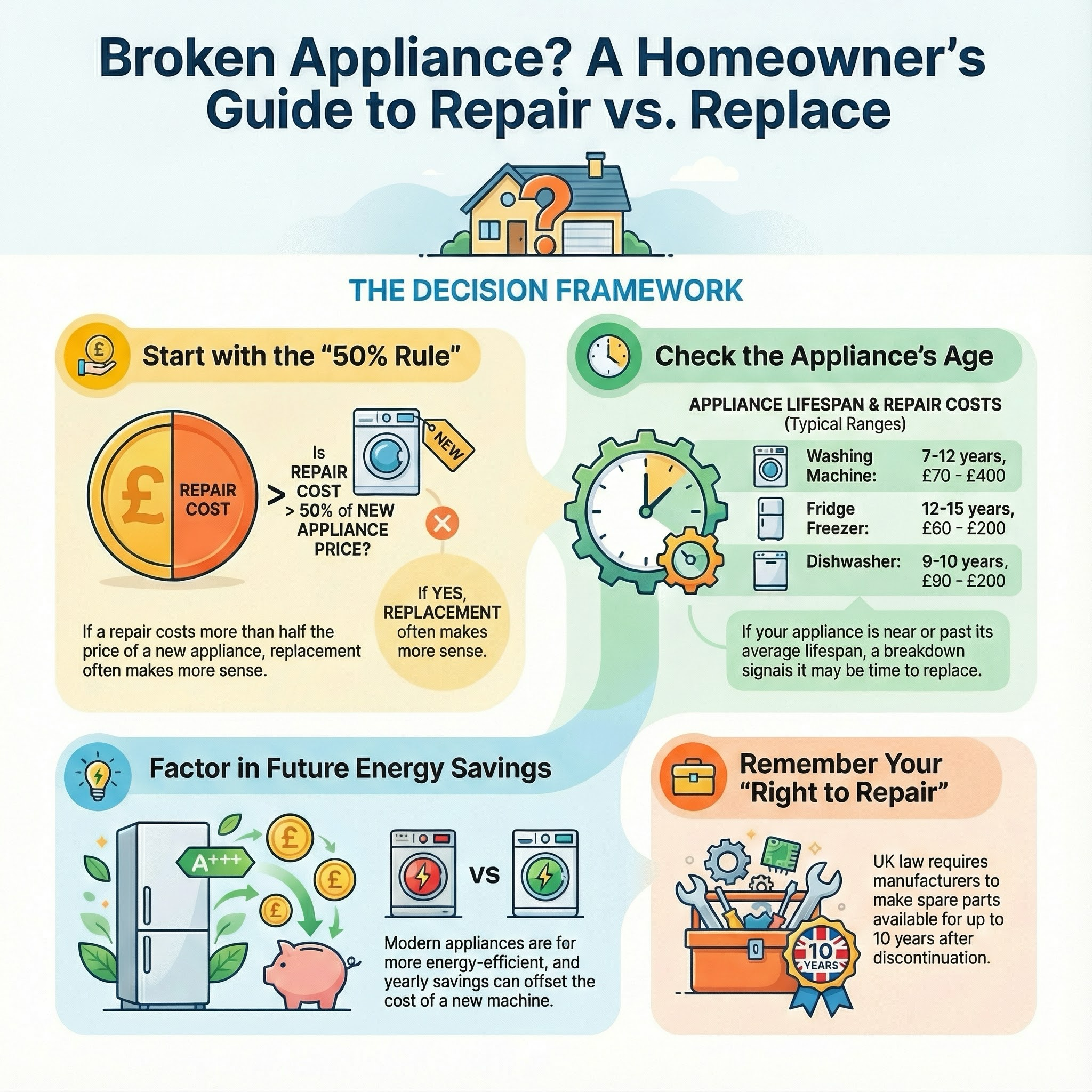
For UK business owners or homeowners with professional-grade appliances, a prompt repair is often more cost-effective than a full replacement. Ensuring your unit is serviced by a qualified engineer protects your investment and ensures compliance with workplace safety standards.
Prices for commercial microwave repairs vary based on the brand (e.g., Panasonic, Merrychef, or Samsung) and the cost of proprietary parts. Most engineers charge a fixed call-out fee that covers the initial diagnostic period.
| Item | Low £ | High £ | Notes |
|---|---|---|---|
| Call-out / Diagnostic Fee | £90 | £145 | Usually covers the first 30–60 minutes on site. |
| Labour (per hour) | £70 | £100 | Charged after the initial diagnostic period. |
| Basic Parts (fuses, seals) | £20 | £60 | Common consumable items often kept on the van. |
| Major Parts (Magnetron/PCB) | £150 | £350 | High-value components specific to the model. |
| Microwave Leakage Test | £30 | £60 | Often included in the repair but sold separately as a safety check. |
Please note that prices typically include VAT at 20% for domestic customers, though businesses may be able to reclaim this. Emergency "same-day" call-outs in London or major UK cities may command a 20-30% premium.
Commercial microwave repair is strictly a professional-only job. These appliances contain high-voltage capacitors that can hold a lethal electrical charge even after the unit has been unplugged for days.
Attempting a DIY repair on a microwave is extremely dangerous and will void your insurance and any existing manufacturer warranties.
In the UK, while there isn't a specific "microwave license," engineers should be electrically competent and ideally hold an appliance-specific qualification. For businesses, a professional repair ensures you meet your obligations under the Electricity at Work Regulations 1989.
If the repair cost is less than 50% of the price of a new unit and the machine is under five years old, repair is usually the best route. For premium brands like Merrychef, repairs are almost always viable due to the high replacement cost.
In a commercial environment, it is recommended to have a microwave leakage test and a visual inspection every 12 months. High-use kitchens may opt for six-monthly checks to ensure staff safety.
This is usually caused by a "carbonised" wave-guide cover. Food splashes that aren't cleaned off eventually burn and turn into carbon, which conducts electricity and causes arcing. Replacing the cover is a quick and inexpensive fix.
No, Gas Safe registration is only required for gas-fed appliances. However, for combination ovens (microwave/convection), you need an engineer who understands both microwave technology and high-temperature heating elements.
Absolutely not. Commercial components are rated for much higher duty cycles and power outputs. Using domestic parts will lead to immediate failure and poses a significant fire risk.
It uses a handheld meter to detect any microwave energy escaping from the door seals or casing. The UK legal limit for leakage is 5mW/cm² at a distance of 50mm from the surface.
This guide was written with AI assistance and is intended for general information only. Prices are estimates based on UK averages and may vary by region. Always get at least three quotes and consult a qualified professional before starting any work.
Ask follow-ups in plain English. The AI explains options, sequencing and what to ask the appliance repair — so you walk in informed.
Microwaves are a staple of the modern UK kitchen, offering convenience for everything from defrosting to full meal preparation. While basic freestanding models ...
READ GUIDE →GuideA faulty fridge or freezer is one of the most urgent domestic repairs, with food safety and waste being the primary concerns. For many UK homeowners, a professi...
READ GUIDE →GuideA cold oven is a major disruption to any UK household, but a failed heating element is one of the most common and cost-effective repairs you can undertake. Inst...
READ GUIDE →GuideScope of Works • inspect appliance and perform diagnostic checks (power, suction, switches, wiring) • clean and test filters, dust bin or bag and airway for blo...
READ GUIDE →GuideA faulty microwave display is a common frustration for UK homeowners. Whether the screen has gone completely dark, is flickering, or showing unintelligible "gho...
READ GUIDE →GuideA faulty oven can bring a UK household to a standstill, turning meal times into a logistical challenge. Whether it is a failed heating element, a noisy fan, or ...
READ GUIDE →