Instant
01 · Ask
Ask the AI a follow-up
Got more questions about fridge freezer repair assistance? Describe the bit you're unsure about — the AI explains options, sequencing and what to ask the appliance repair.

Diagnosis, parts and labour by a local engineer — quoted before the spanner comes out.
You've read the brief on fridge freezer repair assistance. Now lean on us to find the right appliance repair — and stay in control of the job.
Got more questions about fridge freezer repair assistance? Describe the bit you're unsure about — the AI explains options, sequencing and what to ask the appliance repair.
Costs, timelines, pitfalls and the right questions to ask before any appliance repair starts on fridge freezer repair assistance.
Itemised quotes from up to 3 local appliance repairs on fridge freezer repair assistance — so you can compare like-for-like, not lump sums.
Ready when you are
Enter your postcode and get free quotes from local pros.
Four moves that separate a smooth job from a nightmare.
Often caused by dirty condenser coils or a failing door seal, forcing the motor to work overtime.
Usually indicates a failure in the automatic defrost heater or a blocked drainage tube.
Often a sign that the compressor start relay is failing; if caught early, this is a cheap fix.
Typically a failure of the evaporator fan or a "stuck" air damper flap between the two compartments.
Indicative UK ranges and what affects price.
By job type
Quote spread is typically ± 18% — always get 3 quotes.
Appliance Repair quick-view
Appliance Repair explained
Whether you are dealing with a pool of water on the floor, a compressor that sounds like a tractor, or a fridge that simply won't stay cool, professional intervention is usually required. This guide breaks down the costs, timelines, and regulations involved in getting your appliance back to peak performance.
Fridge freezer repair involves a systematic approach to identify whether the fault is mechanical, electrical, or related to the refrigerant gas. A standard repair visit typically includes:
The cost of repairing a fridge freezer in the UK depends heavily on the brand (premium brands like Miele or Sub-Zero carry higher part costs) and the nature of the fault. Most engineers charge a fixed call-out fee that covers the initial diagnosis.
| Item | Low £ | High £ | Notes |
|---|---|---|---|
| Call-out / Diagnosis Fee | £65 | £125 | Includes first 30-60 mins of labour. |
| Hourly Labour Rate | £55 | £95 | Charged after the first hour. |
| Minor Parts (Sensors, Seals) | £25 | £85 | Common fixes for temperature issues. |
| Major Parts (Fans, Control Boards) | £90 | £260 | Varies significantly by manufacturer. |
| Compressor Replacement | £350 | £650 | Includes gas recovery and soldering. |
| Refrigerant Re-gas | £120 | £220 | Requires F-Gas certified specialist. |
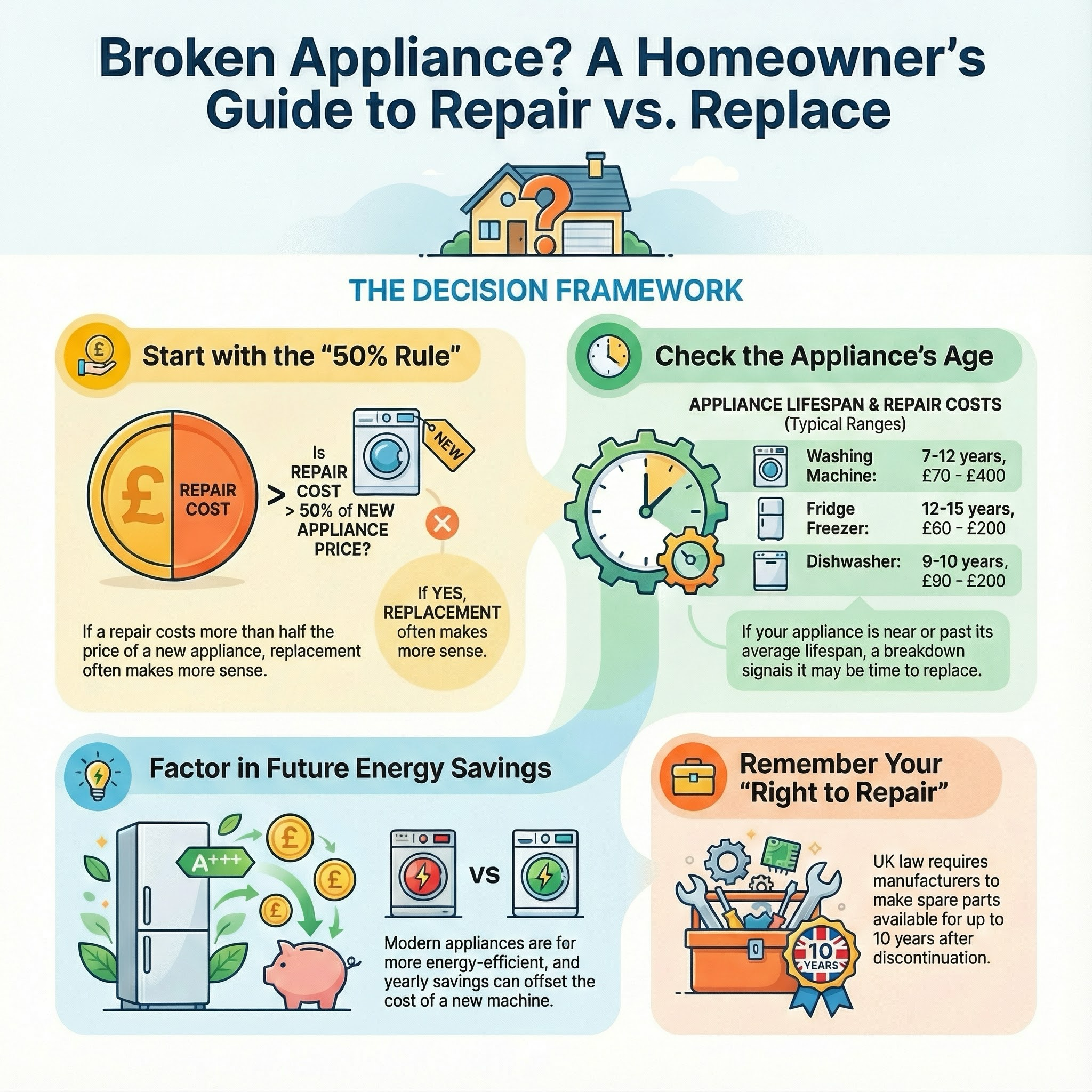
Note: Prices include VAT. Total costs for most common repairs (like a thermostat or fan replacement) usually fall between £150 and £280. If the repair exceeds 50% of the cost of a new equivalent model, your engineer may advise replacement instead.
The duration of the repair depends on the complexity of the fault and the availability of spare parts in the UK supply chain.
While homeowners can safely perform basic maintenance like cleaning condenser coils or clearing a blocked defrost drain, most repairs require a professional. Modern fridge freezers are complex electronic devices that involve high-voltage circuitry and pressurised flammable gases.
Warning: You must never attempt to pierce or repair the cooling coils yourself. Modern appliances often use R600a (isobutane), which is highly flammable.
Any work involving the refrigerant gas must, by law, be carried out by an F-Gas certified engineer. Furthermore, improper DIY electrical repairs can void your home insurance and manufacturer warranty.
Selecting a qualified engineer ensures the longevity of your repair and the safety of your home. Look for the following when hiring:
Questions to ask your engineer:
Repairs must adhere to specific UK standards to ensure safety and environmental protection:
Identifying the symptoms early can prevent a total breakdown. Look out for these common issues:
Generally, if the repair cost is less than 40% of a new model, it is worth it. However, for units over 10 years old, energy efficiency has improved so much that a new 'A' rated appliance might save you significant money on electricity bills over time.
This is most commonly caused by a blocked defrost drain hole. Food debris or ice can clog the small opening at the back of the fridge, causing water to overflow the internal gutter and leak out of the door.
No, unless instructed otherwise. An engineer often needs to see the appliance in its "fault state" (e.g., seeing where ice is forming) to diagnose the issue correctly. However, ensure there is clear access to the plug socket.
Yes, but a leak must be found and repaired first. Simply "topping up" the gas is illegal under UK F-Gas regulations if the system has a leak. If the leak is internal to the cabinet walls, the appliance is usually written off.
A closed freezer will usually keep food safe for 24–48 hours. A fridge will only stay cool for about 4 hours. If the repair requires the unit to be off for longer, you should move perishables to a cool bag or a neighbour's fridge.
This guide was written with AI assistance and is intended for general information only. Prices are estimates based on UK averages and may vary by region. Always get at least three quotes and consult a qualified professional before starting any work.
Ask follow-ups in plain English. The AI explains options, sequencing and what to ask the appliance repair — so you walk in informed.
Microwaves are a staple of the modern UK kitchen, offering convenience for everything from defrosting to full meal preparation. While basic freestanding models ...
READ GUIDE →GuideA faulty fridge or freezer is one of the most urgent domestic repairs, with food safety and waste being the primary concerns. For many UK homeowners, a professi...
READ GUIDE →GuideA cold oven is a major disruption to any UK household, but a failed heating element is one of the most common and cost-effective repairs you can undertake. Inst...
READ GUIDE →GuideScope of Works • inspect appliance and perform diagnostic checks (power, suction, switches, wiring) • clean and test filters, dust bin or bag and airway for blo...
READ GUIDE →GuideA faulty microwave display is a common frustration for UK homeowners. Whether the screen has gone completely dark, is flickering, or showing unintelligible "gho...
READ GUIDE →GuideA faulty oven can bring a UK household to a standstill, turning meal times into a logistical challenge. Whether it is a failed heating element, a noisy fan, or ...
READ GUIDE →