Instant
01 · Ask
Ask the AI a follow-up
Got more questions about washing machine electrical issue? Describe the bit you're unsure about — the AI explains options, sequencing and what to ask the appliance repair.

Tripping, no power or display fault — fixed safely by a qualified appliance engineer.
You've read the brief on washing machine electrical issue. Now lean on us to find the right appliance repair — and stay in control of the job.
Got more questions about washing machine electrical issue? Describe the bit you're unsure about — the AI explains options, sequencing and what to ask the appliance repair.
Costs, timelines, pitfalls and the right questions to ask before any appliance repair starts on washing machine electrical issue.
Itemised quotes from up to 3 local appliance repairs on washing machine electrical issue — so you can compare like-for-like, not lump sums.
Ready when you are
Enter your postcode and get free quotes from local pros.
Four moves that separate a smooth job from a nightmare.
Often caused by a "leaking" heating element or a motor fault that sends current to the earth wire.
Usually indicates a blown transformer on the PCB or a simple thermal fuse failure.
Often caused by overheating wiring looms or a failing capacitor; stop using the machine immediately.
Often a result of a loose connection at the door interlock or a damaged power cable behind the machine.
Indicative UK ranges and what affects price.
By job type
Quote spread is typically ± 18% — always get 3 quotes.
Appliance Repair quick-view
Appliance Repair explained
A qualified appliance technician will diagnose whether the fault lies within the machine’s internal components or your home’s electrical circuit. Getting a professional repair not only restores your laundry routine but ensures the appliance is safely earthed and bonded to UK standards.
Prices for washing machine electrical repairs vary depending on your location in the UK and the cost of manufacturer-specific parts. Most technicians charge a fixed call-out fee that covers the initial diagnosis and the first hour of labour.
| Item | Low £ | High £ | Notes |
|---|---|---|---|
| Call-out / Diagnostic Fee | £80 | £120 | Includes first 30–60 mins of labour. |
| Labour (Hourly Rate) | £60 | £95 | Charged after the initial call-out period. |
| Minor Parts (Fuse, Flex, Switch) | £15 | £45 | Common components kept on the van. |
| Major Parts (PCB or Motor) | £120 | £280 | Varies heavily by brand (e.g., Miele vs Beko). |
| Integrated Appliance Surcharge | £30 | £60 | Covers the extra time to remove/refit cabinetry. |
| Total Estimated Cost | £140 | £420 | Most repairs fall within this range. |
Factors affecting the price include the brand of the machine (premium brands have more expensive components) and whether the unit is integrated, which requires more labour to access.
Electrical repairs on washing machines should almost always be handled by a professional. While a homeowner can safely check a fuse or a tripped RCD at the consumer unit, opening the machine’s casing exposes you to high-voltage capacitors that can hold a charge even when unplugged. Furthermore, incorrect wiring can lead to a fire risk or the appliance casing becoming "live." If the fault is with the wall socket itself, you may need a Part P registered electrician rather than an appliance technician.
Safety Warning: Never attempt to bypass a door interlock or RCD to get a machine working; these are critical safety features designed to prevent electrocution and flooding.
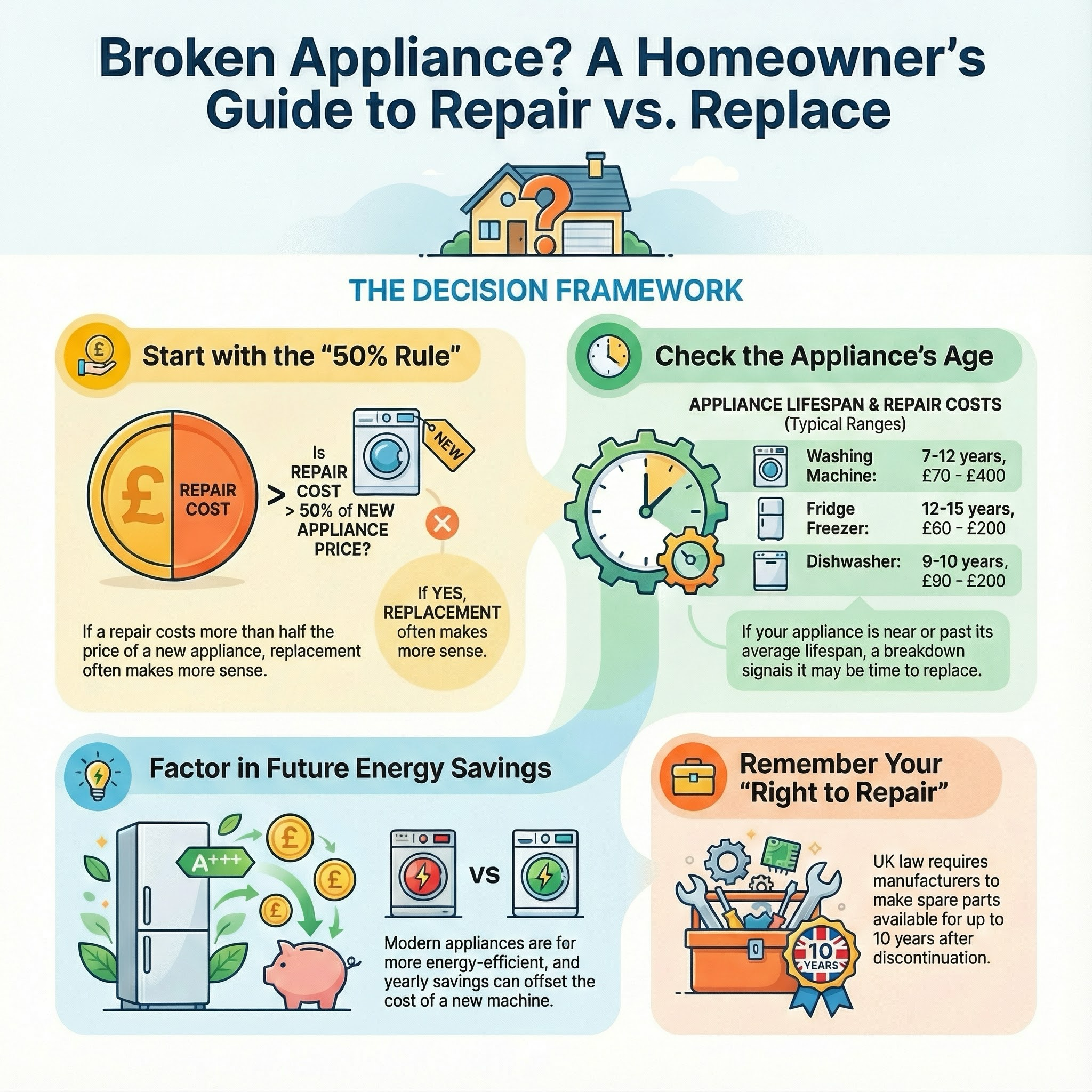
If the repair costs more than 50% of a new equivalent machine, replacement is usually better. However, for premium brands, a £150 repair can often extend the life of a high-quality unit by several years.
This usually points to a motor fault or carbon brushes that have worn down and are causing an internal short. It can also be caused by excessive vibration shaking a loose wire against the metal chassis.
Most general electricians deal with the "fixed wiring" (sockets and consumer units). For the machine itself, you generally need an appliance service technician who understands the specific internal circuitry and mechanical components.
It is helpful but not always necessary. If you have an integrated machine, let them know in advance as they may need to charge more for the extra labour involved in removing it from the cabinetry.
The Printed Circuit Board is the "brain" of the machine. Because they are often specific to a single model and contain complex programming, manufacturers charge a premium for replacements.
This guide was written with AI assistance and is intended for general information only. Prices are estimates based on UK averages and may vary by region. Always get at least three quotes and consult a qualified professional before starting any work.
Ask follow-ups in plain English. The AI explains options, sequencing and what to ask the appliance repair — so you walk in informed.
Microwaves are a staple of the modern UK kitchen, offering convenience for everything from defrosting to full meal preparation. While basic freestanding models ...
READ GUIDE →GuideA faulty fridge or freezer is one of the most urgent domestic repairs, with food safety and waste being the primary concerns. For many UK homeowners, a professi...
READ GUIDE →GuideA cold oven is a major disruption to any UK household, but a failed heating element is one of the most common and cost-effective repairs you can undertake. Inst...
READ GUIDE →GuideScope of Works • inspect appliance and perform diagnostic checks (power, suction, switches, wiring) • clean and test filters, dust bin or bag and airway for blo...
READ GUIDE →GuideA faulty microwave display is a common frustration for UK homeowners. Whether the screen has gone completely dark, is flickering, or showing unintelligible "gho...
READ GUIDE →GuideA faulty oven can bring a UK household to a standstill, turning meal times into a logistical challenge. Whether it is a failed heating element, a noisy fan, or ...
READ GUIDE →