Instant
01 · Ask
Ask the AI a follow-up
Got more questions about washing machine repairs? Describe the bit you're unsure about — the AI explains options, sequencing and what to ask the appliance repair.

Local engineer, parts in the van and a 12-month repair warranty on the work.
You've read the brief on washing machine repairs. Now lean on us to find the right appliance repair — and stay in control of the job.
Got more questions about washing machine repairs? Describe the bit you're unsure about — the AI explains options, sequencing and what to ask the appliance repair.
Costs, timelines, pitfalls and the right questions to ask before any appliance repair starts on washing machine repairs.
Itemised quotes from up to 3 local appliance repairs on washing machine repairs — so you can compare like-for-like, not lump sums.
Ready when you are
Enter your postcode and get free quotes from local pros.
Four moves that separate a smooth job from a nightmare.
Usually caused by frequent low-temperature washes and liquid detergents. A professional can check for mould build-up in the "spider" behind the drum.
Often caused by worn shock absorbers or the machine being unlevel. Ignoring this can lead to cracked concrete weights or snapped drum supports.
Frequently caused by coins, hairpins, or "colour catcher" sheets getting stuck in the pump impeller.
Often a sign of a failing door interlock or a loose connection on the main control board.
Indicative UK ranges and what affects price.
By job type
Quote spread is typically ± 18% — always get 3 quotes.
Appliance Repair quick-view
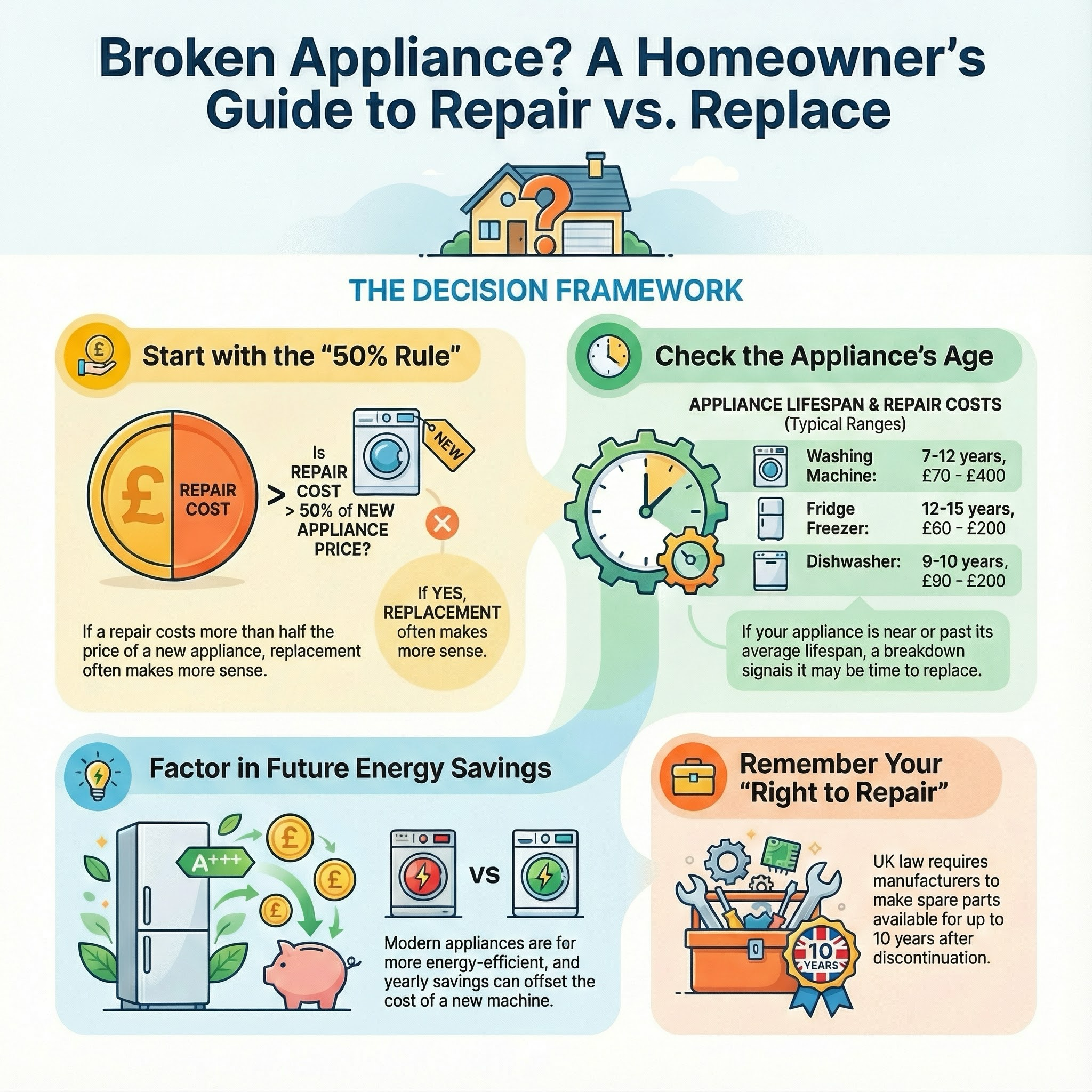
Appliance Repair explained
Most modern machines are complex pieces of engineering that combine high-voltage electrics with high-pressure water systems. Understanding the repair process helps you decide whether to invest in a fix or consider a replacement, especially when dealing with premium brands or integrated models.
Washing machine repair costs vary based on your location in the UK and the brand of the appliance. Premium German brands like Miele or Bosch often command higher parts prices and specialist labour rates compared to budget models.
| Item | Low £ | High £ | Notes |
|---|---|---|---|
| Call-out / Diagnostic Fee | £65 | £110 | Often deducted from the total if repair goes ahead. |
| Labour (Hourly Rate) | £70 | £120 | Varies by region; London and SE are typically higher. |
| Minor Parts (Filters/Belts) | £15 | £45 | Common items often carried in the van. |
| Major Parts (Motor/PCB) | £90 | £300 | Main control boards and motors are the most expensive. |
| Drum Bearings Replacement | £150 | £280 | Labour-intensive; requires a full strip-down. |
| Total Estimated Repair | £140 | £550 | Includes VAT; repairs over £300 may trigger "replace" advice. |
The total price is heavily influenced by the "repairability" of the machine. Some modern budget machines have welded drums, meaning bearings cannot be replaced individually, requiring a whole new drum assembly which can be prohibitively expensive.
Homeowners can safely handle basic maintenance, such as cleaning the debris filter, checking the inlet hoses for kinks, or descaling the machine. However, any work involving the internal electrics, the motor, or the heating element should be left to a professional.
Warning: Washing machines contain capacitors that can hold an electrical charge even when unplugged. Combined with the risk of flooding, professional intervention is the only way to ensure the machine remains safe and your home insurance stays valid.
If your machine is integrated (built into kitchen cabinetry), a professional is essential. Removing and re-levelling an integrated unit without damaging the cupboard doors or the floor requires specialist tools and experience.
Not all appliance engineers are equal. When looking for a local pro, check for the following credentials:
Questions to ask:
Generally, yes. If the repair cost is less than 50% of the price of a new equivalent model, it is worth fixing. However, if the bearings have gone on a budget machine, it is often better to replace it.
This is almost always a sign that the drum bearings have failed. You can check this by spinning the drum by hand when the machine is off—if it feels "gritty" or sounds like a bag of marbles, the bearings need replacing.
Yes. Ensure the detergent drawer is empty and there is clear access to the front and back of the machine. If your machine is under a worktop, clear the items off the top as the engineer may need to remove the lid.
Yes. If the machine cannot drain water within a set timeframe, the sensors will halt the program to prevent flooding. Cleaning the filter every 3-6 months can prevent this common service call.
Some large UK repair firms offer a fixed price that includes all labour and parts. This can be great value for major failures (like a PCB) but is often more expensive than a local independent engineer for simple fixes like a new belt.
This guide was written with AI assistance and is intended for general information only. Prices are estimates based on UK averages and may vary by region. Always get at least three quotes and consult a qualified professional before starting any work.
Ask follow-ups in plain English. The AI explains options, sequencing and what to ask the appliance repair — so you walk in informed.
Microwaves are a staple of the modern UK kitchen, offering convenience for everything from defrosting to full meal preparation. While basic freestanding models ...
READ GUIDE →GuideA faulty fridge or freezer is one of the most urgent domestic repairs, with food safety and waste being the primary concerns. For many UK homeowners, a professi...
READ GUIDE →GuideA cold oven is a major disruption to any UK household, but a failed heating element is one of the most common and cost-effective repairs you can undertake. Inst...
READ GUIDE →GuideScope of Works • inspect appliance and perform diagnostic checks (power, suction, switches, wiring) • clean and test filters, dust bin or bag and airway for blo...
READ GUIDE →GuideA faulty microwave display is a common frustration for UK homeowners. Whether the screen has gone completely dark, is flickering, or showing unintelligible "gho...
READ GUIDE →GuideA faulty oven can bring a UK household to a standstill, turning meal times into a logistical challenge. Whether it is a failed heating element, a noisy fan, or ...
READ GUIDE →