Instant
01 · Ask
Ask the AI a follow-up
Got more questions about brick Retaining Wall — Cost, Engineering & UK? Describe the bit you're unsure about — the AI explains options, sequencing and what to ask the bricklayer.

Engineer-checked retaining wall — drainage, weep holes, foundations and proper backfill.
You've read the brief on brick Retaining Wall — Cost, Engineering & UK. Now lean on us to find the right bricklayer — and stay in control of the job.
Got more questions about brick Retaining Wall — Cost, Engineering & UK? Describe the bit you're unsure about — the AI explains options, sequencing and what to ask the bricklayer.
Costs, timelines, pitfalls and the right questions to ask before any bricklayer starts on brick Retaining Wall — Cost, Engineering & UK.
Itemised quotes from up to 3 local bricklayers on brick Retaining Wall — Cost, Engineering & UK — so you can compare like-for-like, not lump sums.
Ready when you are
Enter your postcode and get free quotes from local pros.
Four moves that separate a smooth job from a nightmare.
— almost always water pressure from missing drainage.
— water ingress + frost. Sealed coping prevents.
— undersized for the load. Engineer-designed foundations prevent.
— foundation not deep enough.
Indicative UK ranges and what affects price.
By job type
Quote spread is typically ± 18% — always get 3 quotes.
Bricklayer quick-view
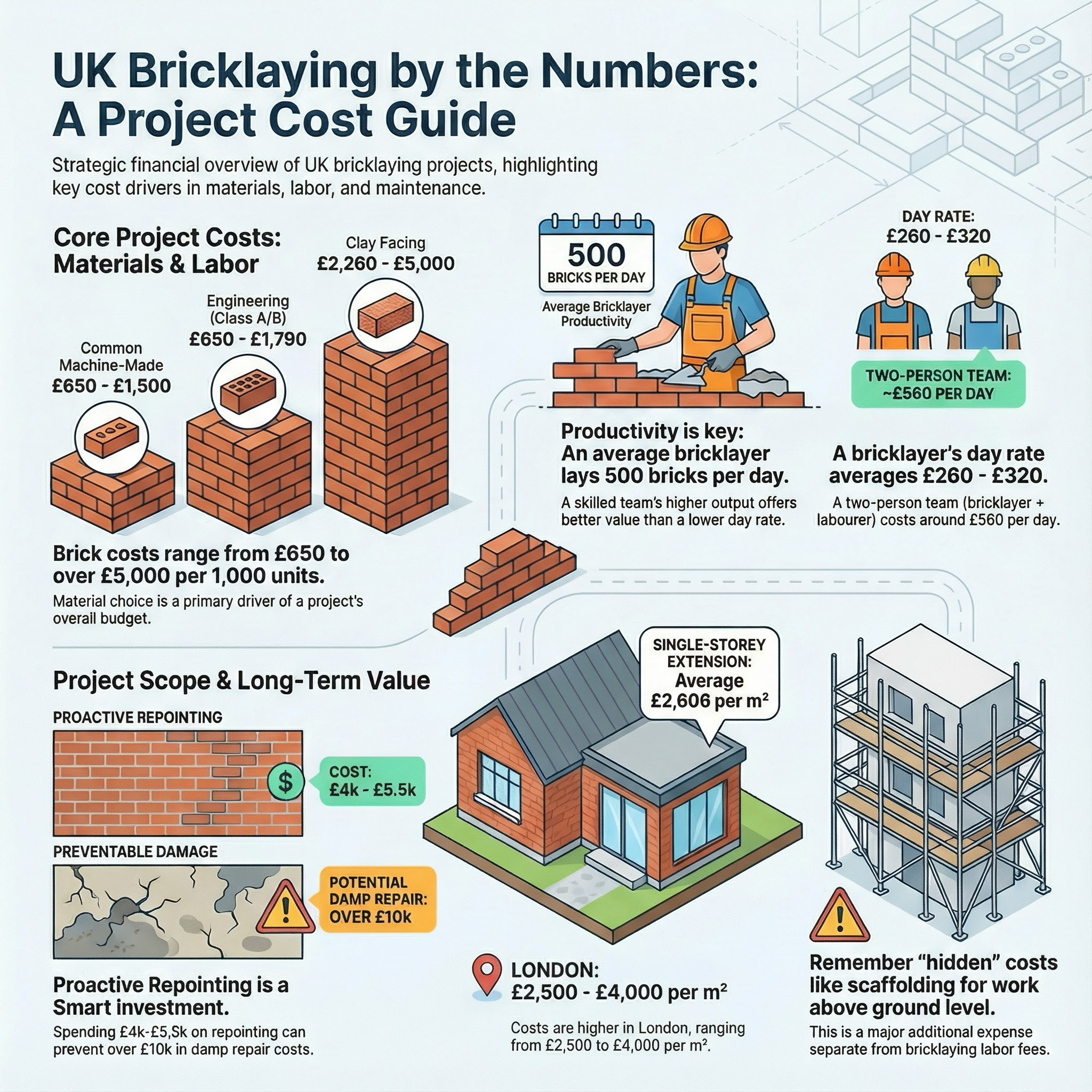
Retaining walls are not garden walls — they hold back earth, water, and load, and their failure modes are dramatic. A retaining wall that collapses can take a hillside down with it. This guide covers what brick retaining walls actually cost in 2026, when you need a structural engineer, and the drainage detail that separates a 30-year wall from a 3-year liability.
The single biggest mistake on retaining walls is missing drainage — water pressure behind the wall is what fails 80% of failed retaining structures in the UK.
| Item | Low £ | High £ | Notes |
|---|---|---|---|
| 600 mm tall (per linear m) | 220 | 400 | Modest retention |
| 1.0 m tall (per linear m) | 320 | 550 | Standard residential |
| 1.5 m tall (per linear m) | 450 | 750 | Engineer-designed essential |
| Engineering / design fees | 500 | 2,000 | For walls over 1 m |
| Drainage backfill (per linear m) | 60 | 140 | Geotextile + free-draining stone |
| 10 m of 1.0 m retaining wall | 3,800 | 6,900 | Inc. engineering |
| 10 m of 1.5 m retaining wall | 5,500 | 9,500 | Inc. engineering |
Retaining walls are 50–80% more expensive per linear m than garden walls of the same height because of foundations, drainage, and reinforcement.
Specialist work only. Retaining walls fail dramatically — taking soil, structures, and sometimes people with them. Always hire experienced bricklayers with retaining-wall portfolios and use structural-engineer design for anything over 1 m.
For any retaining wall over 1 m, and for any wall holding back significant load (under a driveway, retaining a slope above a property, etc.). Below 1 m an experienced bricklayer can usually design appropriately.
£500–£1,500 typically for a domestic retaining wall design and drawings. Money well spent — a single failure costs 10× more.
Water trapped behind a wall creates massive hydrostatic pressure — far more than the soil itself. Drainage relieves this pressure and stops the wall failing.
Properly designed and drained: 50–100 years. Poorly built: 5–15 years.
Yes, but the foundation design needs to account for clay's seasonal movement. Deep foundations with reinforced concrete pads are typical.
Walls over 1 m in front gardens or 2 m elsewhere need planning. Most retaining walls fall in this range — always check before building.
This guide was written with AI assistance and is intended for general information only. Prices are estimates based on UK averages and may vary by region. Always get at least three quotes and consult a qualified professional before starting any work.
Ask follow-ups in plain English. The AI explains options, sequencing and what to ask the bricklayer — so you walk in informed.
Brickwork is the backbone of most UK homes, providing structural integrity and protection against our unpredictable weather. Over time, exposure to rain, frost,...
READ GUIDE →GuideYour front steps are more than just a functional entrance; they are a vital part of your home’s kerb appeal and structural safety. For UK homeowners, replacing ...
READ GUIDE →GuideRepointing is the process of renewing the external part of mortar joints between bricks. Over time, the UK’s harsh weather causes mortar to crumble, crack, and ...
READ GUIDE →GuideCracks in brickwork are a common sight for UK homeowners, often triggered by seasonal temperature changes, heavy clay soils, or historical settlement. While man...
READ GUIDE →GuideGarden walls are more than just boundaries; they provide security, privacy, and kerb appeal to UK homes. However, constant exposure to the British weather—parti...
READ GUIDE →GuideHistoric dry stone walls are a defining feature of the British countryside and many period properties. Unlike modern masonry, these structures rely on gravity a...
READ GUIDE →