Instant
01 · Ask
Ask the AI a follow-up
Got more questions about garden Wall — Cost, Height & UK Install? Describe the bit you're unsure about — the AI explains options, sequencing and what to ask the bricklayer.

Half-brick or full-brick — under 2m without planning, with proper foundation and coping.
You've read the brief on garden Wall — Cost, Height & UK Install. Now lean on us to find the right bricklayer — and stay in control of the job.
Got more questions about garden Wall — Cost, Height & UK Install? Describe the bit you're unsure about — the AI explains options, sequencing and what to ask the bricklayer.
Costs, timelines, pitfalls and the right questions to ask before any bricklayer starts on garden Wall — Cost, Height & UK Install.
Itemised quotes from up to 3 local bricklayers on garden Wall — Cost, Height & UK Install — so you can compare like-for-like, not lump sums.
Ready when you are
Enter your postcode and get free quotes from local pros.
Four moves that separate a smooth job from a nightmare.
— wall heaves in winter as ground freezes. 450 mm minimum depth in most UK soils.
— damp wicks up from ground, mortar fails, frost spalls bricks within 5 years.
— walls over 6 m crack as they expand/contract.
— too strong (4:1) for soft bricks causes bricks to crack instead of mortar.
Indicative UK ranges and what affects price.
By job type
Quote spread is typically ± 18% — always get 3 quotes.
Bricklayer quick-view
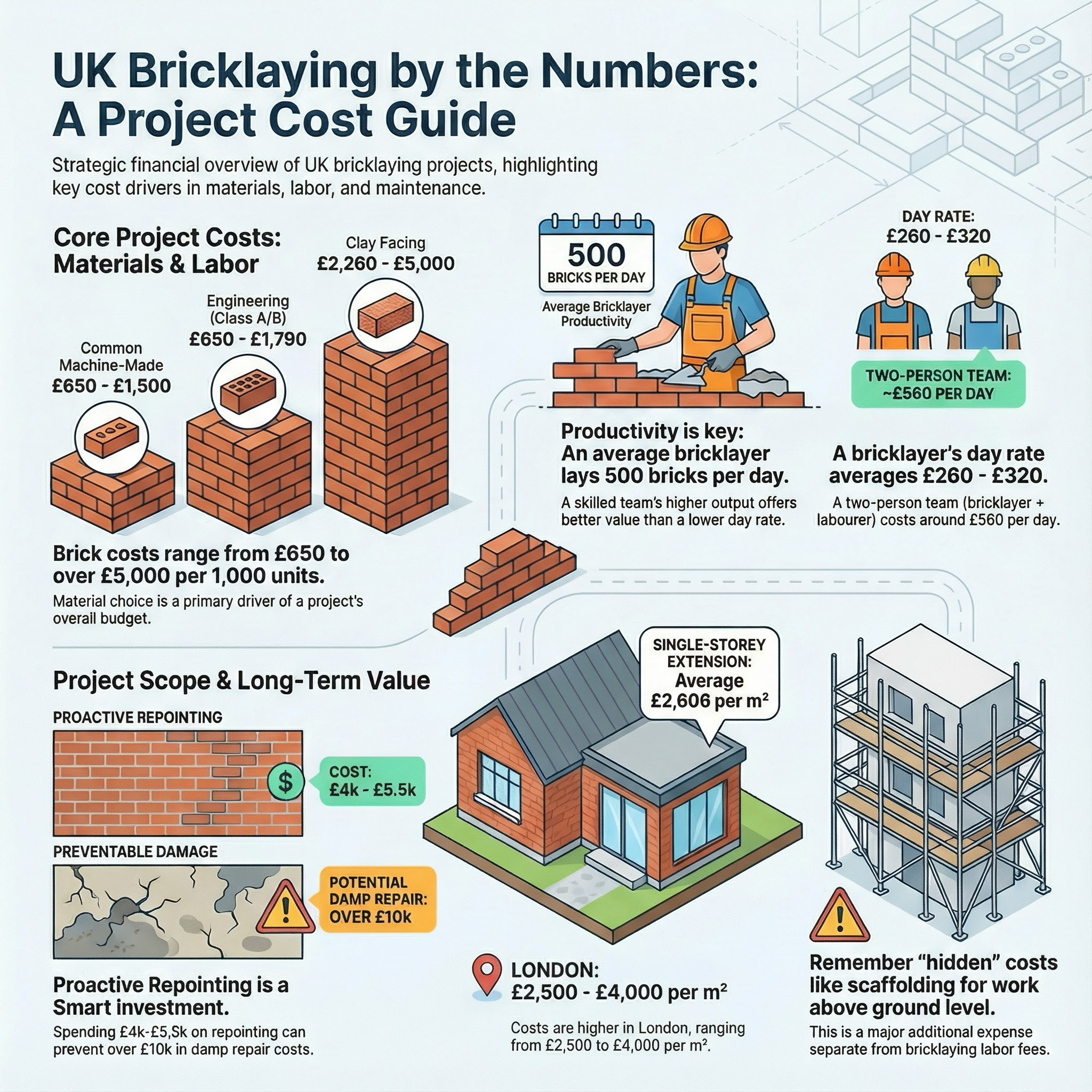
A brick garden wall is one of the most-quoted bricklayer jobs in the UK — and one where shortcuts cause the most callbacks years later. Get the foundations and damp course right and the wall lasts a century; skip the basics and it bulges, cracks, or leans inside a decade. This guide covers what brick garden walls actually cost in 2026, the planning rules that apply, and the install detail that matters.
Most domestic garden walls are 1.2 m (single-skin) or 1.8 m (double-skin / cavity) — anything taller is structurally serious and usually needs engineering input.
| Item | Low £ | High £ | Notes |
|---|---|---|---|
| 1.2 m single-skin wall (per linear m) | 120 | 200 | Standard 215 mm wide |
| 1.8 m single-skin wall (per linear m) | 180 | 280 | Needs piers every 3 m |
| 1.8 m double-skin wall (per linear m) | 240 | 400 | Standard cavity construction |
| Decorative capping (per linear m) | 25 | 80 | Plain, half-round, or stone |
| Foundations included above — extra if rocky | 50 | 150 | Per linear m for difficult ground |
| 10 m of 1.2 m wall | 1,300 | 2,200 | Standard front garden boundary |
| 10 m of 1.8 m wall | 2,000 | 3,200 | Privacy wall |
Brick choice is the biggest variable — engineering bricks at £600/1,000 vs handmade reclaimed at £2,500/1,000 changes total cost dramatically.
Building a structurally sound brick wall takes years of bricklaying experience. DIYers regularly lay walls that look fine for 18 months and fail within 5 years. Foundation depth, mortar mix, plumb, and bond detail all matter. For walls over 600 mm or in any visible location, hire a professional bricklayer.
Walls under 1 m in front gardens and 2 m elsewhere are permitted development. Anything taller, or in conservation areas, usually needs permission.
Properly built with good foundations and mortar: 80–150 years. Most failed walls are install problems, not material failure.
Engineering bricks (Class B) for foundations and DPC course. Facing bricks (Tudor blends or local reds) for the visible courses. Hand-made for high-end heritage looks.
Single-skin (215 mm) is fine for walls up to 1.2 m. Double-skin (327 mm or cavity) for 1.5 m+ or where the wall has a structural role.
Cement mortar 30–50 years before repointing. Lime mortar 100+ years if maintained, but softer and needs care.
Yes — quality boundary walls add kerb appeal. A handmade brick wall on a period property can add 1–3% to home value.
This guide was written with AI assistance and is intended for general information only. Prices are estimates based on UK averages and may vary by region. Always get at least three quotes and consult a qualified professional before starting any work.
Ask follow-ups in plain English. The AI explains options, sequencing and what to ask the bricklayer — so you walk in informed.
Brickwork is the backbone of most UK homes, providing structural integrity and protection against our unpredictable weather. Over time, exposure to rain, frost,...
READ GUIDE →GuideYour front steps are more than just a functional entrance; they are a vital part of your home’s kerb appeal and structural safety. For UK homeowners, replacing ...
READ GUIDE →GuideRepointing is the process of renewing the external part of mortar joints between bricks. Over time, the UK’s harsh weather causes mortar to crumble, crack, and ...
READ GUIDE →GuideCracks in brickwork are a common sight for UK homeowners, often triggered by seasonal temperature changes, heavy clay soils, or historical settlement. While man...
READ GUIDE →GuideGarden walls are more than just boundaries; they provide security, privacy, and kerb appeal to UK homes. However, constant exposure to the British weather—parti...
READ GUIDE →GuideHistoric dry stone walls are a defining feature of the British countryside and many period properties. Unlike modern masonry, these structures rely on gravity a...
READ GUIDE →