Instant
01 · Ask
Ask the AI a follow-up
Got more questions about london Stock Bricks — Heritage Cost & UK Install? Describe the bit you're unsure about — the AI explains options, sequencing and what to ask the bricklayer.

Yellow stocks for Victorian terraces — matching, sourcing and what reclaimed vs new costs in 2026.
You've read the brief on london Stock Bricks — Heritage Cost & UK Install. Now lean on us to find the right bricklayer — and stay in control of the job.
Got more questions about london Stock Bricks — Heritage Cost & UK Install? Describe the bit you're unsure about — the AI explains options, sequencing and what to ask the bricklayer.
Costs, timelines, pitfalls and the right questions to ask before any bricklayer starts on london Stock Bricks — Heritage Cost & UK Install.
Itemised quotes from up to 3 local bricklayers on london Stock Bricks — Heritage Cost & UK Install — so you can compare like-for-like, not lump sums.
Ready when you are
Enter your postcode and get free quotes from local pros.
Four moves that separate a smooth job from a nightmare.
— modern strong cement destroys soft stocks. Lime mortar essential.
— reclaimed bricks vary; embrace it or hand-sort for placement.
— old bricks may have hairline cracks. Inspect carefully.
— popular bricks; book early.
Indicative UK ranges and what affects price.
By job type
Quote spread is typically ± 18% — always get 3 quotes.
Bricklayer quick-view
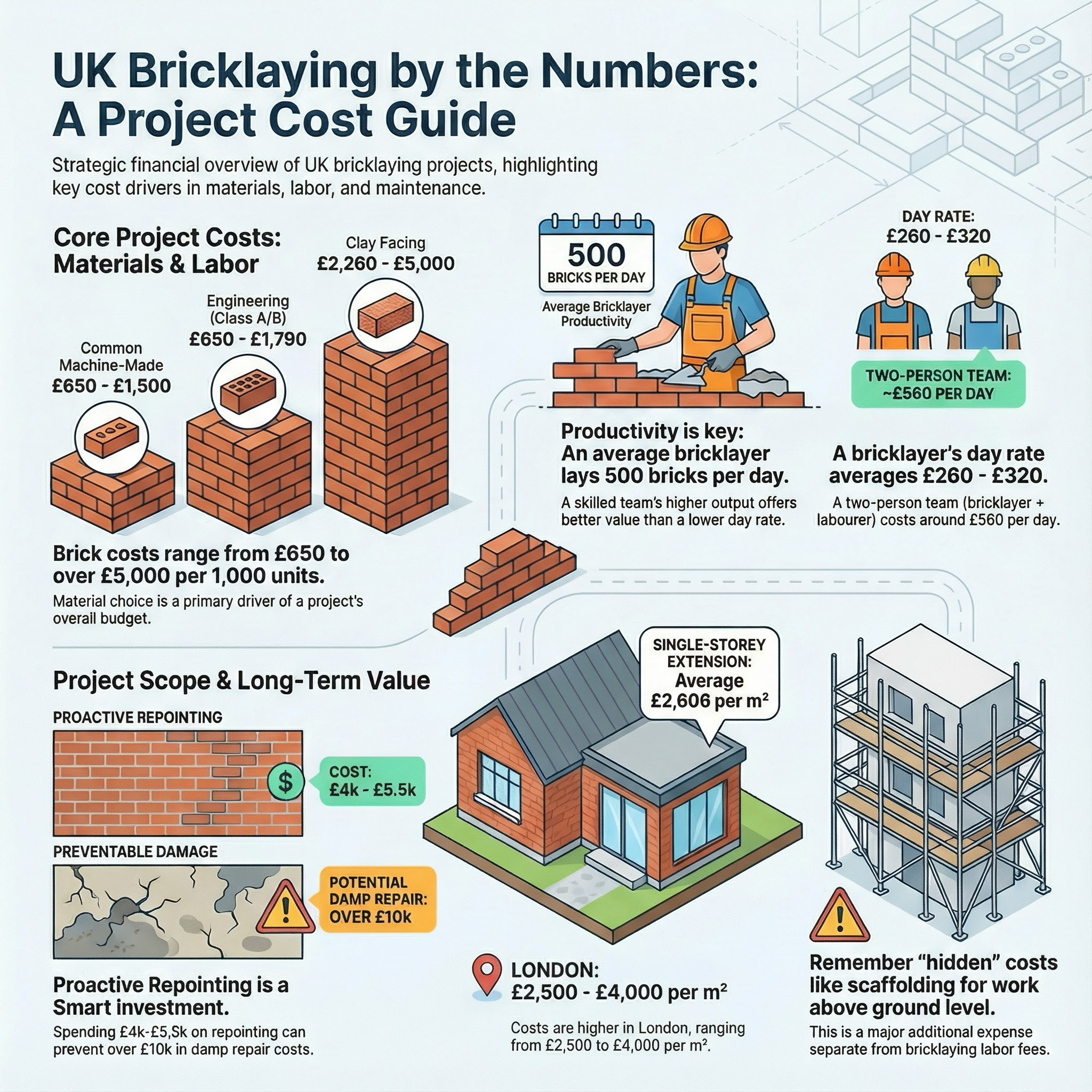
London Stock bricks are the yellow-brown bricks that built Victorian London — millions of them, made from London clay between 1700 and 1939. Today, they're almost exclusively reclaimed (modern manufactured "London Stock" looks similar but lacks the variation of the originals). This guide covers what genuine reclaimed London Stocks cost in 2026, where to source them, and the install detail for matching to existing Victorian work.
Hand-made stocks have a unique colour variation — yellows, browns, oranges, occasionally near-black — that no machine-made brick replicates.
| Source | Low £/1,000 | High £/1,000 | Notes |
|---|---|---|---|
| Modern reproduction stocks | 500 | 900 | Machine-made, uniform |
| Reclaimed Victorian stocks | 800 | 1,400 | Mixed yards |
| Selected reclaimed stocks | 1,400 | 1,800 | Cleaned, sorted, certified |
| Hand-picked from old buildings | 1,500 | 2,500 | Premium provenance |
Reclaimed bricks are 2–3× more expensive than modern equivalents. The look is unreplicable.
Look for natural colour variation, mortar residue on some faces, irregular bottom faces from being mortared. Provenance certificates from reputable yards.
Old stocks are soft. Cement mortar is too strong — it expands with moisture and cracks the bricks rather than the joints. Lime is softer and forgiving.
UK reclamation yards: Salvo-listed companies specialise. Online marketplaces for smaller quantities.
For inconspicuous areas yes. For visible heritage repairs, reclaimed is strongly preferred — listed property conditions may require it.
Already 150+ years old. With sympathetic repair and lime mortar, another 100+ years easily.
Yes — 20–40% slower because of variable sizes and pre-soaking. Skilled bricklayers needed.
This guide was written with AI assistance and is intended for general information only. Prices are estimates based on UK averages and may vary by region. Always get at least three quotes and consult a qualified professional before starting any work.
Ask follow-ups in plain English. The AI explains options, sequencing and what to ask the bricklayer — so you walk in informed.
Brickwork is the backbone of most UK homes, providing structural integrity and protection against our unpredictable weather. Over time, exposure to rain, frost,...
READ GUIDE →GuideYour front steps are more than just a functional entrance; they are a vital part of your home’s kerb appeal and structural safety. For UK homeowners, replacing ...
READ GUIDE →GuideRepointing is the process of renewing the external part of mortar joints between bricks. Over time, the UK’s harsh weather causes mortar to crumble, crack, and ...
READ GUIDE →GuideCracks in brickwork are a common sight for UK homeowners, often triggered by seasonal temperature changes, heavy clay soils, or historical settlement. While man...
READ GUIDE →GuideGarden walls are more than just boundaries; they provide security, privacy, and kerb appeal to UK homes. However, constant exposure to the British weather—parti...
READ GUIDE →GuideHistoric dry stone walls are a defining feature of the British countryside and many period properties. Unlike modern masonry, these structures rely on gravity a...
READ GUIDE →