Instant
01 · Ask
Ask the AI a follow-up
Got more questions about repointing — Cost, Lime vs Cement & UK? Describe the bit you're unsure about — the AI explains options, sequencing and what to ask the bricklayer.

Lime or cement, partial or full façade — what affects the per-m² rate in 2026.
You've read the brief on repointing — Cost, Lime vs Cement & UK. Now lean on us to find the right bricklayer — and stay in control of the job.
Got more questions about repointing — Cost, Lime vs Cement & UK? Describe the bit you're unsure about — the AI explains options, sequencing and what to ask the bricklayer.
Costs, timelines, pitfalls and the right questions to ask before any bricklayer starts on repointing — Cost, Lime vs Cement & UK.
Itemised quotes from up to 3 local bricklayers on repointing — Cost, Lime vs Cement & UK — so you can compare like-for-like, not lump sums.
Ready when you are
Enter your postcode and get free quotes from local pros.
Four moves that separate a smooth job from a nightmare.
— bricks crack as mortar is too strong. Irreversible damage.
— flat or recessed joints trap water.
— visible from across the street.
— new mortar pops out within 2 years.
Indicative UK ranges and what affects price.
By job type
Quote spread is typically ± 18% — always get 3 quotes.
Bricklayer quick-view
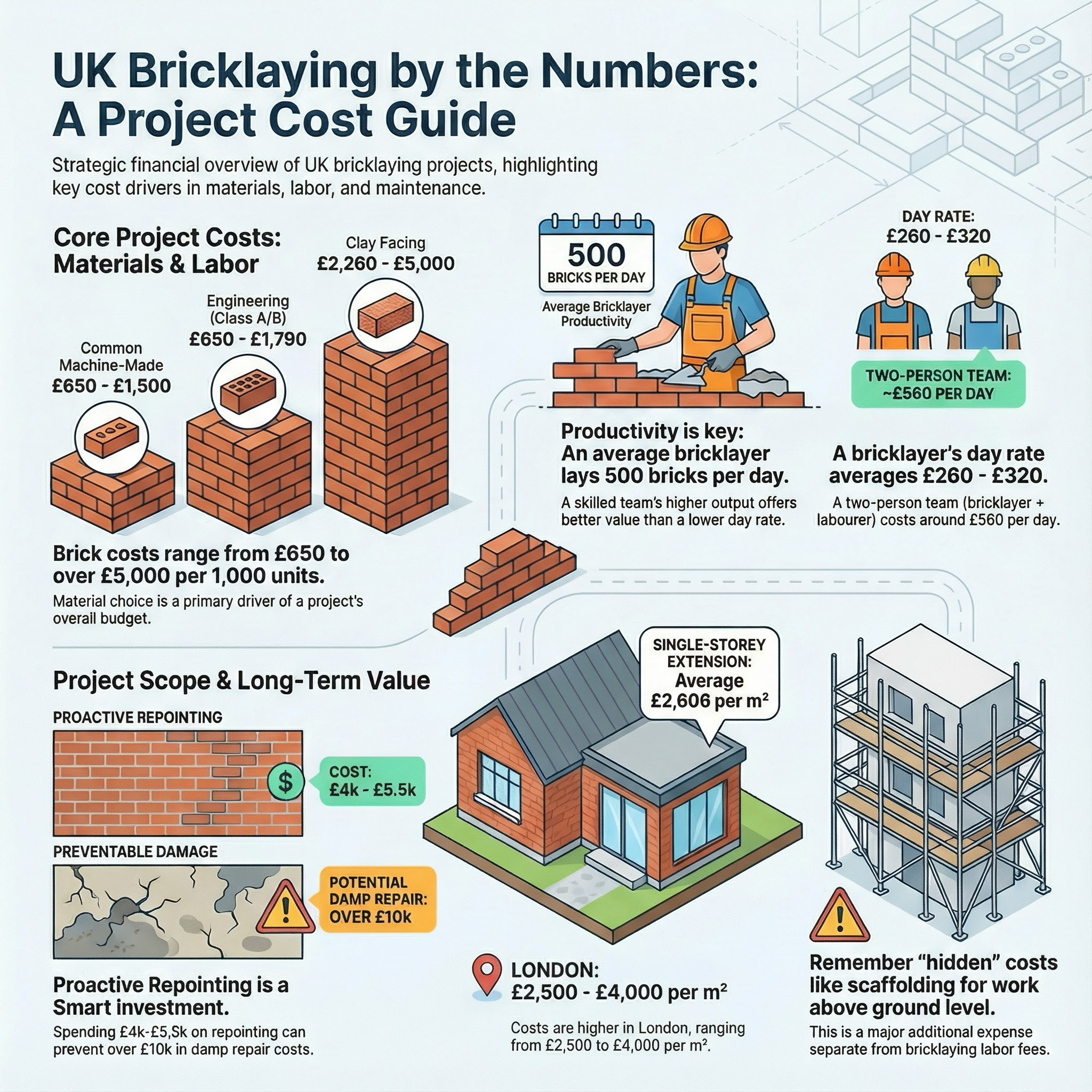
Repointing — replacing degraded mortar joints between bricks — is one of the most common bricklayer jobs in the UK. Done right, it adds decades to a wall's life. Done wrong (using cement on soft heritage brick), it destroys the wall it was meant to save. This guide covers what repointing costs in 2026, the critical lime vs cement decision, and the install detail.
The single most important rule: hard cement mortar on soft pre-1919 bricks destroys them. Soft lime mortar on modern bricks is fine but more expensive. Choose based on brick, not preference.
| Mortar type | Low £/m² | High £/m² | Notes |
|---|---|---|---|
| Cement repointing | 40 | 80 | Modern buildings |
| Lime repointing | 65 | 120 | Heritage / listed |
| Specialist heritage mortars | 80 | 180 | Conservation work |
| Scaffolding (if needed) | +£500 | +£3,000 | Per project |
| 30 m² wall, cement repointing | 1,200 | 2,400 | Standard back wall |
Repointing is moderately DIY-friendly for cement work on flat walls. Lime repointing and heritage work needs specialist experience. Wrong mortar mix causes irreversible damage.
Joints crumbling, missing in places, water ingress inside the wall. Tap with a coin — sound joints don't flake or dust.
Cement: 30–50 years. Lime: 50–100 years.
Yes — partial repointing is common. Match the new mortar colour and consistency for invisible joins.
Use lime for the original parts; matching mortar where someone previously used cement. Honest repair acknowledges history.
Slower to work, longer curing, fewer skilled trades available. Premium for the skilled time.
Yes if comparing — lime has softer, off-white character. Cement is harder, greyer. Both can be tinted to match.
This guide was written with AI assistance and is intended for general information only. Prices are estimates based on UK averages and may vary by region. Always get at least three quotes and consult a qualified professional before starting any work.
Ask follow-ups in plain English. The AI explains options, sequencing and what to ask the bricklayer — so you walk in informed.
Brickwork is the backbone of most UK homes, providing structural integrity and protection against our unpredictable weather. Over time, exposure to rain, frost,...
READ GUIDE →GuideYour front steps are more than just a functional entrance; they are a vital part of your home’s kerb appeal and structural safety. For UK homeowners, replacing ...
READ GUIDE →GuideRepointing is the process of renewing the external part of mortar joints between bricks. Over time, the UK’s harsh weather causes mortar to crumble, crack, and ...
READ GUIDE →GuideCracks in brickwork are a common sight for UK homeowners, often triggered by seasonal temperature changes, heavy clay soils, or historical settlement. While man...
READ GUIDE →GuideGarden walls are more than just boundaries; they provide security, privacy, and kerb appeal to UK homes. However, constant exposure to the British weather—parti...
READ GUIDE →GuideHistoric dry stone walls are a defining feature of the British countryside and many period properties. Unlike modern masonry, these structures rely on gravity a...
READ GUIDE →