Instant
01 · Ask
Ask the AI a follow-up
Got more questions about door Adjustment Costs &? Describe the bit you're unsure about — the AI explains options, sequencing and what to ask the carpenter.

Sticking, dropped or rubbing — hinges packed, latch realigned and a clean reveal restored.
You've read the brief on door Adjustment Costs &. Now lean on us to find the right carpenter — and stay in control of the job.
Got more questions about door Adjustment Costs &? Describe the bit you're unsure about — the AI explains options, sequencing and what to ask the carpenter.
Costs, timelines, pitfalls and the right questions to ask before any carpenter starts on door Adjustment Costs &.
Itemised quotes from up to 3 local carpenters on door Adjustment Costs & — so you can compare like-for-like, not lump sums.
Ready when you are
Enter your postcode and get free quotes from local pros.
Four moves that separate a smooth job from a nightmare.
Removing too much timber leads to "gapping," which looks poor and creates significant draughts.
Doors often stick after being painted because the extra thickness of the paint hasn't been accounted for; always wait for the paint to cure fully before adjusting.
Repeatedly tightening screws into old timber can strip the wood; a professional will "plug and glue" the holes to create a fresh grip.
New, thicker carpets or underlay are a common cause of binding; the door usually needs a "bottom shave" rather than side adjustment.
Indicative UK ranges and what affects price.
By job type
Quote spread is typically ± 18% — always get 3 quotes.
Carpenter quick-view
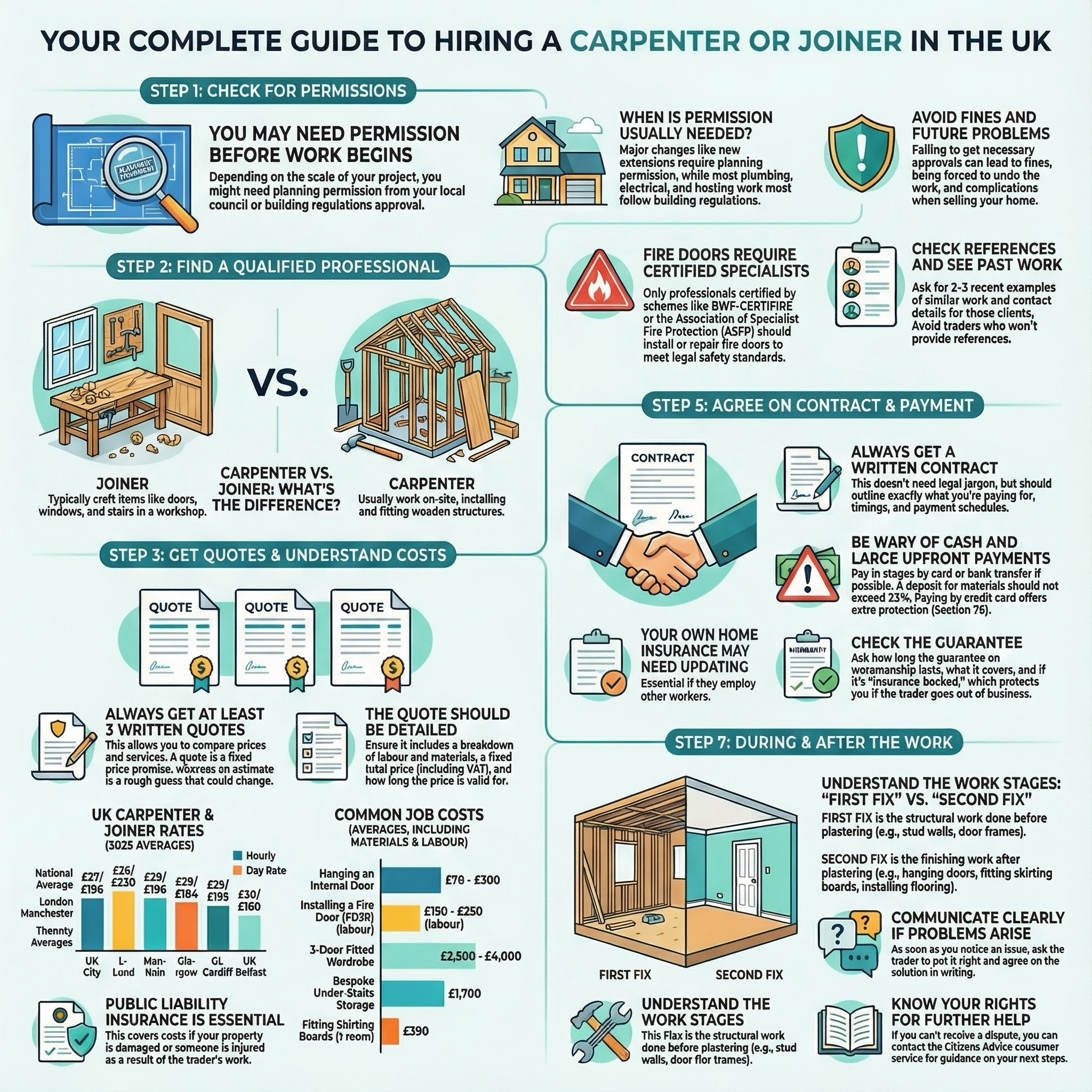
Carpenter explained
Professional door adjustment ensures your internal and external doors operate smoothly without damaging the flooring or the jamb. For UK homeowners, hiring a skilled carpenter to "ease and adjust" doors is a cost-effective way to extend the life of your joinery and improve the comfort of your living space.
| Item | Low £ | High £ | Notes |
|---|---|---|---|
| Call-out / Minimum Charge | £70 | £130 | Usually covers the first hour of work and travel. |
| Labour (Hourly Rate) | £40 | £80 | Varies by region; London and the SE sit at the higher end. |
| Materials (Hinges/Screws/Seals) | £10 | £50 | Standard steel hinges are cheap; high-end brass or weather-strips cost more. |
| Waste Disposal | £0 | £15 | Most carpenters include shavings/dust cleanup in their rate. |
| Total (Single Door Adjustment) | £110 | £240 | Includes call-out and minor material costs. |
The primary factor affecting price is the type of door; a standard hollow-core internal door is much faster to adjust than a heavy solid oak front door or a fire-rated door. If you have multiple doors requiring attention, most carpenters will offer a discounted day or half-day rate rather than charging per door.
While tightening a loose screw is a simple DIY task, planing a door is a precision job that is easy to get wrong. Taking too much off can leave unsightly gaps that cause draughts, or worse, ruin a fire door’s integrity. Professionals use specialised power planes and door stands to ensure a perfectly straight, clean edge.
Warning: If you are adjusting a fire door (common in flats and garages), you must maintain specific gaps (usually 3mm). Improper DIY trimming can invalidate your home insurance and breach fire safety regulations.
Wood is a hygroscopic material, meaning it absorbs moisture from the air. In the UK's damp winter months, timber doors swell, often causing them to bind against the frame. A carpenter can "ease" the door to allow for this seasonal expansion.
No, uPVC and composite doors cannot be planed. These doors are adjusted via the "flag hinges" or by "toeing and heeling" the glass/panel. If your uPVC door is sticking, you need a specialist who understands these specific hinge mechanisms.
Typically, a gap of 10mm to 15mm is standard for internal doors to allow for air circulation, especially if you have a ventilation system or thick carpets. For fire doors, this gap is strictly regulated and usually shouldn't exceed 10mm.
It can. Often, draughts are caused by the door not sitting flush against the weather-stripping. Adjusting the hinges or the strike plate can pull the door tighter against the seals, significantly reducing heat loss.
It is almost always significantly cheaper to adjust an existing door. A new quality solid wood door can cost £200–£500 plus installation, whereas a professional adjustment usually costs under £150 and can make an old door feel like new.
This guide was written with AI assistance and is intended for general information only. Prices are estimates based on UK averages and may vary by region. Always get at least three quotes and consult a qualified professional before starting any work.
Ask follow-ups in plain English. The AI explains options, sequencing and what to ask the carpenter — so you walk in informed.
Joinery and Metalwork Installation Guide Scope of Works Survey & design brief – site measure‑up, discuss timber/steel grade, produce sketches/CAD. Workshop ...
READ GUIDE →GuideAssembling a chest of drawers is one of the most common yet frustrating home improvement tasks. Whether you have purchased a flat-pack unit from a high-street r...
READ GUIDE →GuideCustom carpentry is the hallmark of a well-finished UK home. Unlike flat-pack furniture, bespoke joinery is designed to fit the unique, often irregular dimensio...
READ GUIDE →GuideLetterbox Repair Guide Scope of Works Initial inspection & measure‑up – check door thickness, sleeve length and draught issues. Remove interior trim & o...
READ GUIDE →GuideFrom squeaky floorboards and sticking doors to more serious issues like timber rot or structural joist damage, carpentry repairs are a staple of UK home mainten...
READ GUIDE →GuideA wobbly or broken dining chair leg doesn't mean your furniture set is destined for the skip. Professional repair restores the structural integrity and aestheti...
READ GUIDE →