Instant
01 · Ask
Ask the AI a follow-up
Got more questions about door & Wall Fittings Costs &? Describe the bit you're unsure about — the AI explains options, sequencing and what to ask the carpenter.

Hooks, rails, picture rails, handles and dado — supplied, fitted and finished to spec.
You've read the brief on door & Wall Fittings Costs &. Now lean on us to find the right carpenter — and stay in control of the job.
Got more questions about door & Wall Fittings Costs &? Describe the bit you're unsure about — the AI explains options, sequencing and what to ask the carpenter.
Costs, timelines, pitfalls and the right questions to ask before any carpenter starts on door & Wall Fittings Costs &.
Itemised quotes from up to 3 local carpenters on door & Wall Fittings Costs & — so you can compare like-for-like, not lump sums.
Ready when you are
Enter your postcode and get free quotes from local pros.
Four moves that separate a smooth job from a nightmare.
Many modern UK homes have a gap between the plasterboard and the brickwork; standard plugs will fail here without specialist "Corefix" or similar spacers.
Standard screws will not hold in modern lightweight internal doors; they require specialist gravity toggles or "Molly" bolts.
Drilling into a central heating pipe or electrical conduit can lead to expensive emergency repair costs.
Overloading a plasterboard wall without finding the timber studs can lead to the entire wall section collapsing.
Indicative UK ranges and what affects price.
By job type
Quote spread is typically ± 18% — always get 3 quotes.
Carpenter quick-view
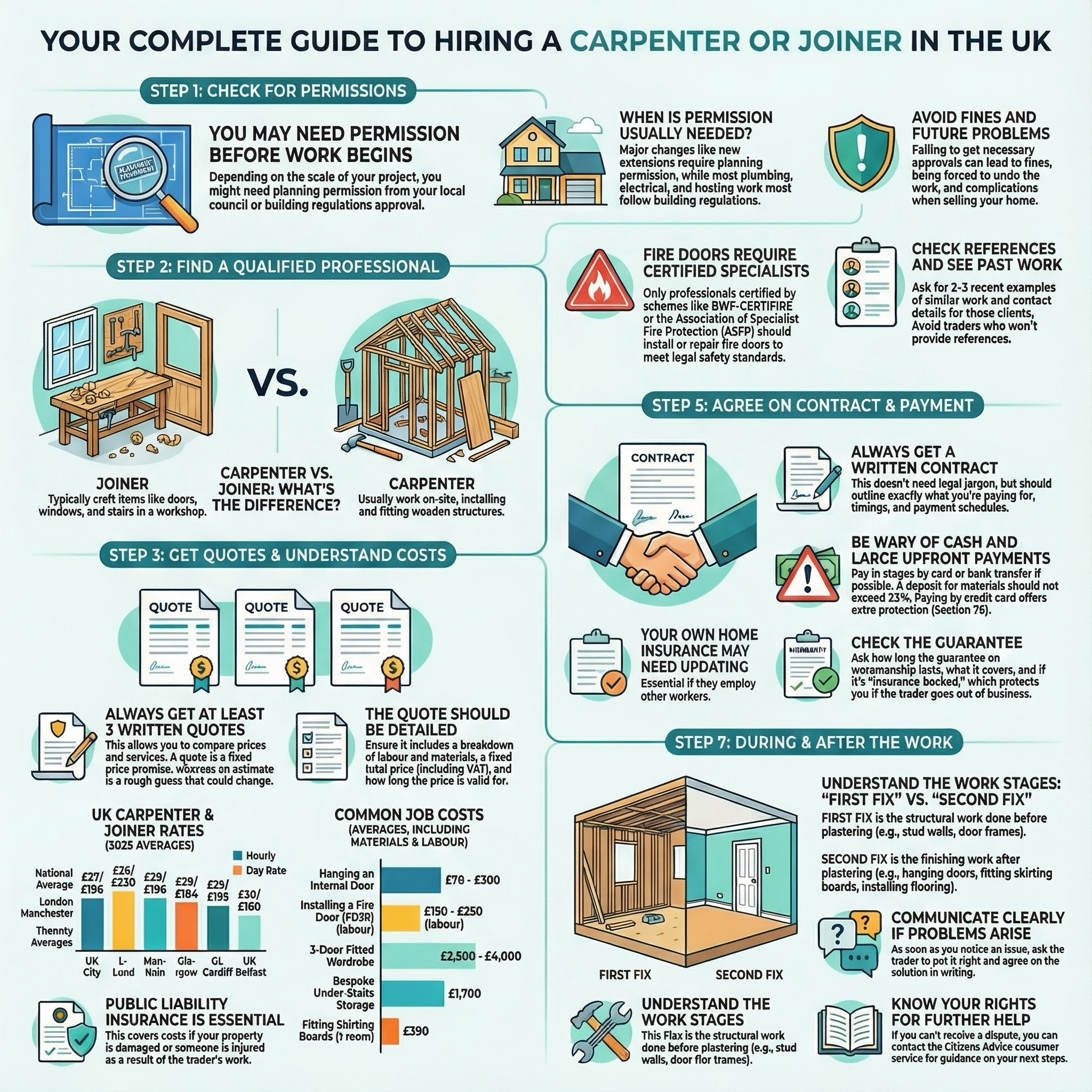
Carpenter explained
In the UK, modern homes often feature a mix of solid masonry and hollow plasterboard walls, each requiring specific fixings and expertise. Hiring a professional carpenter ensures that your fittings are perfectly level, securely anchored, and capable of bearing the necessary weight without damaging your property.
Prices for door and wall fittings vary based on your location in the UK and the complexity of the installation. Most carpenters or handymen will charge a minimum call-out fee to cover travel and the first hour of labour.
| Item / Service | Low £ | High £ | Notes |
|---|---|---|---|
| Call-out Fee (First Hour) | £60 | £120 | Higher rates apply in London and the SE. |
| Labour (Per Hour thereafter) | £35 | £70 | Standard rate for additional tasks. |
| Internal Door Handle Set (Labour only) | £20 | £45 | Per door; assumes existing mortice. |
| TV Wall Mounting (Large Screen) | £70 | £160 | Includes heavy-duty fixings and levelling. |
| Floating Shelf Installation | £30 | £60 | Per shelf; depends on wall type. |
| Consumables (Plugs, Screws, Glue) | £10 | £30 | Small flat fee for professional-grade fixings. |
Factors affecting the price include the number of items to be fitted, the hardness of the wall material (e.g., engineering brick), and whether you require cables to be chased into the wall or hidden behind trunking.
While hanging a simple picture frame is a straightforward DIY task, more complex fittings often require a professional. Carpenters possess the high-torque drills and specialist bits needed for masonry, as well as the expertise to fix heavy items to modern "drywall" without the bracket pulling through the plaster.
Safety Warning: If you are mounting items near sockets or light switches, there is a high risk of hitting electrical cables. Professionals use calibrated scanners to avoid potentially fatal accidents.
Furthermore, fitting door hardware requires "dead-on" accuracy; a millimetre of misalignment can cause a door to stick, rattle, or fail to latch properly.
Questions to ask:
Yes, but it requires specialist fixings like "GripIt" anchors or mounting the bracket directly into the vertical timber studs. A professional will use a stud finder to locate the strongest points of the wall.
Most tradespeople prefer to supply their own professional-grade fixings to ensure the safety of the installation. You should provide the main hardware (the bracket or handle), but let the pro handle the anchors.
This is usually due to the spindle being slightly misaligned or the latch mechanism being under tension. A carpenter can adjust the "strike plate" or the internal housing to ensure a smooth operation.
The "tap test" is a simple indicator; a hollow sound suggests a stud or dot-and-dab wall, while a dull thud suggests solid brick or stone. However, a professional will often drill a small pilot hole to confirm the substrate before starting.
Professional carpenters typically use M-Class dust extractors attached to their drills or have an assistant hold a vacuum nozzle directly under the drill bit to catch 99% of the debris.
This guide was written with AI assistance and is intended for general information only. Prices are estimates based on UK averages and may vary by region. Always get at least three quotes and consult a qualified professional before starting any work.
Ask follow-ups in plain English. The AI explains options, sequencing and what to ask the carpenter — so you walk in informed.
Joinery and Metalwork Installation Guide Scope of Works Survey & design brief – site measure‑up, discuss timber/steel grade, produce sketches/CAD. Workshop ...
READ GUIDE →GuideAssembling a chest of drawers is one of the most common yet frustrating home improvement tasks. Whether you have purchased a flat-pack unit from a high-street r...
READ GUIDE →GuideCustom carpentry is the hallmark of a well-finished UK home. Unlike flat-pack furniture, bespoke joinery is designed to fit the unique, often irregular dimensio...
READ GUIDE →GuideLetterbox Repair Guide Scope of Works Initial inspection & measure‑up – check door thickness, sleeve length and draught issues. Remove interior trim & o...
READ GUIDE →GuideFrom squeaky floorboards and sticking doors to more serious issues like timber rot or structural joist damage, carpentry repairs are a staple of UK home mainten...
READ GUIDE →GuideA wobbly or broken dining chair leg doesn't mean your furniture set is destined for the skip. Professional repair restores the structural integrity and aestheti...
READ GUIDE →