Instant
01 · Ask
Ask the AI a follow-up
Got more questions about carpet Tiles Installation? Describe the bit you're unsure about — the AI explains options, sequencing and what to ask the carpets.

Commercial or domestic — quick to install, easy to replace single tiles, ideal for offices.
You've read the brief on carpet Tiles Installation. Now lean on us to find the right carpets — and stay in control of the job.
Got more questions about carpet Tiles Installation? Describe the bit you're unsure about — the AI explains options, sequencing and what to ask the carpets.
Costs, timelines, pitfalls and the right questions to ask before any carpets starts on carpet Tiles Installation.
Itemised quotes from up to 3 local carpetss on carpet Tiles Installation — so you can compare like-for-like, not lump sums.
Ready when you are
Enter your postcode and get free quotes from local pros.
Four moves that separate a smooth job from a nightmare.
If tiles aren't butt-jointed tightly during installation, gaps will appear over time, collecting dust and becoming a trip hazard.
Using the wrong adhesive on a dusty subfloor can lead to "travelling" tiles that shift when walked upon.
Most tiles have arrows on the back; if these aren't followed correctly, the floor will look patchy and inconsistent under light.
While carpet tiles will always have seams, poor quality cutting or choosing a low-pile tile in a high-contrast colour can make seams look like mistakes.
Indicative UK ranges and what affects price.
By job type
Quote spread is typically ± 18% — always get 3 quotes.
Carpets quick-view
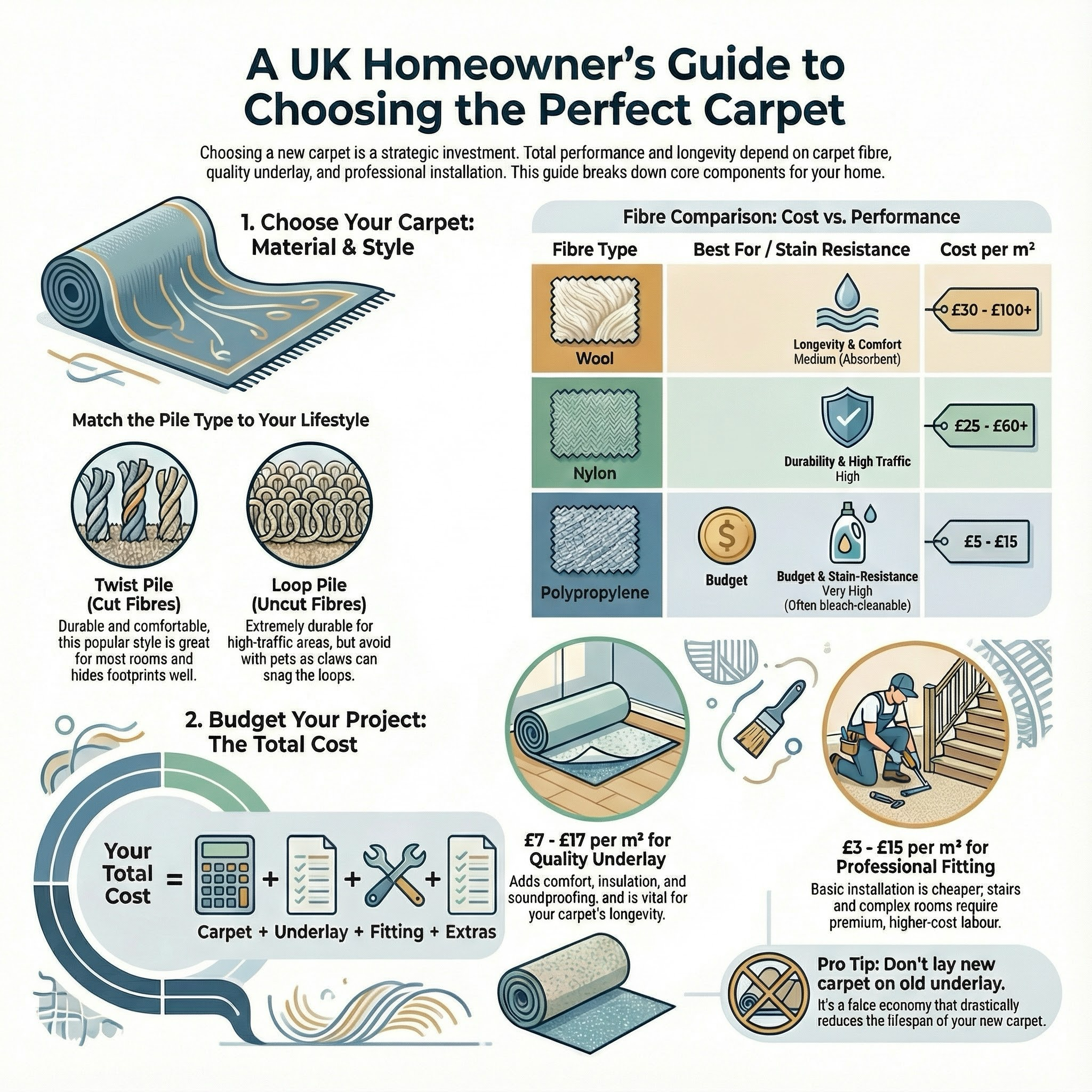
Carpets explained
The primary appeal lies in their modular nature. If a spill occurs or a tile is damaged, you can simply swap out a single square rather than replacing the entire room's flooring, making them a cost-effective long-term investment for busy households.
Expect to pay between £25 and £65 per square metre for a professional installation, including mid-range tiles and labour. Prices vary based on the quality of the tile and the amount of subfloor preparation required.
| Item | Low £ | High £ | Notes |
|---|---|---|---|
| Standard Carpet Tiles (per m²) | £15 | £30 | Basic nylon or polypropylene tiles. |
| Premium/Designer Tiles (per m²) | £35 | £70 | Heavy contract rated or luxury textures. |
| Labour Rate (per m²) | £12 | £20 | Minimum call-out fees often apply for small rooms. |
| Subfloor Prep (Screed/Ply) | £10 | £20 | Per m² including materials and labour. |
| Tackifier/Adhesive | £2 | £5 | Per m² for professional-grade pressure sensitive glue. |
Pro Tip: Always order 10% more tiles than your room's square footage to account for cutting waste and to keep as spares for future repairs.
While carpet tiles are significantly easier to install than traditional broadloom carpet, the finish is only as good as the subfloor beneath it. A professional installer has the tools to ensure perfectly straight lines and seamless perimeter cuts that won't fray or lift.
If you are laying tiles over a perfectly flat, modern floor, DIY is achievable. However, if your floorboards are uneven or your concrete is damp, a professional is essential to prevent the tiles from "telegraphing" (showing lumps) or failing to stick.
No, carpet tiles are designed with an integrated bitumen or felt backing that acts as its own underlay. Adding a separate underlay would make the floor too soft, causing the tiles to move and the joints to open up.
No. Carpet tiles must be laid on a hard, flat surface. Laying them over existing carpet will cause them to flex, shift, and eventually unstick, creating an unstable and dangerous surface.
Generally, no. While they are durable, most carpet tiles are not waterproof. In bathrooms, moisture can seep between the seams and sit on the subfloor, leading to mould and odours.
You can often lift the specific tile and rinse it under a tap with mild detergent. Ensure it is completely dry before popping it back into place to prevent moisture from being trapped underneath.
Yes, but you must check the manufacturer's "thermal resistance" (tog rating). Most carpet tiles are compatible with UFH, provided the floor temperature does not exceed 27°C.
This guide was written with AI assistance and is intended for general information only. Prices are estimates based on UK averages and may vary by region. Always get at least three quotes and consult a qualified professional before starting any work.
Ask follow-ups in plain English. The AI explains options, sequencing and what to ask the carpets — so you walk in informed.
New flooring is one of the most impactful upgrades you can make to a UK home. Beyond the immediate aesthetic boost, high-quality flooring improves insulation, r...
READ GUIDE →GuideLaminate flooring remains one of the most popular choices for UK homeowners, offering the aesthetic of real hardwood with significantly higher durability and ea...
READ GUIDE →GuideInstalling new carpet is one of the most effective ways to instantly improve the comfort and insulation of your home. Whether you are opting for a durable wool-...
READ GUIDE →GuideFloor screeding is the process of applying a blended mixture of cement and graded sand (or a specialized liquid compound) to a structural concrete subfloor. For...
READ GUIDE →GuideModern vinyl flooring has evolved far beyond the basic "lino" of the past. Today, UK homeowners can choose from high-end sheet vinyl, Luxury Vinyl Tiles (LVT), ...
READ GUIDE →GuideRefinishing a wooden floor is one of the most effective ways to restore character and add significant value to a UK home. Whether you have discovered original V...
READ GUIDE →