Instant
01 · Ask
Ask the AI a follow-up
Got more questions about flooring Installation? Describe the bit you're unsure about — the AI explains options, sequencing and what to ask the carpets.

Floor stripped, sub-floor prepped, new flooring laid and trimmed to a clean line.
You've read the brief on flooring Installation. Now lean on us to find the right carpets — and stay in control of the job.
Got more questions about flooring Installation? Describe the bit you're unsure about — the AI explains options, sequencing and what to ask the carpets.
Costs, timelines, pitfalls and the right questions to ask before any carpets starts on flooring Installation.
Itemised quotes from up to 3 local carpetss on flooring Installation — so you can compare like-for-like, not lump sums.
Ready when you are
Enter your postcode and get free quotes from local pros.
Four moves that separate a smooth job from a nightmare.
Usually caused by insufficient stretching or using an old underlay that has collapsed.
Poorly executed joins in the middle of a room can be a trip hazard and look unsightly.
If the carpet is trimmed too short, it will pull away from the skirting boards.
Using a "cheap" underlay with a premium carpet will make the floor feel hard and reduce the carpet's lifespan.
Indicative UK ranges and what affects price.
By job type
Quote spread is typically ± 18% — always get 3 quotes.
Carpets quick-view
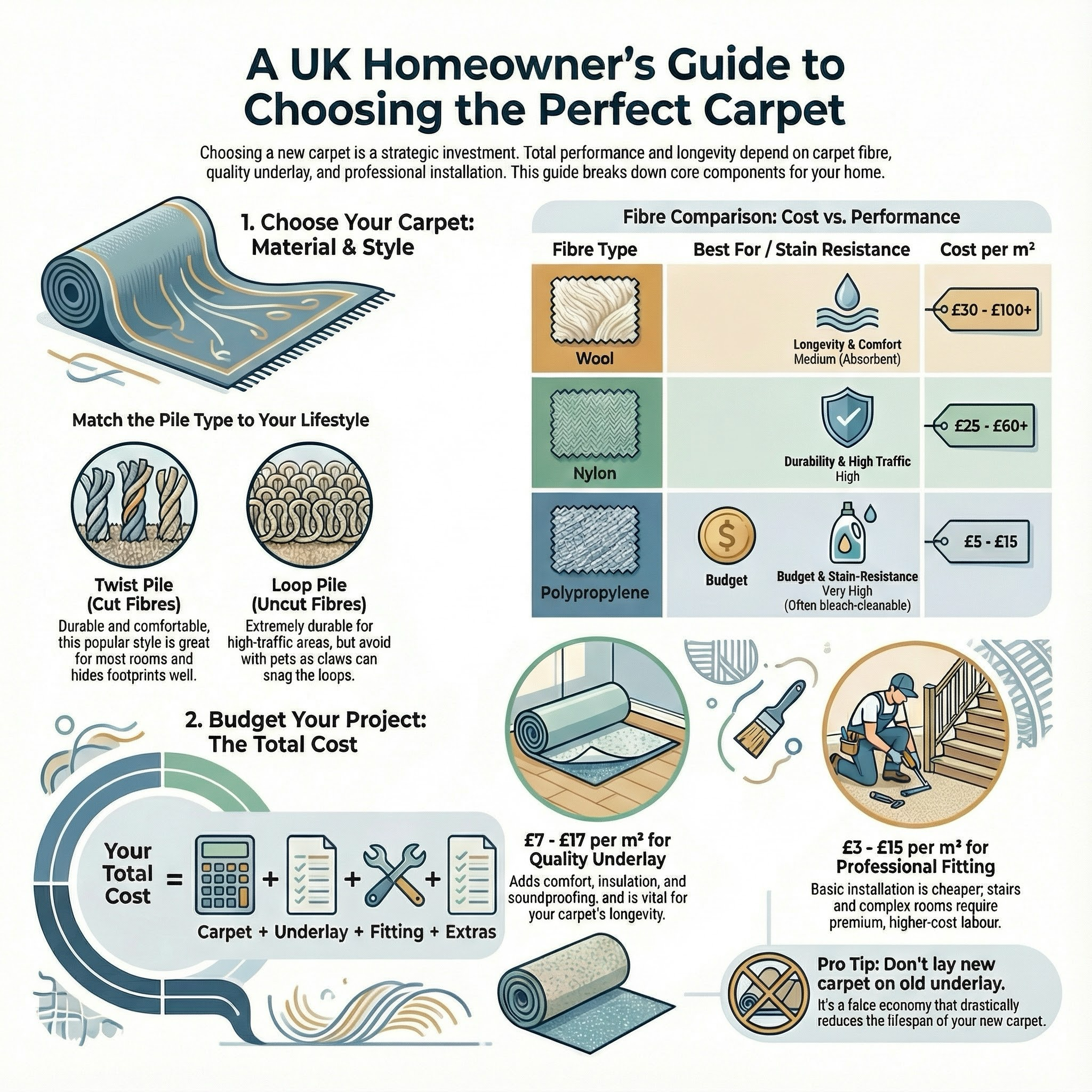
Carpets explained
While choosing the right pile and colour is essential, the secret to a perfect finish lies in the preparation and the quality of the underlay. This guide covers everything from current UK market rates to the technical steps required for a flawless fit.
| Item / Service | Low £ | High £ | Notes |
|---|---|---|---|
| Labour (per m²) | £4.50 | £8.50 | Higher rates for stairs or complex patterns. |
| Basic Polypropylene Carpet (per m²) | £12 | £25 | Stain-resistant, ideal for rentals or playrooms. |
| Mid-Range Wool Blend (per m²) | £30 | £55 | Durable and naturally flame-retardant. |
| Premium Wool/Axminster (per m²) | £60 | £120+ | Luxury finishes and intricate designs. |
| Quality Underlay (per m²) | £6 | £12 | Based on 10mm-12mm thickness. |
| Uplift & Disposal (per room) | £40 | £80 | Includes waste transfer notes/recycling fees. |
Prices vary significantly based on your location in the UK, with London and the South East typically seeing a 15-20% premium. The complexity of the job, such as winding staircases or the need to trim doors, will also add to the final invoice.
While you can buy carpet online, fitting it is a specialist skill that requires expensive tools like power stretchers and carpet shears. A poorly fitted carpet will shift, ripple, and wear out twice as fast as a professional installation.
Professional fitting is highly recommended for stairs and large rooms where seams (joins) are necessary, as these are difficult to hide without experience.
In the UK, there are no mandatory "licences" like Gas Safe for carpet fitters, but look for those following BS 5325 (the code of practice for installation of textile floor coverings).
Almost always, yes. Underlay wears out at the same rate as the carpet; reusing old underlay will make your new carpet feel flat and may void its warranty.
Yes, but you must ensure the combined "Tog" rating of the carpet and underlay does not exceed 2.5 to allow heat to pass through efficiently.
Some fitters include this in their price, while others charge a "per item" fee. It is always cheaper and safer to clear the room yourself before they arrive.
This is known as "off-gassing" from the latex backing and new fibres. It is perfectly normal and usually disappears within 48-72 hours with good ventilation.
Door bars (or thresholds) secure the carpet at the entrance of a room and transition it to the next floor type. You should replace them when getting a new carpet for a clean finish.
This guide was written with AI assistance and is intended for general information only. Prices are estimates based on UK averages and may vary by region. Always get at least three quotes and consult a qualified professional before starting any work.
Ask follow-ups in plain English. The AI explains options, sequencing and what to ask the carpets — so you walk in informed.
New flooring is one of the most impactful upgrades you can make to a UK home. Beyond the immediate aesthetic boost, high-quality flooring improves insulation, r...
READ GUIDE →GuideLaminate flooring remains one of the most popular choices for UK homeowners, offering the aesthetic of real hardwood with significantly higher durability and ea...
READ GUIDE →GuideInstalling new carpet is one of the most effective ways to instantly improve the comfort and insulation of your home. Whether you are opting for a durable wool-...
READ GUIDE →GuideFloor screeding is the process of applying a blended mixture of cement and graded sand (or a specialized liquid compound) to a structural concrete subfloor. For...
READ GUIDE →GuideModern vinyl flooring has evolved far beyond the basic "lino" of the past. Today, UK homeowners can choose from high-end sheet vinyl, Luxury Vinyl Tiles (LVT), ...
READ GUIDE →GuideRefinishing a wooden floor is one of the most effective ways to restore character and add significant value to a UK home. Whether you have discovered original V...
READ GUIDE →