Instant
01 · Ask
Ask the AI a follow-up
Got more questions about conservatory Building Regs & Planning? Describe the bit you're unsure about — the AI explains options, sequencing and what to ask the conservatories.

What's 'exempt' (most), what needs Building Regs (some) and what triggers planning.
You've read the brief on conservatory Building Regs & Planning. Now lean on us to find the right conservatories — and stay in control of the job.
Got more questions about conservatory Building Regs & Planning? Describe the bit you're unsure about — the AI explains options, sequencing and what to ask the conservatories.
Costs, timelines, pitfalls and the right questions to ask before any conservatories starts on conservatory Building Regs & Planning.
Itemised quotes from up to 3 local conservatoriess on conservatory Building Regs & Planning — so you can compare like-for-like, not lump sums.
Ready when you are
Enter your postcode and get free quotes from local pros.
Four moves that separate a smooth job from a nightmare.
Some conservation areas have their permitted development rights removed by Article 4. Always check with the local planning office.
National Parks, AONBs and World Heritage Sites have tighter limits than general permitted development.
Removing the external door between house and conservatory loses the exemption — many homeowners do this for open-plan flow without realising.
Without a Lawful Development Certificate, a future buyer's solicitor may raise concerns. Get one issued at install time.
Indicative UK ranges and a typical week-by-week schedule.
By job type
Quote spread is typically ± 18% — always get 3 quotes.
Mid-size conservatory · week by week
Schedule slips on dependencies — pad each phase by 10–20% for real-world delays.
Conservatories quick-view
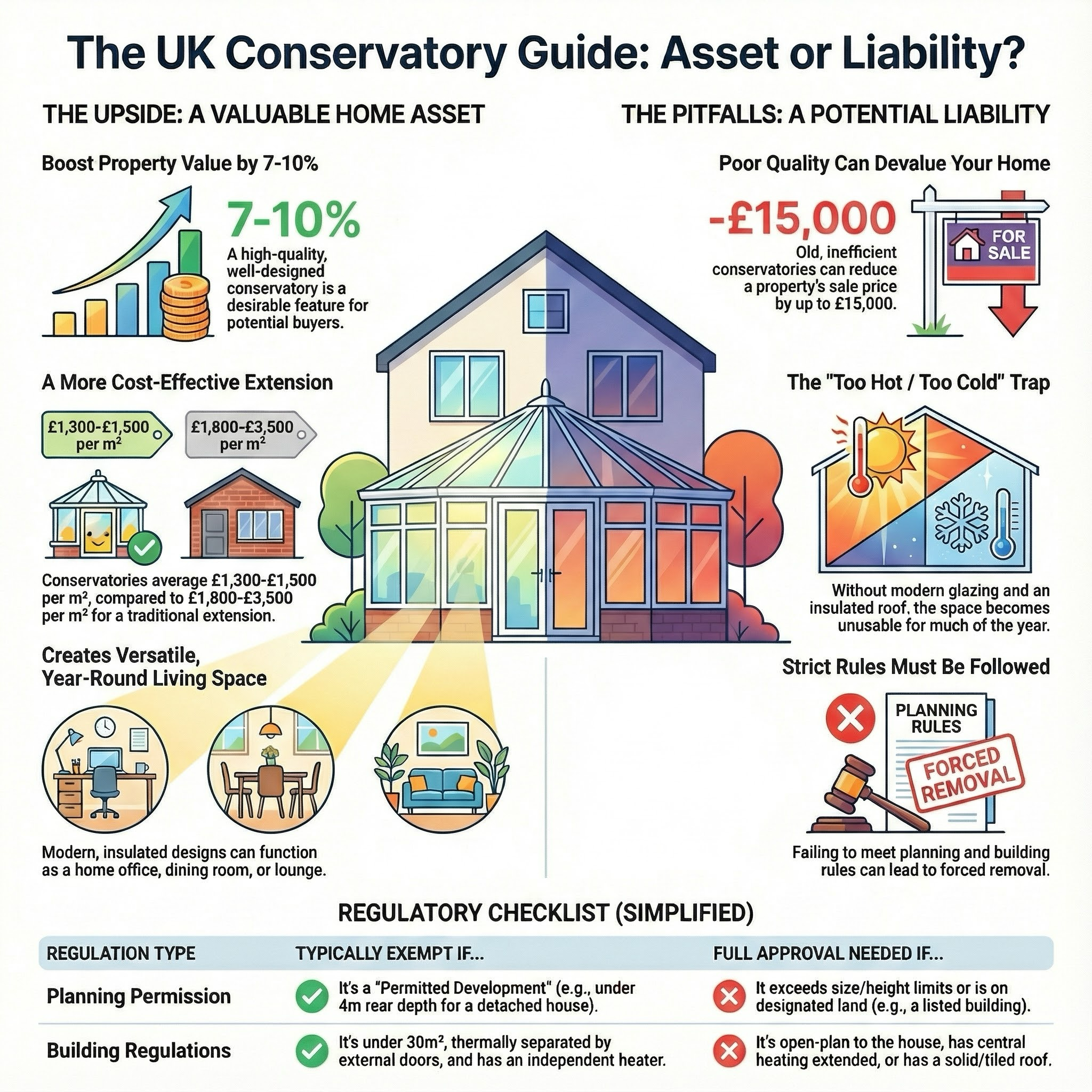
Conservatories explained
Conservatories sit in a regulatory grey area — most are exempt from Building Regs and permitted under planning, but the exceptions catch out many homeowners. This guide breaks down the UK compliance landscape so you know what's notifiable, what isn't, and what triggers an enforcement notice.
The conservatory installer normally handles compliance — confirming the build is exempt or notifying building control. The homeowner should still understand the rules to avoid surprise enforcement notices. The two parallel regulatory regimes are planning permission (about appearance and impact on neighbours) and Building Regulations (about structural and thermal performance).
| Item | Low (£) | High (£) | Notes |
|---|---|---|---|
| Planning application (householder) | 206 | 206 | Fixed national fee 2026 |
| Pre-application advice (recommended) | 50 | 250 | Council planning officer |
| Lawful Development Certificate | 103 | 103 | Confirms permitted development |
| Building Regs full plans application | 200 | 600 | If notifiable |
| Building Regs building notice | 200 | 500 | Alternative to full plans |
| Listed building consent | 0 | 0 | Free but compulsory |
| Conservation area consent | 206 | 206 | If demolition involved |
Lawful Development Certificate: 8 weeks. Planning permission: 8 weeks (extended for major). Building Notice: starts within 48 hours. Full Plans: 5 weeks. Listed building consent: 8 weeks.
The installer normally handles compliance. For complex cases (listed buildings, conservation areas, larger orangeries), use a planning consultant — typically £400–£1,200 for guidance and submission.
Insist that the installer confirms in writing which compliance route applies. Get the Lawful Development Certificate if uncertain — protects the property at resale.
Permitted Development Order 2015 (England) / equivalent in devolved nations: rear extensions up to 3m depth (terraced/semi) or 4m (detached), 4m height maximum. Building Regulations: conservatories under 30 m² + separated by external doors = exempt. Listed buildings: always need consent. Conservation areas: stricter limits.
Usually no — most domestic conservatories are permitted development. Listed buildings, conservation areas, Article 4 directions and oversized builds need planning permission.
Exempt if under 30 m² and separated from house by external-grade doors. Notifiable otherwise.
A council-issued document confirming your build is permitted development. Costs £103, takes 8 weeks. Highly recommended even when you're confident — it protects the property at resale.
3m rear depth (terraced/semi), 4m (detached) under permitted development. 30 m² for Building Regs exemption. Larger builds need permission and full compliance.
Yes — the previous build counts toward your permitted development allowance only if extant. Demolish and rebuild differently can sometimes be cleaner than extending.
Council enforcement can require demolition. After 4 years (in most cases) the build becomes "lawful by inaction" but this isn't reliable — always get permission up front.
This guide was written with AI assistance and is intended for general information only. Prices are estimates based on UK averages and may vary by region. Always get at least three quotes and consult a qualified professional before starting any work.
Ask follow-ups in plain English. The AI explains options, sequencing and what to ask the conservatories — so you walk in informed.
Victorian conservatories are the multi-faceted bay-fronted classic. UK costs, planning, glazing and how the style suits period homes.
READ GUIDE →GuideEdwardian conservatories are the rectangular box-shape classic. UK costs, comparison vs Victorian and where the style suits best.
READ GUIDE →GuideLean-to conservatories are the simplest and cheapest. UK costs, when they suit, and how they look on bungalows and small homes.
READ GUIDE →GuideGable conservatories have a tall feature front. UK costs, the dramatic apex aesthetic and where they suit best.
READ GUIDE →GuideP-shape and L-shape conservatories combine styles for maximum space. UK costs, layouts and which suits semi-detached homes.
READ GUIDE →GuideOrangeries are the brick-pillared upgrade from a conservatory. UK costs, lantern roofs and how they bridge garden room and extension.
READ GUIDE →