Instant
01 · Ask
Ask the AI a follow-up
Got more questions about conservatory Removal & Replacement? Describe the bit you're unsure about — the AI explains options, sequencing and what to ask the conservatories.

Strip out the old, base-check, rebuild with modern glazing and a warm or solid roof.
You've read the brief on conservatory Removal & Replacement. Now lean on us to find the right conservatories — and stay in control of the job.
Got more questions about conservatory Removal & Replacement? Describe the bit you're unsure about — the AI explains options, sequencing and what to ask the conservatories.
Costs, timelines, pitfalls and the right questions to ask before any conservatories starts on conservatory Removal & Replacement.
Itemised quotes from up to 3 local conservatoriess on conservatory Removal & Replacement — so you can compare like-for-like, not lump sums.
Ready when you are
Enter your postcode and get free quotes from local pros.
Four moves that separate a smooth job from a nightmare.
Old conservatory flashing has often left water damage on the house wall. Allow budget for repointing or rendering repair.
Old foundations may not be reusable. Cheap quotes assume they are; inspect carefully.
Pre-1990 conservatories occasionally have asbestos cement panels — get a survey if uncertain.
Many tip operators won't accept polycarbonate — specialist disposal needed.
Indicative UK ranges and a typical week-by-week schedule.
By job type
Quote spread is typically ± 18% — always get 3 quotes.
Mid-size conservatory · week by week
Schedule slips on dependencies — pad each phase by 10–20% for real-world delays.
Conservatories quick-view
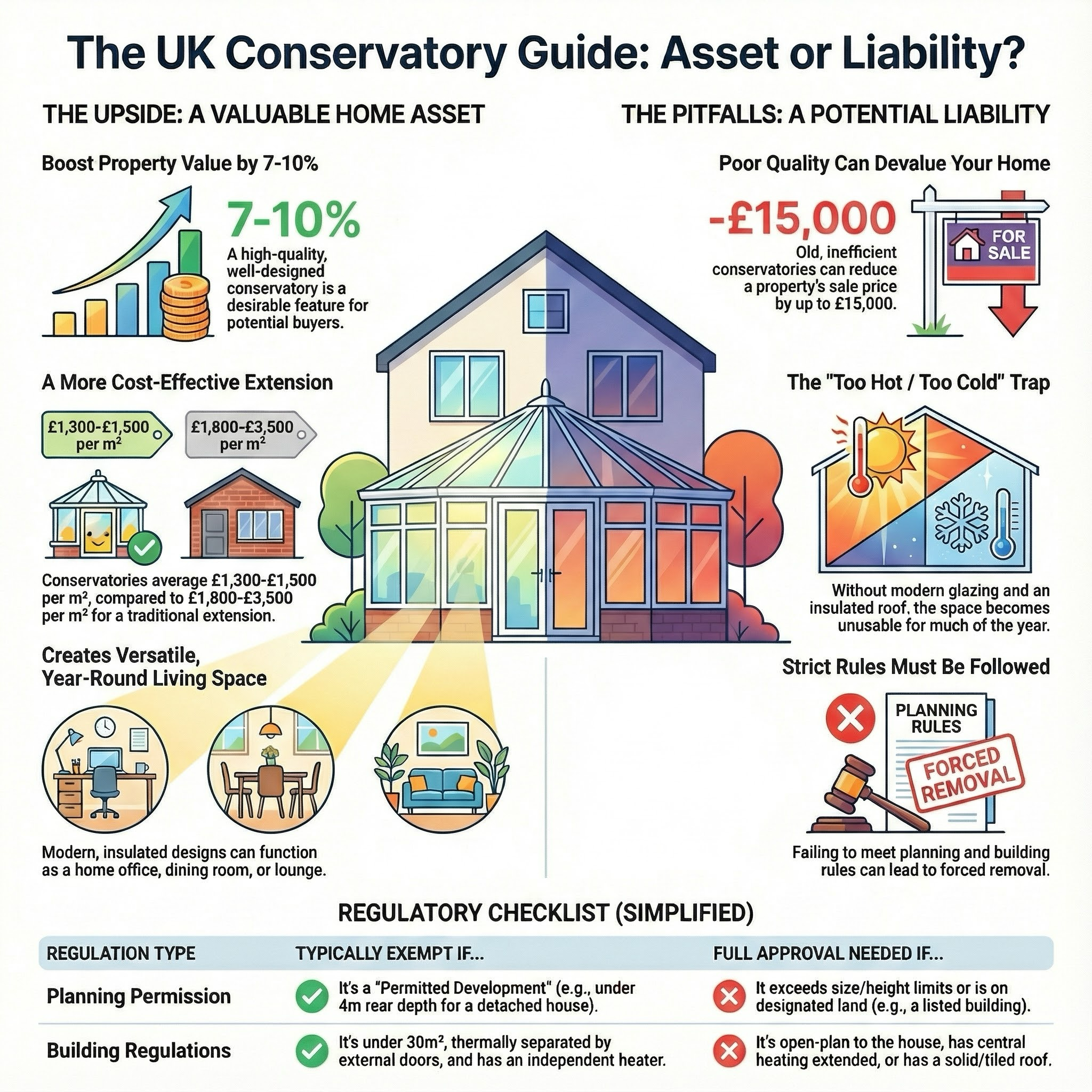
Conservatories explained
Old conservatories — typically 25–30 years old, with polycarbonate roofs, single-glazed walls, and yellowing uPVC frames — reach end of life. Removal, disposal and replacement is a common UK project. Expect to pay £800–£3,500 for removal alone, plus the cost of any replacement.
The contractor strips the old conservatory in reverse-order: roof glass or polycarbonate first, then frames, then dwarf wall. Concrete slab and foundations are usually retained if they're in good condition (saves £2,500+ on rebuild). DPC and DPM are inspected and replaced if damaged. uPVC frames are recycled; polycarbonate is recycled where facilities exist; concrete and brick rubble are crushed and reused as hardcore.
| Item | Low (£) | High (£) | Notes |
|---|---|---|---|
| Small lean-to removal | 800 | 1,500 | 1–2 day project |
| Medium conservatory removal | 1,200 | 2,500 | 3–4 days |
| Large P-shape removal | 2,000 | 3,500 | 4–6 days |
| Skip hire (8-yard) | 250 | 450 | For brick/concrete waste |
| uPVC recycling | Free | 50 | Most recycling centres take |
| Polycarbonate disposal | 50 | 250 | Specialist recycling needed |
| Make-good of house wall | 200 | 800 | If flashing/seal needs work |
Small lean-to: 1–2 days. Medium conservatory: 3–4 days. Large or P-shape: 4–6 days. Foundations and slab inspection: half a day extra.
Professional. The roof needs to come down safely (large glass panels are heavy and fragile). Working at height and disposal regulations apply.
A demolition contractor or conservatory specialist. The conservatory installer doing the replacement often handles removal too as a package. Ask for itemised quote for removal and replacement separately.
Waste regulations apply — registered waste carrier needed. Listed buildings need consent before any demolition. Removal of a structurally-integral element (e.g. a conservatory used as a kitchen-extension) needs Building Regs notification for the make-good.
Often yes — if they were properly built (600mm minimum depth, sound concrete). Inspect for cracking or settlement before committing. Reuse saves £2,500–£5,000 on rebuild.
Yes if the brickwork is in good condition and the new frame is the same height. Saves £1,500–£3,000 on rebuild.
Recycled — uPVC has a well-established recycling industry. Most installers handle this in the disposal fee.
Often — water tracking behind old flashing damages the brick and plaster. Allow £200–£800 for make-good.
Yes if you're confident with safe demolition. Roof glass and large panels are heavy and fragile — not a one-person job.
Listed buildings — yes. Conservation areas — yes if total demolition. Standard properties — no permission needed for like-for-like rebuild.
This guide was written with AI assistance and is intended for general information only. Prices are estimates based on UK averages and may vary by region. Always get at least three quotes and consult a qualified professional before starting any work.
Ask follow-ups in plain English. The AI explains options, sequencing and what to ask the conservatories — so you walk in informed.
Victorian conservatories are the multi-faceted bay-fronted classic. UK costs, planning, glazing and how the style suits period homes.
READ GUIDE →GuideEdwardian conservatories are the rectangular box-shape classic. UK costs, comparison vs Victorian and where the style suits best.
READ GUIDE →GuideLean-to conservatories are the simplest and cheapest. UK costs, when they suit, and how they look on bungalows and small homes.
READ GUIDE →GuideGable conservatories have a tall feature front. UK costs, the dramatic apex aesthetic and where they suit best.
READ GUIDE →GuideP-shape and L-shape conservatories combine styles for maximum space. UK costs, layouts and which suits semi-detached homes.
READ GUIDE →GuideOrangeries are the brick-pillared upgrade from a conservatory. UK costs, lantern roofs and how they bridge garden room and extension.
READ GUIDE →