Instant
01 · Ask
Ask the AI a follow-up
Got more questions about conservatory Underfloor Heating? Describe the bit you're unsure about — the AI explains options, sequencing and what to ask the conservatories.

Wet UFH under tile or warm-roof conservatory — usable in winter without heating the rest of the house.
You've read the brief on conservatory Underfloor Heating. Now lean on us to find the right conservatories — and stay in control of the job.
Got more questions about conservatory Underfloor Heating? Describe the bit you're unsure about — the AI explains options, sequencing and what to ask the conservatories.
Costs, timelines, pitfalls and the right questions to ask before any conservatories starts on conservatory Underfloor Heating.
Itemised quotes from up to 3 local conservatoriess on conservatory Underfloor Heating — so you can compare like-for-like, not lump sums.
Ready when you are
Enter your postcode and get free quotes from local pros.
Four moves that separate a smooth job from a nightmare.
Adding a conservatory load to a marginal existing boiler can cause heating problems elsewhere. Boiler upsizing may be needed.
UFH doesn't work well under thick carpet. Tile, LVT or engineered wood ≤20mm thick are ideal.
UFH heats the floor downward and outward as well as upward. 100mm PIR under the slab is essential.
Large conservatories need 2–3 thermostat zones for comfort. Cheap installs use one.
Indicative UK ranges and a typical week-by-week schedule.
By job type
Quote spread is typically ± 18% — always get 3 quotes.
Mid-size conservatory · week by week
Schedule slips on dependencies — pad each phase by 10–20% for real-world delays.
Conservatories quick-view
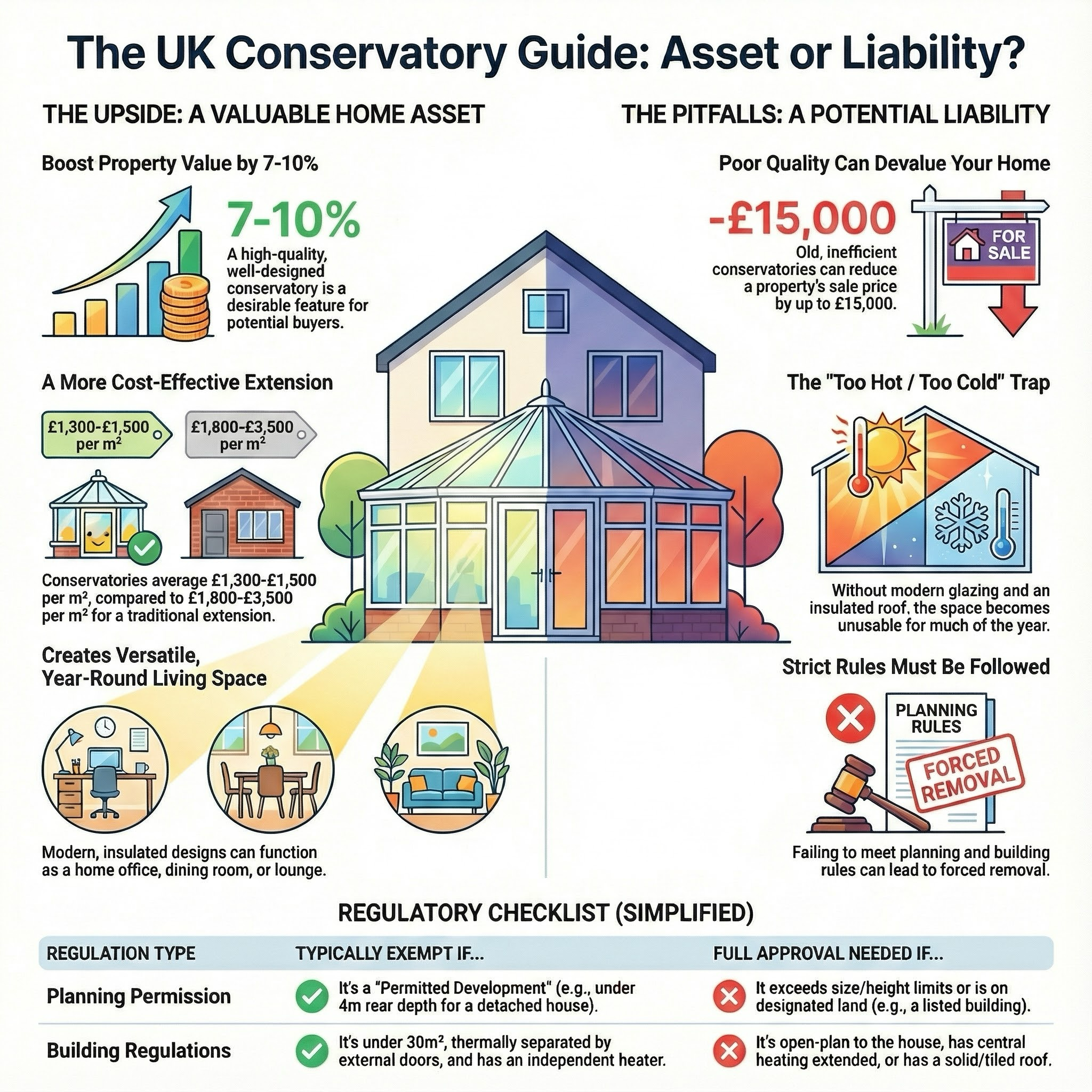
Conservatories explained
Underfloor heating (UFH) is the most efficient way to heat a conservatory — large surface, even warmth, no radiators eating wall space. Expect to pay £1,200–£3,500 for a UK conservatory UFH installation depending on system type, size and existing boiler integration.
Wet UFH (most common): PEX pipes are laid in the screed of the conservatory floor — at slab pour time for new builds, or in a 50mm screed overlay for retrofits. Manifold connects pipes to the boiler via a flow-and-return circuit, with a thermostat-controlled mixing valve. Electric UFH: thin heating mat laid under the floor tiles or LVT. Both need a thermostat and time controller.
| Item | Low (£) | High (£) | Notes |
|---|---|---|---|
| Wet UFH small conservatory (10–15 m²) | 800 | 1,800 | Pipes + manifold |
| Wet UFH medium (15–25 m²) | 1,200 | 2,500 | More pipe runs |
| Wet UFH large (25 m²+) | 1,800 | 4,000 | Multi-loop manifold |
| Electric UFH per m² (cheaper supply) | 40 | 80 | Mat + thermostat |
| Boiler tie-in | 200 | 800 | If existing boiler suitable |
| New boiler if upsize needed | 1,800 | 4,500 | If existing boiler undersized |
| Smart controls (Nest, Hive) | 180 | 500 | Per zone |
Wet UFH at slab pour time: 1 day to install pipes, included in slab pour. Retrofit wet UFH: 2–3 days. Electric UFH: half a day for a small conservatory.
Wet UFH must be installed by a plumber/heating engineer — boiler integration is gas-safe regulated. Electric UFH mat install is DIY-able but the thermostat wiring needs an electrician for Part P certification.
Wet UFH: plumber or heating engineer (Gas Safe registered). Electric UFH: electrician (Part P registered). Combined: a heating specialist often does both. Brands: Polypipe, JG Speedfit, Robbens for wet; Warmup, ProWarm for electric.
Wet UFH falls under Part L (thermal efficiency) and Gas Safe (boiler work). Electric UFH falls under Part P (electrical). New conservatory installations integrate with the wider Part L compliance for the whole conservatory.
Wet for new builds and floor-up retrofits — cheaper to run long-term, integrates with existing boiler. Electric for retrofit-only installs where digging up the slab isn't practical.
Wet UFH: 1–3 hours to warm a cold conservatory. Electric: faster (30–60 minutes). Both work better with smart timer than on-demand.
Yes — most conservatories with UFH have no radiators. Saves wall space and gives even warmth.
Usually yes — modern combi boilers (24kW+) can take the additional load. Older or smaller boilers may need upsizing. A heating engineer will calculate.
Porcelain tile, LVT, or engineered wood. Avoid thick carpet (insulates the heat down). Avoid solid timber over 20mm (slows response time).
Comparable to radiators per m² heated. Saving comes from even comfort meaning the thermostat can be set 1–2°C lower than with radiators.
This guide was written with AI assistance and is intended for general information only. Prices are estimates based on UK averages and may vary by region. Always get at least three quotes and consult a qualified professional before starting any work.
Ask follow-ups in plain English. The AI explains options, sequencing and what to ask the conservatories — so you walk in informed.
Victorian conservatories are the multi-faceted bay-fronted classic. UK costs, planning, glazing and how the style suits period homes.
READ GUIDE →GuideEdwardian conservatories are the rectangular box-shape classic. UK costs, comparison vs Victorian and where the style suits best.
READ GUIDE →GuideLean-to conservatories are the simplest and cheapest. UK costs, when they suit, and how they look on bungalows and small homes.
READ GUIDE →GuideGable conservatories have a tall feature front. UK costs, the dramatic apex aesthetic and where they suit best.
READ GUIDE →GuideP-shape and L-shape conservatories combine styles for maximum space. UK costs, layouts and which suits semi-detached homes.
READ GUIDE →GuideOrangeries are the brick-pillared upgrade from a conservatory. UK costs, lantern roofs and how they bridge garden room and extension.
READ GUIDE →