Instant
01 · Ask
Ask the AI a follow-up
Got more questions about solar Glass & Glazing Options? Describe the bit you're unsure about — the AI explains options, sequencing and what to ask the conservatories.

Self-cleaning, solar-reflective and A++ glazing — cuts heat gain without losing the daylight.
You've read the brief on solar Glass & Glazing Options. Now lean on us to find the right conservatories — and stay in control of the job.
Got more questions about solar Glass & Glazing Options? Describe the bit you're unsure about — the AI explains options, sequencing and what to ask the conservatories.
Costs, timelines, pitfalls and the right questions to ask before any conservatories starts on solar Glass & Glazing Options.
Itemised quotes from up to 3 local conservatoriess on solar Glass & Glazing Options — so you can compare like-for-like, not lump sums.
Ready when you are
Enter your postcode and get free quotes from local pros.
Four moves that separate a smooth job from a nightmare.
Original 1990s-2000s conservatories often have these — U-value 2.0+ W/m²K, unusable in summer or winter. Replace with modern glass or tiled roof.
Low-E coating must be on the inner face of the outer pane. Reversed coatings reduce performance 30%+.
Argon-filled units lose gas over 10–15 years if not properly sealed. U-value degrades.
Solar-control glass on a north elevation reduces winter sun unnecessarily. Specify per elevation.
Indicative UK ranges and a typical week-by-week schedule.
By job type
Quote spread is typically ± 18% — always get 3 quotes.
Mid-size conservatory · week by week
Schedule slips on dependencies — pad each phase by 10–20% for real-world delays.
Conservatories quick-view
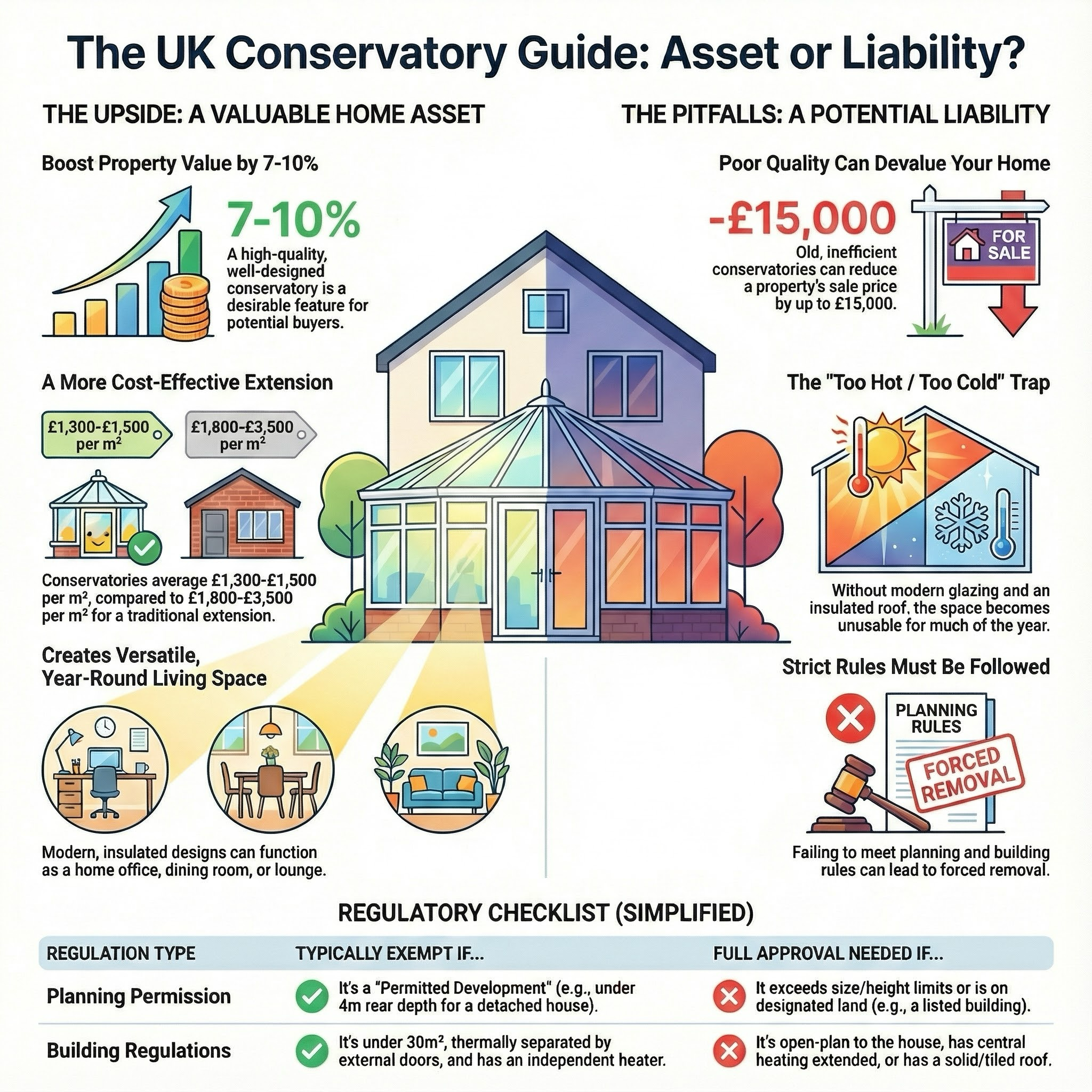
Conservatories explained
The glass spec is the single biggest factor in whether a UK conservatory is usable year-round or a greenhouse 4 months a year. Expect to pay £80–£350 per m² for upgraded conservatory glazing, depending on coating and pane count.
Glazing units are factory-made sealed double or triple-glazed panels with specific coatings on the inner faces. The installer measures, orders to size, fits the panels into the existing or new frame profile, beads in the glazing strip, and silicones the gasket. Roof glass is usually larger (1m × 2m) and needs two fitters. Solar-control coatings reflect infrared heat in summer; low-E coatings reflect interior heat back in winter.
| Item | Low (£) | High (£) | Notes |
|---|---|---|---|
| Standard double-glazed per m² | 80 | 160 | Argon-filled, low-E |
| Self-cleaning glass per m² | 120 | 220 | Pilkington Activ, SGG Bioclean |
| Solar-control glass per m² | 140 | 260 | Reflects summer heat |
| Self-cleaning + solar-control per m² | 180 | 350 | Premium roof spec |
| Triple-glazed per m² | 250 | 500 | Highest insulation, heavy |
| Heat-reflective film retrofit per m² | 30 | 80 | Aftermarket adhesive film |
| Full conservatory roof reglaze | 3,500 | 10,000 | 15–25 m² typical roof |
Full conservatory roof reglaze: 2–3 days. Single pane replacement: 2–4 hours. Glazing units are delivered 2–4 weeks after measurement, depending on spec.
Professional. Glazing units are heavy, fragile, and require manufacturer's specific bead/sealant systems. DIY install voids the manufacturer's warranty.
A conservatory specialist or window fitter familiar with the brand of conservatory you have. Insist on Pilkington, SGG (Saint-Gobain) or Guardian brand glass — these are the proper UK self-cleaning and solar-control brands. Cheap "self-cleaning" generic glass is often a marketing claim with no real coating.
Part L requires conservatory glazing to achieve specific U-values for thermal compliance — 1.4 W/m²K for replacement windows. Part N (or Part K in newer editions) requires safety glass within 800mm of finished floor level — P1A laminated to BS 6206.
Glass with a titanium oxide outer coating that reacts with UV light to break down organic dirt, then sheets off in rain. Pilkington Activ is the original; SGG Bioclean is the other UK leader.
Yes — south or west elevations especially. Cuts solar gain 60–70% vs standard glass, transforming summer comfort.
Usually not worth the weight and cost. Standard solar-control + low-E + argon-filled double glazing is the sweet spot for cost-performance.
Yes — heat-reflective film (3M, Solar Gard) adheres to the inner surface and reduces heat gain. £30–£80 per m². Cheaper than re-glazing but less effective than proper solar-control glass.
1.4 W/m²K is the Part L minimum. Premium spec achieves 1.0 W/m²K (double-glazed) or 0.7 W/m²K (triple-glazed). Roof glass should match.
It significantly reduces cleaning frequency — but bird droppings, pollen and high-pressure rain are not 100% self-cleaning. Annual hand-clean still recommended.
This guide was written with AI assistance and is intended for general information only. Prices are estimates based on UK averages and may vary by region. Always get at least three quotes and consult a qualified professional before starting any work.
Ask follow-ups in plain English. The AI explains options, sequencing and what to ask the conservatories — so you walk in informed.
Victorian conservatories are the multi-faceted bay-fronted classic. UK costs, planning, glazing and how the style suits period homes.
READ GUIDE →GuideEdwardian conservatories are the rectangular box-shape classic. UK costs, comparison vs Victorian and where the style suits best.
READ GUIDE →GuideLean-to conservatories are the simplest and cheapest. UK costs, when they suit, and how they look on bungalows and small homes.
READ GUIDE →GuideGable conservatories have a tall feature front. UK costs, the dramatic apex aesthetic and where they suit best.
READ GUIDE →GuideP-shape and L-shape conservatories combine styles for maximum space. UK costs, layouts and which suits semi-detached homes.
READ GUIDE →GuideOrangeries are the brick-pillared upgrade from a conservatory. UK costs, lantern roofs and how they bridge garden room and extension.
READ GUIDE →